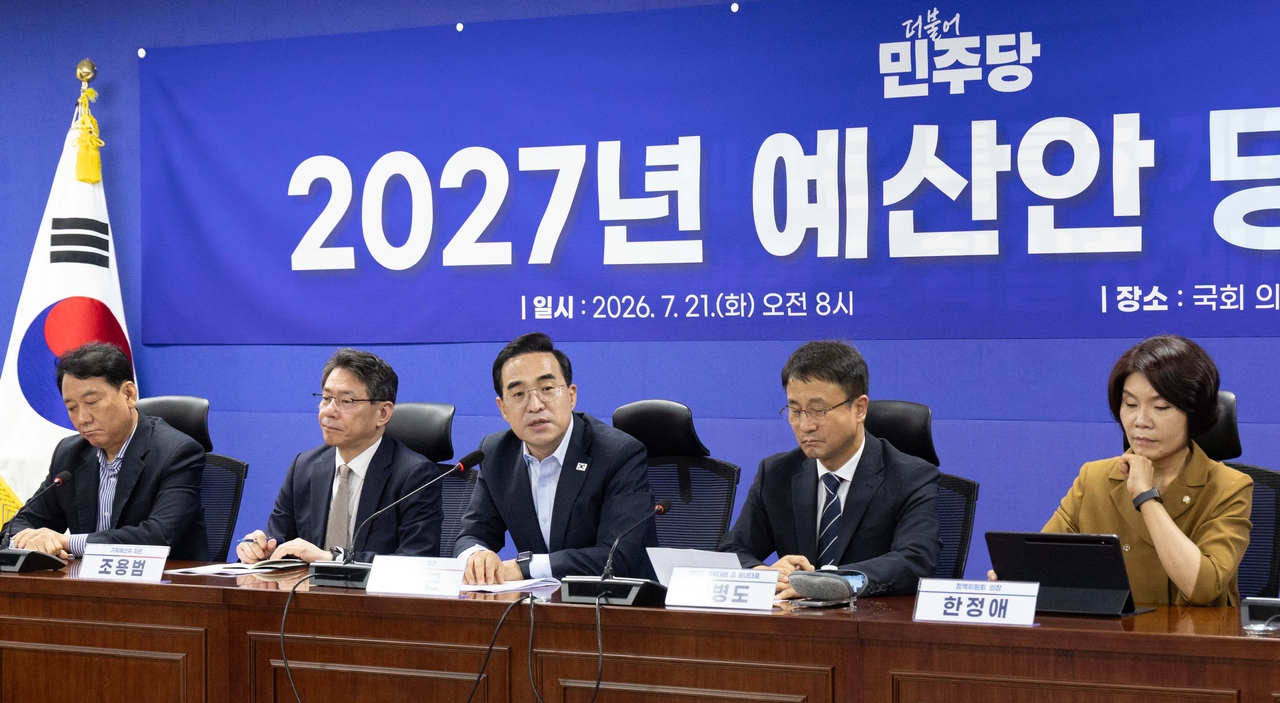
The ruling party and government said Tuesday they expect the 2027 budget to exceed 800 trillion won ($540 billion), which would make it the largest in history, and outlined plans for strategic investment and sweeping spending restructuring.
Han Byung-do, acting leader and floor leader of the Democratic Party of Korea, made the announcement at a party-government budget consultation at the National Assembly. "Next year's budget is set to be drafted at 800 trillion won plus alpha — the largest ever — and national tax revenue is projected to surpass 500 trillion won, also a record," Han said.
Han said the direction for next year's national finances was clear. "It must be used as a source of strategic investment funding to prepare for the future," he said, outlining budget priorities including strategic investment in three major mega-projects, region-led growth, livelihood recovery and inequality reduction, and disaster safety.
Han Jeong-ae, the Democratic Party's policy committee chairwoman, said the party had unveiled key campaign pledges during the recent local elections, including mega special zones, a climate insurance scheme and a solar income village program. "We will work closely with the government to ensure the budget reflects active responses to people's livelihoods and everyday concerns — including region-led growth, housing supply, infrastructure expansion and youth employment — as well as the K-shaped polarization we face and the climate crisis," she said.
Park Hong-keun, minister of the Ministry of Planning and Budget, said the budget would be accompanied by the most aggressive spending restructuring in history. "At the end of March, we issued budget guidelines calling for 15 percent cuts to discretionary spending, 10 percent to mandatory spending and 10 percent to program coefficients, with the freed-up funds to be reinvested more strategically into the relevant ministries," Park said.
Park said the spending restructuring target for this year stands at 50 trillion won, and stressed that even strong additional tax revenue would not justify tolerating waste. "We cannot turn a blind eye to inefficient, wasteful and underperforming programs just because additional tax revenue is coming in," he said. He went on to say the government would create a future-response fund from the additional tax revenue generated by the record semiconductor boom and reinvest it in the younger generation, growth engines and regional development.
On the overall budget drafting process, Park said next year would be "the first year the Lee Jae Myung administration drafts a budget from start to finish on its own," and that the government intended to take a broader approach to gathering input than in other years.
Regarding delays in forming National Assembly committees, Park said that although budget drafting authority rests with the government, it had formally asked the Assembly speaker to relay lawmakers' views. "Even if it has to wait until next year, if the Assembly speaker can compile the opinions of each standing committee and share them with us, we will take them fully into account in the drafting process," he said.
addressh@heraldcorp.com