SK hynix's American depositary receipt listing has been widely welcomed by the market. The prevailing view was that raising dollar capital in the United States while securing a higher valuation than at home would be a win-win for the domestic shares as well.
In practice, however, the domestic shares are structurally prone to trading at a discount to the ADR. The ADR also involves the issuance of new shares — even as SK hynix canceled treasury shares in January, citing a commitment to shareholder value. The latest offering raised substantial capital, but any future ADR issuance will require either SK Square to buy additional shares or SK hynix to manage its parent company's ownership ratio through share buybacks and cancellations to stay within holding-company regulations. More troubling, SK hynix's ADR has now collided with the "monster" of single-stock leveraged ETFs — handing US investors a grip on Korea's stock market that is hard to shake. Every silver lining has a cloud, and this one is particularly dark.
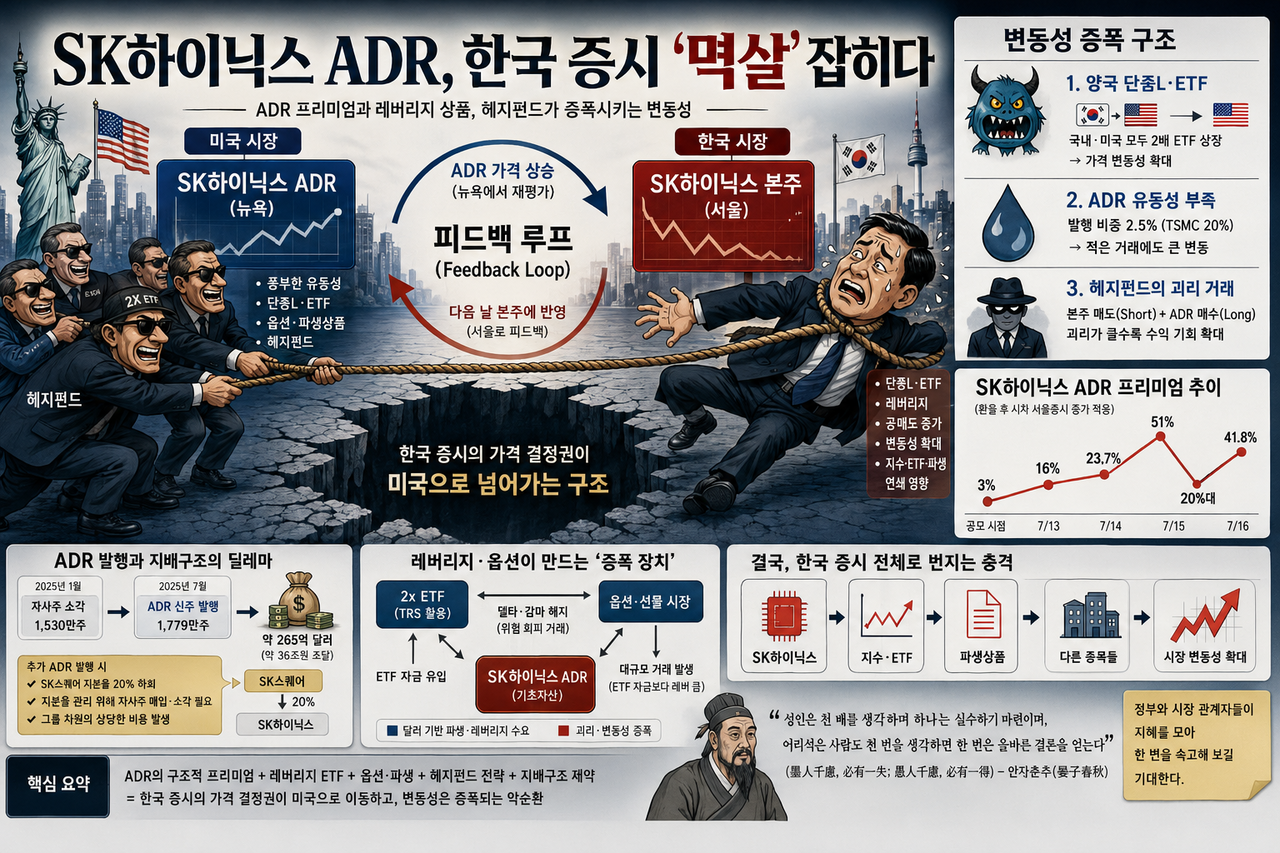
The Korea-US 'feedback loop' created by the ADR
The ADR and the domestic share operate in a semi-convertible structure. SK hynix's ADR can be converted into domestic shares, but converting domestic shares into ADRs requires a complex process that makes it effectively impossible. Arbitrage — buying the domestic share when it is cheaper and converting it into the higher-priced ADR — is not realistically viable. Without a mechanism to close the gap, the ADR is likely to sustain a premium over the domestic share. TSMC, which has a similar structure, also trades at a persistent premium to its Taiwan-listed shares.
Even so, the ADR and the domestic share influence each other's prices. Through the ADR, SK hynix's Seoul-set price is reassessed in New York each day, and the result feeds back into Seoul the following morning — a classic feedback loop.
The concept gained wider currency through George Soros, the legendary hedge fund investor, who used his Theory of Reflexivity to explain market bubbles. The theory holds that market participants' perceptions and actual market fundamentals feed back into each other, amplifying volatility. Expectations push prices higher, and higher prices in turn inflate expectations further.
Volatility amplifier No. 1: single-stock leveraged ETFs on both sides
Single-stock leveraged ETFs are turbocharging the feedback loop. In Korea, 16 single-stock leveraged ETFs and two single-stock leveraged ETNs based on Samsung Electronics and SK hynix listed simultaneously on May 27. In the United States, just four days after the ADR debuted, GraniteShares (SKUU, SKDD) and ProShares (SKHU) launched 2x products on Tuesday, followed by Direxion (SKHL) on Wednesday. The structure creates a channel through which amplified price swings in the US travel via the ADR to the domestic share, where domestic single-stock leveraged ETF rebalancing then amplifies them further. TSMC also has single-stock leveraged ETFs tied to its US ADR, but leveraged exposure to the Taiwan-listed shares is available only through futures and options.
Volatility amplifier No. 2: thin ADR liquidity in a deep market
Liquidity is another variable. ADRs represent about 20 percent of TSMC's total shares outstanding, compared with just 2.5 percent for SK hynix. A small float means even modest trading can move the price sharply. US markets are far deeper than Korea's, and a surge of American liquidity into a relatively thin ADR market could widen price swings considerably.
Leverage can be built not only through physical shares but also through futures and options, and the US options market offers a wide variety of instruments — single-stock options are commonplace, and products with a one-day expiry exist as well. Most US single-stock leveraged ETFs do not buy the ADR directly; they use total return swaps and options instead. Even when an asset manager does not hold the ADR outright, the TRS counterparties and options market makers hedge their own risk by trading the ADR or related derivatives. Once delta and gamma hedging are layered on top, the volume of trading in the underlying asset and surrounding markets can far exceed the actual capital that has flowed into the ETF. Options trading on SK hynix's ADR began at the Chicago Board Options Exchange on Tuesday.
Volatility amplifier No. 3: hedge funds that profit from a wider gap
Hedge funds are yet another wild card. At the time of the ADR offering, the premium over the domestic share was roughly 3 percent. It widened to 16 percent on the first day of trading, surpassed 23.7 percent on Monday and briefly exceeded 51 percent on Tuesday, before pulling back to the 20 percent range on Wednesday. On Thursday it expanded again to 41.8 percent, calculated using the Seoul foreign-exchange market closing rate at each point. The wider the price gap and the greater the volatility, the more opportunity there is for relative value trading strategies. Long-short and pair-trading approaches — hedge fund strategies that target the spread between two assets rather than the absolute direction of either — thrive in exactly this kind of environment.
UBS, for instance, recommended a strategy of shorting SK hynix's domestic shares and going long the ADR before the listing. The stock loan balance — a leading indicator of short selling — jumped 31.4 percent between June 23 and July 8, compared with 11.7 percent for Samsung Electronics over the same period. This suggests foreign investors anticipated a premium for the ADR over the domestic share and positioned themselves early, buying the more expensive ADR while shorting the cheaper domestic stock. Such trades profit from a widening gap, making it more likely that the spread grows rather than narrows.
Single-stock leveraged ETFs concentrate their rebalancing at the close of trading to maintain the target multiple against the underlying asset's price. Because the direction of that rebalancing can be read from the underlying's intraday moves, it invites anticipatory trading and high-frequency trading, which can push volatility in the underlying even higher.
Korea has effectively handed New York pricing power over its second-largest stock
SK hynix is the second-largest stock by market capitalization on the Kospi, so swings in its share price ripple through the index as well as ETFs and derivatives tied to it. Single-stock leveraged ETFs can translate volatility in a single name into volatility across the broader market. The combined Kospi market cap share of Samsung Electronics and SK hynix rose from 51.06 percent on May 26 — the day before the single-stock leveraged ETFs listed — to 55.17 percent on July 10. The two stocks' share of total trading value climbed from around 30 percent to as high as 44 percent. When Samsung Electronics and SK hynix move, the resulting rebalancing of related ETFs ripples out to other stocks as well.
SK hynix has left the door open to issuing additional ADRs. When TSMC first listed its ADR in 1996, it represented just 2.9 percent of shares outstanding; the company gradually increased issuance to reach the current 20 percent. The more ADRs SK hynix issues, the stronger the grip US investors will have on Korea's stock market. Because US markets are far larger, Korean investors' ability to influence New York through SK hynix's ADR will remain limited no matter how much the issuance grows.
SK Group's ownership structure limits the capital-raising benefit of the ADR
SK hynix's ownership structure also complicates the capital-raising rationale for the ADR. The company decided in January to cancel 15.3 million treasury shares — yet the ADR issuance created even more new shares, totaling 17.79 million. The offering raised approximately 40 trillion won ($26.5 billion), but that may be as far as it can go. Any additional ADR issuance would push SK Square's stake in SK hynix below the 20 percent minimum that the Fair Trade Act requires a holding company to maintain in a subsidiary — SK Square currently holds exactly 20 percent. To keep the ratio at or above that threshold, SK Square would need to buy more shares or SK hynix would need to repurchase and cancel its own stock. In other words, even when the ADR raises capital, the group must spend a significant amount managing the ownership ratio.
Remedies announced, but they fall short — a fundamental fix is needed
The Financial Services Commission announced supplementary measures for single-stock leveraged ETFs on Thursday. The focus was on raising deposit requirements and minimum trading units while tightening education and marketing regulations to make access harder for retail investors. Even so, the measures do not apply retroactively to existing holdings, and rapid intraday trading remains unrestricted. Brokerages and asset managers face higher accountability for managing premium-discount ratios, but the end-of-day rebalancing mechanism — widely seen as the primary driver of volatility — was left to the industry to address through self-regulation. The measures appear insufficient to tackle the root of the problem.
The core issue is that leveraged ETFs, options, and hedge fund strategies on both sides of the Pacific have all converged on a structure where the arbitrage channel between the domestic share and the ADR is narrow. SK hynix has not merely listed its shares in New York — it has effectively ceded part of the price-discovery function for Korea's stock market to New York as well.
"Even a wise man, if he thinks a thousand times, will make at least one mistake; even a fool, if he thinks a thousand times, will arrive at least one correct conclusion." — Yanzi Chunqiu
When Duke Jing of Qi saw the modest circumstances of his prime minister Yan Ying and offered him great wealth, Yan declined. The duke pointed to the example of Duke Huan, who had lavished enormous riches on his prime minister Guan Zhong. Yan's reply was that Guan Zhong, wise as he was, had erred in accumulating personal wealth while serving as prime minister — and that he himself, though less gifted, intended not to repeat that mistake.
Both the ADR listing and the single-stock leveraged ETFs appear to carry significant side effects and unresolved problems. It is hard to call either the work of a truly wise hand. Even Yan Ying — held in the highest regard by Confucius — described himself as a fool. One can only hope that policymakers and market participants will approach these issues with Yan's humility, thinking a thousand times before acting.
kyhong@heraldcorp.com