"Power supply is the single most important factor in building a semiconductor cluster. It is essential to swiftly establish a Jeonnam-Gwangju Power Corporation and designate it as the dedicated agency for supplying electricity to the cluster." (Moon Chae-ju, research professor, Korea Institute of Energy Technology)
Experts at a National Assembly forum said the rapid establishment of a dedicated regional power utility is a prerequisite for the successful development of the Honam semiconductor cluster — one of the flagship initiatives under the Lee Jae Myung government's three mega-projects covering semiconductors, physical AI and AI data centers.
On Thursday, Rep. Lim Moon-young of the Democratic Party of Korea (Gwangju Gwangsan-eul) co-hosted a policy forum at the National Assembly Members' Office Building with fellow Gwangju-based Democratic Party lawmakers — Reps. Park Gyun-taek, Ahn Do-geol, Yang Bu-nam, Jeon Jin-suk, Jeong Jun-ho, Jeong Jin-uk and Jo In-cheol — under the theme "The Honam Semiconductor Cluster: What Must Be Prepared and How Can It Succeed?"
At the forum, the lawmakers and academics put their heads together over the conditions needed for the project to take root successfully.
Presentations by specialists focused on four areas identified as critical to the cluster's success: power, water, land and talent.
Leading off, Moon, who delivered the keynote on power grid strategy for the Honam semiconductor industrial complex, said water can be stored and recycled, land can be additionally designated and expanded, and commuting from a distance is feasible — "but power is irreplaceable." He recommended amending the articles of incorporation of the Jeonnam Development Corporation to establish it as a local public enterprise under the name Jeonnam-Gwangju Power Corporation, and designating it as the dedicated agency for supplying electricity to the semiconductor cluster.
On water supply, Park Jun-hong, a professor of civil and environmental engineering at Yonsei University, said the Yeongsan and Seomjin river basins experience greater flow variability than other watersheds, making contingency plans for extreme drought driven by climate change essential. He said expanding the reuse of wastewater and reclaimed water is "the most preferred technological alternative" for ensuring the long-term sustainability of regional water management. Park added that the National Infrastructure Basic Act, introduced in the National Assembly, must be legislated this year for the southwestern semiconductor cluster to succeed.
Regarding the Gwangju military airbase — a candidate site for the Honam semiconductor cluster — Jeong Yun-nam, a professor in the department of architecture at Chonnam National University, said the relocation of the airbase is "the key prerequisite that determines when the land becomes available." He advised that planners should not simply wait for the relocation to be completed, but instead identify zones that can be made available early and preparatory tasks that can be tackled in advance, pursuing technology, infrastructure and urban planning work simultaneously.
Lee Min-seok, a professor in the department of software at Kookmin University, who presented on workforce issues, said the national talent foundation — including contract-based semiconductor degree programs, special legislation and a plan to train 100,000 workers — is already in place. "The remaining gaps can be filled through the adoption of proven systems and new policies," he said, adding that a talent acquisition roadmap and policies to sustain the regional workforce ecosystem must be presented together.
The subsequent discussion was moderated by Kim Dong-sun, a professor of semiconductor systems engineering at Sejong University, with panelists including Jeon Yu-deok, vice president of the Korea Institute for Advancement of Technology; Seo Dong-il, emeritus professor of environmental engineering at Chungnam National University; and Ahn Hong-sang, director of the semiconductor division at the Ministry of Trade, Industry and Energy. The panel explored implementation strategies from the perspectives of industry, academia, research and government.
Rep. Lim, who co-hosted the forum, said "turning concerns into alternatives is precisely the role the National Assembly must play," and pledged that the legislature would fulfill its responsibilities to ensure the government's mega-projects translate into regional growth and stronger semiconductor competitiveness for South Korea.
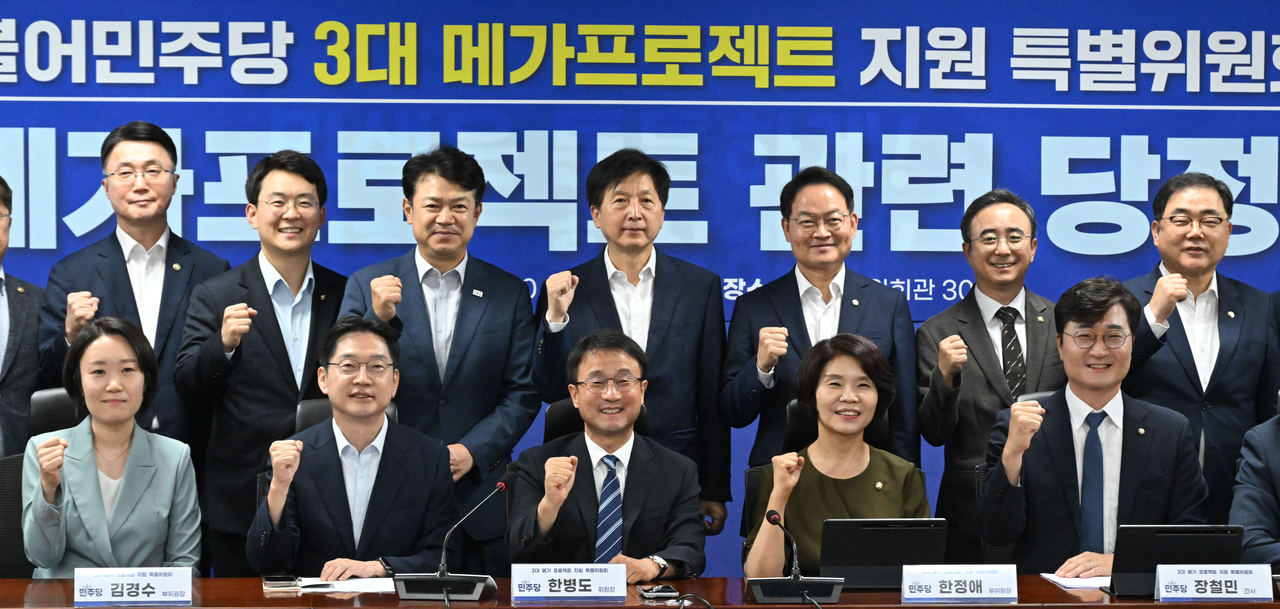
Meanwhile, the Democratic Party held a ruling party-government consultative meeting of its Special Committee on Three Mega-Project Support on Wednesday, announcing that it would "accelerate legislation, including special laws, and budget support related to the three mega-projects."
Han Byung-do, the party's acting leader and floor leader who also chairs the special committee, said "the fate of this project hinges entirely on speed," pledging to push through all related legislation — including a special law on mega special zones — as well as the budgets needed for infrastructure development. He added that the party would closely review each ministry's detailed implementation plans and seek ways to strengthen cooperation between the party and the government to dramatically improve the project's execution. Officials from the Ministry of Land, Infrastructure and Transport, the Ministry of Science and ICT, the Ministry of Climate, Environment and Energy, and the Ministry of Trade, Industry and Energy also attended the meeting.
Rep. Lim, a member of the special committee, plans to introduce this month a special bill on mega special zones as the lead sponsor to underpin the three mega-projects.
bigroot@heraldcorp.com