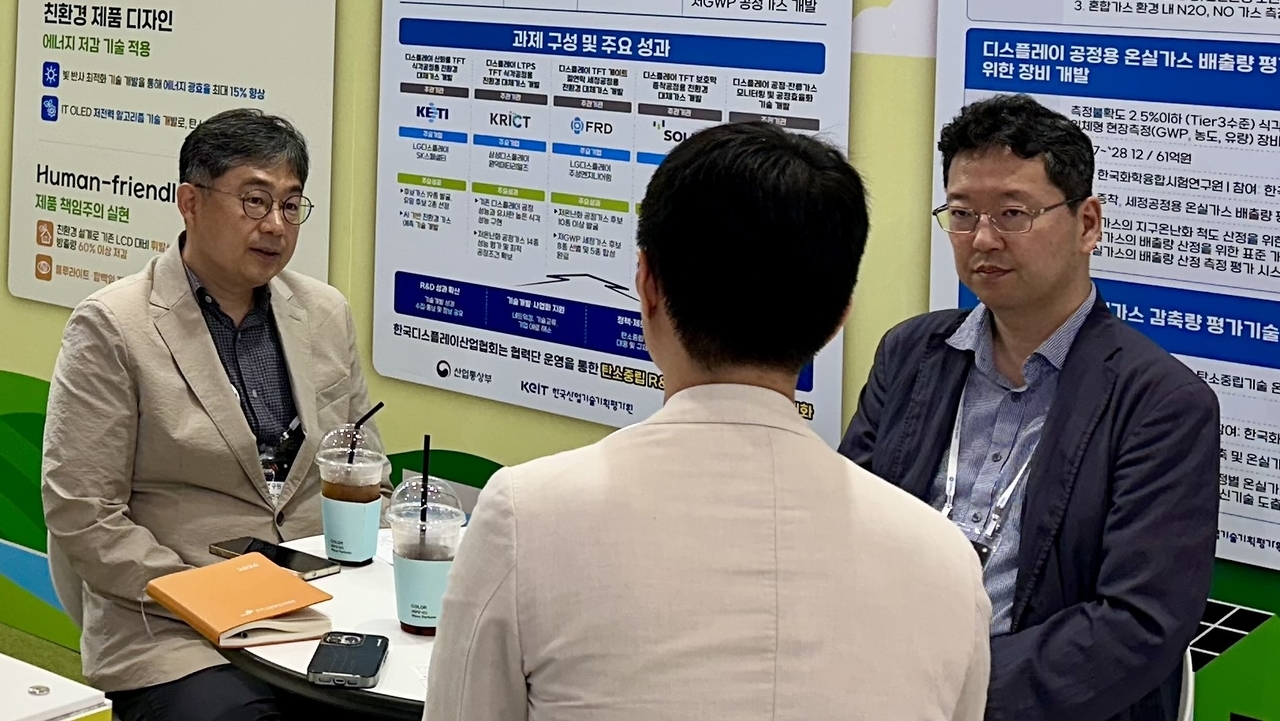
"Recent heat waves in France and Spain will only push European environmental regulations further. The moment we succeed in developing eco-friendly alternative gases, we can build a technological moat that widens our lead over China even further." — Han Cheol-jong, director of the Display Research Center at the Korea Electronics Technology Institute
South Korea's display industry is accelerating the development of low-carbon process gases in anticipation of carbon neutrality demands from major global customers and potential trade barriers from Europe. Samsung Display, LG Display and 35 other industry, academic and research institutions — 37 in all — have formed what participants call a "dream team."
The group's goal is to reduce the global warming potential (GWP) of process gases to one-thousandth of current levels while maintaining etching performance. Researchers have identified promising candidate materials and are targeting full development by 2030.
Major global customers demand carbon neutrality; industry braces for US, European regulations
The two researchers leading the Display Carbon Neutrality Core Technology Development Project sat down for an interview at the K-Display exhibition, which opened at COEX in Seoul on Wednesday. The Korea Display Industry Association is running a dedicated Display Carbon Neutrality Achievement Pavilion at the event to highlight the industry's emissions-reduction efforts.
The project, backed by the Ministry of Trade, Industry and Energy, launched in 2023. The government will provide about 95.4 billion won ($64.4 million) through 2030 to develop low-GWP process gases. Given that the materials and components sector is dominated by small and medium-sized enterprises, the government opted to fund the effort directly.
"Until now there was no integrated research platform, but this project has created a foundation where demand-side companies and research institutions covering materials and processes can all come together," said Son Eun-ho, the center director. "There is probably no other country running a project of this scale."
The push to develop low-carbon process gases gained momentum after major global companies declared carbon neutrality targets. Finished-product makers such as Apple, Google and Dell are now requiring their display manufacturing suppliers to meet carbon neutrality standards — putting South Korean component makers under immediate pressure.
Countering Europe's environment-based trade barriers is another key driver. As protectionism deepens, eco-friendly credentials could become a competitive weapon.
"Europe, which lacks strong consumer electronics manufacturing capacity of its own, could introduce regulations allowing only carbon-neutral smartphones to be imported as a way to check China," Han said. "China is also working hard on related technology, but from our perspective that could be an opportunity."
Son added that even in the United States, environmental, social and governance policy has been deprioritized since President Donald Trump returned to office, but said that if the Democratic Party regains power, stalled environmental regulations could be pushed through rapidly.
Candidate materials identified; commercialization prep set for next phase
The long-term goal is to replace high-carbon greenhouse gases with GWP values ranging from several thousand to more than 20,000. Researchers aim to dramatically lower GWP while replicating the performance of sulfur hexafluoride (SF6) and carbon tetrafluoride (CF4), the fluorinated gases currently used in etching processes.
"We are researching ways to reduce the fluorine content in existing fluorinated process gases and add hydrogen and oxygen," Han said. "Fluorinated process gases are light by nature, which is why they destroy the ozone layer in the atmosphere — the idea is to make them heavier."
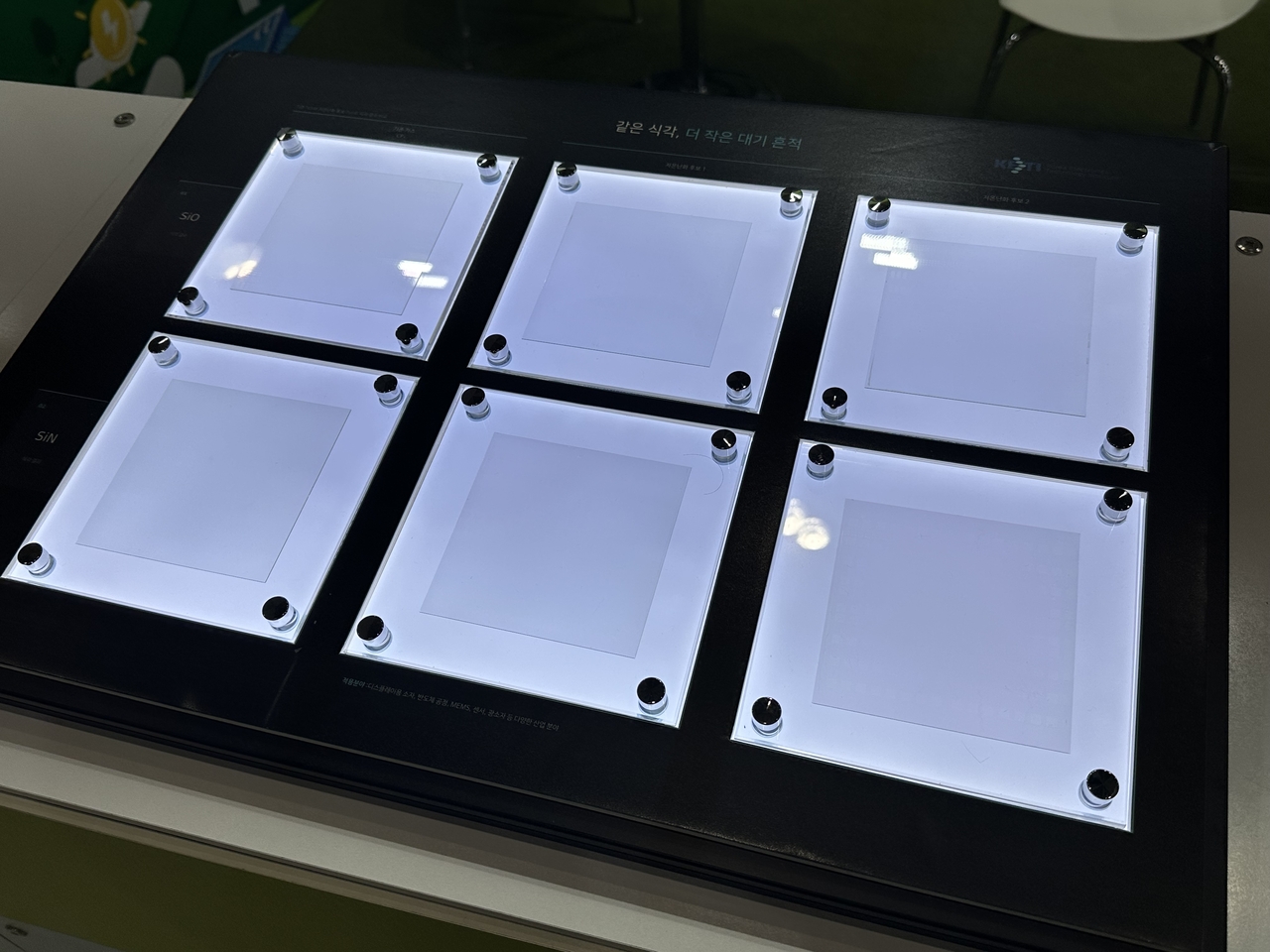
The project is still in its early stages, with candidate materials only recently identified. Development follows a process similar to drug development: candidate gases are tested independently at research institutions before being validated by end-user companies, all prior to deployment on production lines.
"We are currently at phase one — identifying the candidate pool — and when we move to phase two we plan to complete pilot-scale validation and lab testing before actual production line deployment, then prepare for commercialization," Son said. "The key is finding a material with a GWP below 150."
Han added that the team is developing materials along a spectrum to meet the varying needs of end-user companies — from high-performance substances that carry some toxicity to safer options with guaranteed stability. "End-user companies maintain strict confidentiality, which makes it difficult to receive feedback, but we are still trying to meet their requirements," he said.
Secrecy paramount; supply chain management for key materials also a priority
The researchers said maintaining secrecy is critical throughout the development process. Because China's display industry is also pursuing low-carbon process gas development, intellectual property must be rigorously protected.
"Even after we identify the final material, we will need to register IP for all 20 to 30 candidate materials so competitors remain unaware," Han said. "Chemical materials are particularly vulnerable because knowing the molecular structure alone allows unlimited replication — material security is essential."
Supply chain management for process gas development is another major challenge. "The fluorine compound raw materials that go into process gases are often sourced from China," Son said. "Even if we complete development and bring the product to the factory floor, any disruption in raw material supply would be a serious problem, so diversifying the supply chain is critical."
With the project running on a long timeline through 2030, the researchers also called for sustained attention from the government and the display industry. "The government is showing strong interest right now, but what matters is consistent support that does not waver with external developments," Son said.
Han offered a broader perspective in closing. "South Korea has long been a manufacturing powerhouse in semiconductors and displays, and in doing so has been emitting high-carbon process gases," he said. "This project carries great significance in that we are fulfilling our environmental and moral obligations."

jeongwan@heraldcorp.com