A study tracking life expectancy across 34 Asian countries over 34 years has found that South Korea and Japan lead the region, with an average life expectancy of 84.1 years — roughly 13 years higher than other parts of Asia. The COVID-19 pandemic and the rise of chronic diseases have widened regional disparities. The findings come from a joint research team at Korea University and Kyung Hee University and were published in Nature.
The Asia-Pacific high-income region, which includes South Korea and Japan, recorded the highest life expectancy in Asia at 84.1 years, with a notable gender gap: women in the region lived to 87.1 years on average, 6.1 years longer than men at 81.0 years.
The joint research team, led by Kang Ji-seung, a professor at Korea University, and Yeon Dong-geon, a professor at Kyung Hee University, published the findings after a long-term analysis of health indicators across 34 Asian nations over 34 years.
Life expectancy rose across Asia over the 34-year period, with South Asia recording the steepest gains — jumping from 58.6 years in 1990 to 71.2 years in 2023, an increase of 12.6 years. Women outlived men in every region studied, without exception.
Asia's steady rise in life expectancy partially reversed during the COVID-19 pandemic from 2019 to 2023. Southeast Asia lost approximately 0.33 years of life expectancy, while East Asia lost about 0.28 years.
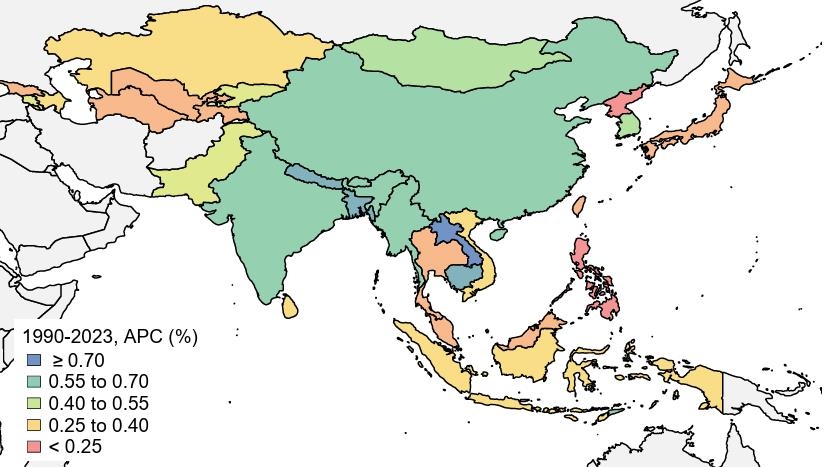
Changes in life expectancy at birth across 34 Asian countries, 1990–2023
The drivers of rising life expectancy differed sharply by economic status. In high-income countries such as South Korea, advances in cardiovascular medicine and access to systematic treatment led the gains. In lower-income nations concentrated in South and Southeast Asia, expanded infant vaccine coverage and improvements in clean water and sanitation were the primary factors.
Beyond infectious diseases, the research team identified high blood pressure, poor diet and air pollution as the three leading risk factors threatening longevity across Asia. Exposure to hypertension and diabetes — measured by elevated fasting blood glucose — has risen steadily across the region over the past 30 years, pointing to an urgent need for focused intervention by public health authorities.
"This large-scale Asian study is the world's first to most comprehensively analyze changes in life expectancy across a region that is home to roughly 60 percent of the global population," said Kang of Korea University. "Going beyond fragmented health statistics, it precisely identifies which diseases and risk factors drive improvements or declines in life expectancy at both the regional and national level. We hope it will serve as a key indicator and compass for health authorities across Asia as they develop practical, effective and tailored health policy."
Yeon of Kyung Hee University said that while Asia's health outcomes had improved dramatically over the past 30 years, "inequality in life expectancy driven by economic disparities between regions and countries remains serious." He added that low-income countries with weak healthcare infrastructure urgently need expanded access to essential medicines, sanitation programs and vaccine initiatives. High-income countries such as South Korea and regions seeing a surge in chronic disease, he said, must pursue prevention-focused policies — including hypertension management, anti-smoking campaigns and air quality improvements — to raise healthy life expectancy evenly across Asia.

From left: Kang Ji-seung, professor at Korea University; Yeon Dong-geon, professor at Kyung Hee University; and Kim Hyun-jin, researcher at Kyung Hee University
The study was published in the July issue of Nature (impact factor 56.1). The large-scale international collaboration involved Korea University, Kyung Hee University, Yonsei University, the Institute for Health Metrics and Evaluation at the University of Washington, and the Gates Foundation. Its significance lies in the detailed analysis of a region that is home to 60 percent of the world's population.
kty@heraldcorp.com