
![[Generated with ChatGPT]](https://wimg.heraldcorp.com/news/cms/2026/07/23/news-p.v1.20260723.caecb6c438264a40be6248ad04ad6521_P1.png)
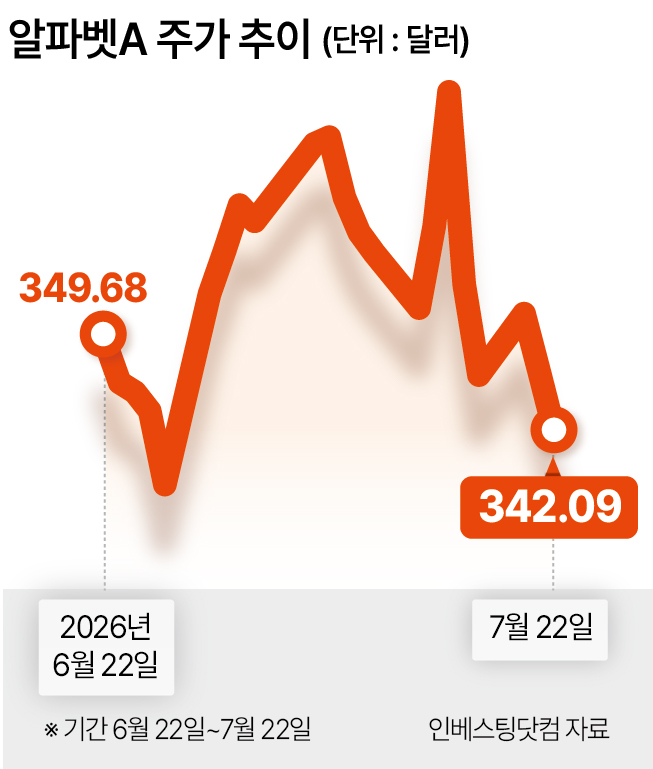
Alphabet, Google's parent company, posted earnings that beat market expectations and reaffirmed its commitment to expanding AI infrastructure investment.
After raising its capital expenditure outlook for this year, the company signaled that next year's investment would grow "significantly" beyond this year's level — a development expected to ease market concerns about slowing AI spending and a potential peak-out in the semiconductor cycle. The news is seen as a relatively positive signal for the share prices of Samsung Electronics and SK Hynix in particular.
Alphabet said Thursday its second-quarter sales rose 24 percent year-on-year to $119.8 billion, topping the market consensus of $116.9 billion. Operating profit climbed 30 percent to $40.8 billion, with an operating margin of 34 percent.
Market attention was fixed above all on the returns from AI investment and the company's forward capital expenditure plans. Google Cloud revenue surged 82 percent year-on-year to $24.8 billion, driven by growing demand for enterprise AI and infrastructure. The cloud segment's operating profit nearly tripled to $8.8 billion, pushing its operating margin to 35.6 percent — confirming that heavy investment is translating into real revenue growth and improved profitability.
Alphabet also raised its full-year capital expenditure guidance to between $195 billion and $205 billion, up from the previous range of $180 billion to $190 billion. At the midpoint, that represents an increase from $185 billion to $200 billion. The revision marks the second consecutive quarterly upgrade from the $175 billion to $185 billion range the company set out at the end of last year.
The company also signaled strong intent on next year's spending. Chief Financial Officer Anat Ashkenazi said capital expenditure in 2027 would grow "significantly" beyond this year's level to support data center construction and the securing of computing resources.
Alphabet's second-quarter capital expenditure came in at $44.9 billion, roughly double the year-earlier figure. The bulk of the spending went toward expanding technology infrastructure, including servers, data centers and AI accelerators.
Market analysts note that the capital expenditure expansion is driven not by competitive spending alone but by a need to address supply shortages. Google has determined that expanding its own data centers is not enough to meet demand and plans to tap external computing capacity as well.
Jang Moon-young, a researcher at Hyundai Motor Securities, said "supply is still unable to keep pace with demand, and the plan to expand third-party computing capacity makes that clear." He added that "the fact that Google must turn to external computing capacity on top of its own data center expansion is evidence that the intensity of demand is outpacing the speed of capital deployment."
He went on to say that "the cloud business's future growth rate will be determined by supply, not demand," and added that "this was a quarter in which the data backed up the case that supply — not demand — is what is driving capital expenditure expansion."
Cloud backlog has reportedly expanded to around $510 billion, with more than half expected to be recognized as revenue within the next 24 months.
The fact that Google is drawing on external resources because its own computing capacity falls short was interpreted as a positive signal for demand for AI servers and high-bandwidth memory (HBM).
This is favorable news for Samsung Electronics and SK Hynix, South Korea's two leading chipmakers. Continued data center investment by hyperscalers is likely to sustain demand for high-value memory products such as HBM, server DRAM and enterprise solid-state drives.
Semiconductor stocks have been under pressure in recent weeks as concerns mounted over slowing AI investment and a potential memory cycle peak-out. Alphabet's upward revision to its investment guidance is seen as having removed at least one of the market's biggest worries — a demand slowdown.
Securities firms moved quickly to reiterate buy calls on chipmakers. KB Securities maintained a buy rating on Samsung Electronics and a target price of 600,000 won ($405), calling it "the biggest beneficiary in Google's AI ecosystem."
Kim Dong-won, head of research, said that "given the race to dominate the AI market and the trend of rapidly surging demand, major US tech companies including Google share the view that underinvesting in AI going forward is more dangerous than overinvesting." He added that "big tech companies will therefore execute unstoppable AI investment over the next three years."
The cash flow burden on big tech from rising capital expenditure remains a variable, however. Alphabet's free cash flow turned negative in the second quarter at minus $5.86 billion. After exceeding $24 billion per quarter in the second half of last year, free cash flow fell to around $10 billion in the first quarter of this year before swinging to a deficit in the second quarter.
Analysts caution that it is too early to interpret this as a sign that Alphabet is running out of capacity to fund AI investment. The company can raise investment capital through debt and equity financing in addition to operating cash flow, making it unlikely that deteriorating free cash flow will translate directly into reduced spending anytime soon.
Hwang Su-wook, a researcher at Meritz Securities, said "the reason Alphabet was able to raise its capital expenditure guidance even as free cash flow turned negative is that it does not rely solely on operating cash flow to fund investment," adding that "this suggests big tech can continue capital expenditure by tapping other financing channels even as cash is depleted."
Risks have not disappeared entirely. While concerns about the sustainability of AI investment have eased somewhat, expanding reliance on external financing could increase exposure to interest rate and credit pressures. The center of gravity for investment risk may be shifting from "big tech halting AI investment" toward credit-related issues such as financing costs and financial soundness.
Hwang said "AI investment is no longer simply a question of cash deployment — it is increasingly a question of optimal capital structure," adding that "unlike 2023 and 2024, when investment was largely cash-funded, AI capital expenditure going forward may become more sensitive to interest rate levels."
Ultimately, the significance of this earnings season lies in confirming that the AI investment cycle has not turned prematurely. With cloud growth far exceeding market expectations and profitability also improving, the expanded capital expenditure is being assessed as delivering real results rather than amounting to premature front-loaded spending.
With Google having navigated the opening round of the hyperscaler earnings season relatively smoothly, market attention is now turning to Microsoft, Meta and Amazon.
If those companies also confirm a continued commitment to expanding data center and AI investment, concerns about a peak-out surrounding Samsung Electronics and SK Hynix could ease more quickly. Conversely, if deteriorating cash flows and questions about investment efficiency come to the fore, the scope for a rebound may be limited.
th5@heraldcorp.com





