
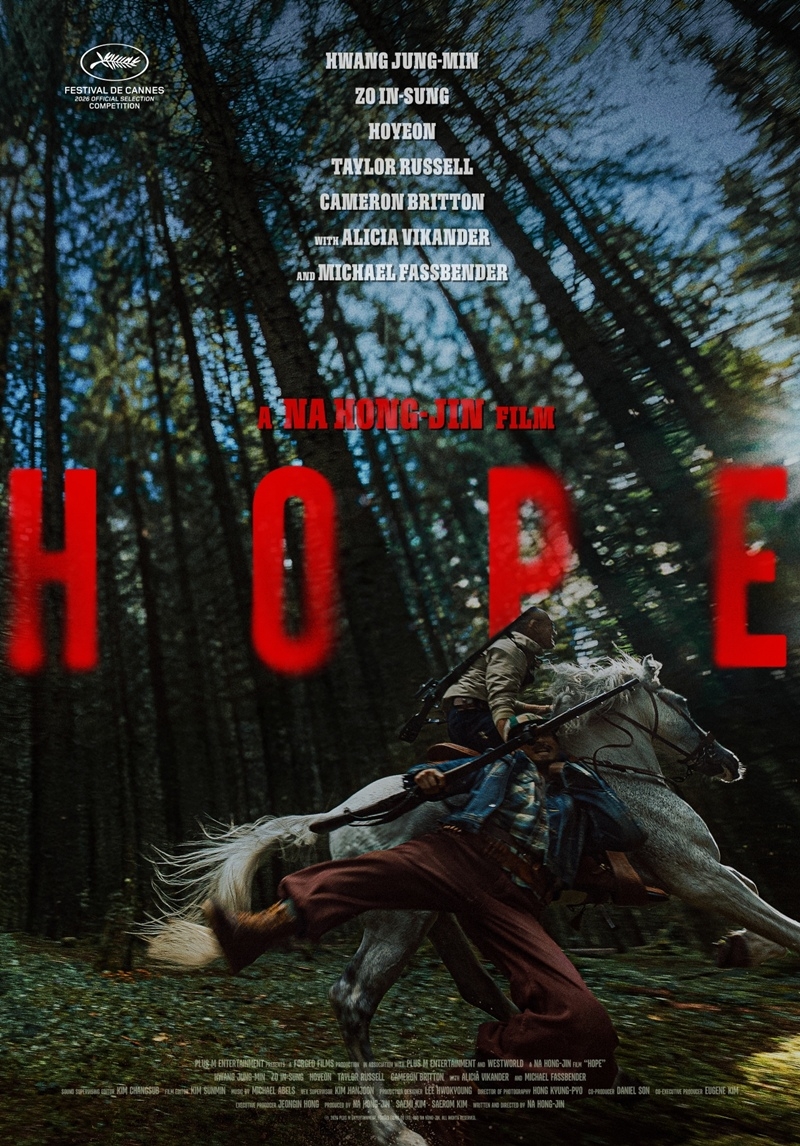
One scene in director Na Hong-jin's new film "Hope" has audiences buzzing above all others — a chase sequence in which actor Jo In-sung gallops on horseback through a forest and along a highway. Jo trained for three months, riding two to three days a week, to prepare for the role, and performed the key action scenes without CGI assistance. But just how much of what appears on screen is physically possible? The Korea Racing Authority weighed in.
How fast is the horse in the film?
The breed of horse in the film cannot be confirmed, but the Thoroughbred — generally considered the fastest breed — averages a top speed of around 60 kph. Converting the all-time record at Seoul Racecourse for the 2,000-meter race — 2 minutes and 4.3 seconds — into kilometers per hour yields roughly 58 kph. The Guinness World Record for the fastest racehorse stands at 70.35 kph.
The film, however, is not set on a racetrack. The terrain is a forest tangled with trees and rocks, not a flat sand track, and a full gallop through rough, obstructed ground is considered extremely dangerous in real riding — speed must always be limited. "The realistic speed achievable on a forest trail would inevitably be considerably lower than racecourse records," a Korea Racing Authority official said. "An alien that can run as fast as a car failing to catch a single horse is a cinematic liberty."
Can a horse sustain that speed?
No — and that is the biggest gap between the film and reality. A horse is an explosive sprinter, not a marathon runner. Most horse races are run over distances of 1,000 to 3,000 meters for exactly this reason: a near-top-speed gallop burns enormous energy and cannot be maintained for long.
In practice, a real mounted chase would look less like a sustained sprint and more like a series of bursts punctuated by slowdowns to let the horse recover. When Jo spoke of "the difficulty of syncing with the horse," that included reading and managing the animal's stamina — knowing when to push and when to ease off.
Can someone be snatched off the ground from a galloping horse?
The scene in which Hyeon-ho (played by Seo Beom-sik), the leader of a fishing village, rides up and hauls Jo In-sung off the ground left many viewers slack-jawed. The move requires the rider to hold the reins with one hand while lifting a full-grown man with the other.
The verdict: "Extremely difficult, but not impossible." The evidence comes, perhaps surprisingly, from Korean traditional martial arts. "Masangje," a Joseon-era discipline, was a military training event in which riders competed to stand, lie flat or conceal themselves along the flank of a galloping horse. It also served as a signature performance that Joseon envoys demonstrated in Japan. Large upper-body movements on a moving horse have been a real, practiced skill for hundreds of years.
The actor's background adds credibility. Seo, who plays Hyeon-ho, is a veteran actor with a career as a stunt coordinator, and he was the figure on horseback in the film's first teaser poster. Still, a Korea Racing Authority official cautioned that "this is a move only possible in a controlled environment with trained actors, horses prepared for filming, and safety personnel on hand — it is not something that can be easily replicated by the general public."
Can two people ride one horse at a gallop?
The film also features a scene in which two people ride a single horse together. Short distances are possible, but the added load places significant strain on the animal and is not recommended as a standard riding practice. The weight a horse can safely carry depends on its breed, build, muscle mass and training level, as well as the weight of the saddle and equipment and the distance traveled. The equestrian industry generally recommends keeping the combined load — rider and saddle — within 20 percent of the horse's body weight. For a 500-kilogram horse, that means a combined weight of around 100 kilograms is the recommended ceiling. Two adult men push that figure to around 150 kilograms almost immediately — reducing speed and significantly increasing the physical burden on the horse and the risk of injury over any meaningful distance.
Does gunfire spook a horse?
Here, too, tradition holds the answer. "Gisa" — mounted archery performed on a galloping horse — was one of the signature equestrian martial arts practiced alongside masangje by Korea's ancestors. The key factor is the horse, not the rider. Horses evolved to flee from predators and are acutely sensitive to loud noises, so desensitization training to prevent a horse from startling at gunfire is an essential prerequisite. The horses used in film production are specialist animals that have undergone exactly this kind of conditioning.
yjc@heraldcorp.com





