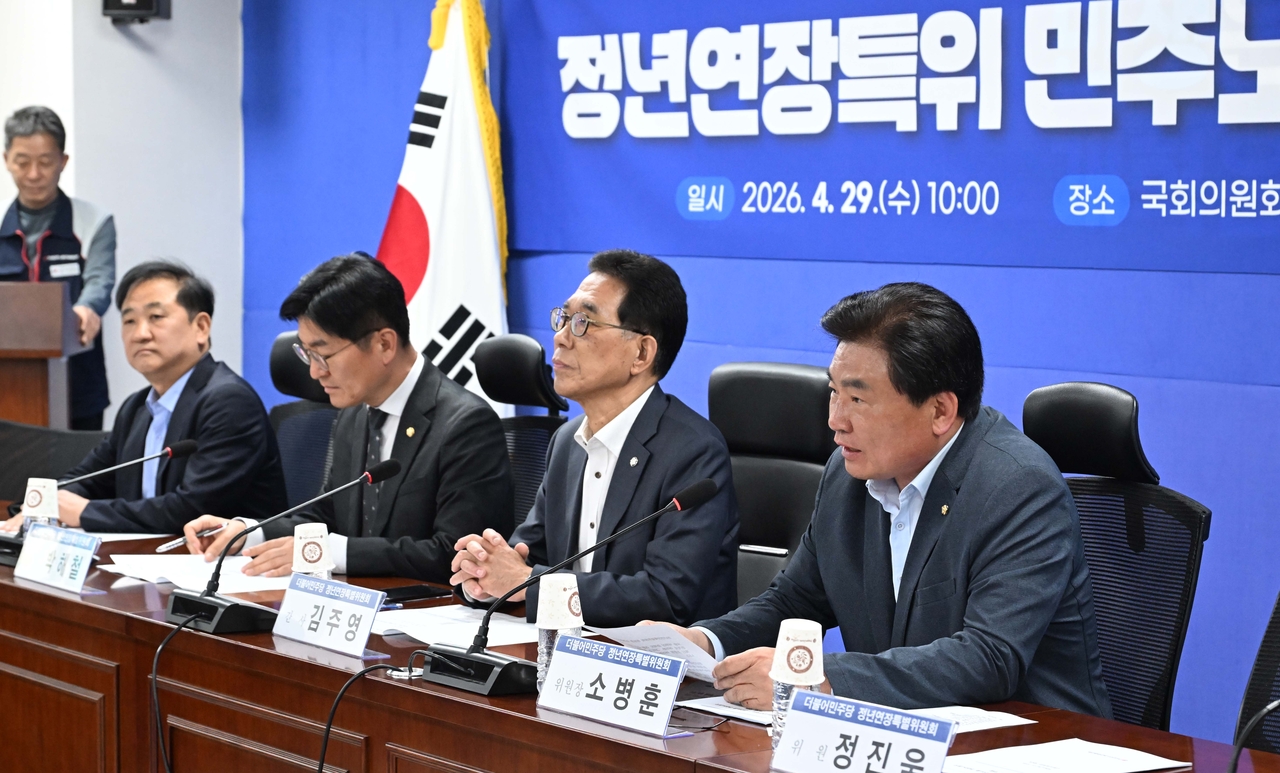
The Democratic Party of Korea plans to strengthen the practical authority of worker representatives in tandem with raising the statutory retirement age to 65. The core measure would require employers and worker representatives to consult when changing workplace rules — including wage structures — during the period in which the retirement age is being phased up.
Political observers say the Democratic Party could use the push to extend the retirement age as an opportunity to overhaul the long-toothless worker representative system.
According to reporting compiled Friday, the Democratic Party's special committee on retirement age extension has decided to add a mandatory clause — requiring employers to "consult sincerely with worker representatives" — to the amendment of the Act on Prohibition of Age Discrimination in Employment and Elderly Employment Promotion, commonly known as the Elderly Employment Act. The provision imposes a procedural obligation on employers to carry out the measures needed to implement the retirement age extension.
The measures that employers must carry out in consultation with worker representatives will also be spelled out in greater detail. While the existing Elderly Employment Act mentions only "wage structure reform and similar measures," the amendment adds job and position redesign and working-hours adjustment. The special committee is understood to have crafted the proposal as a compromise between labor's demand that government support be made mandatory and management's position that consultations be premised on wage adjustments.
A worker representative is defined as the head of a trade union that organizes a majority of workers at a given workplace, or, where no such majority union exists, a person representing a majority of workers. Worker representatives negotiate and reach agreements with employers on a broad range of matters including working conditions, employment security and workplace safety.
The measure is expected to bolster workers' bargaining power as the retirement age extension moves forward. Analysts note it is highly unusual for labor-relations legislation to include a mandatory consultation clause with worker representatives. A business community official said the proposal "strengthened the authority of worker representatives by making job and position redesign and working-condition adjustments — matters similar to workplace rules under the Labor Standards Act — subject to mandatory consultation."
However, some in the labor community have raised concerns that strengthening the worker representative system could serve as a lever to ease the threshold for making unfavorable changes to workplace rules.
The special committee is understood to have agreed to create a special exemption clause that would allow employers to change workplace rules — covering wage structure reform, job or position redesign, and working-hours adjustment — by simply soliciting the opinions of a majority of workers, without requiring their consent. In exchange, the relaxed exemption would apply only to the additional employment period created by the phased retirement age increase, and the exemption clause itself would remain in effect only through 2036.
Under current labor law, employers must seek the opinions of a majority of workers when drafting or revising workplace rules, and must obtain the consent of a majority when changes are unfavorable to workers. A labor community official criticized the proposal, saying it amounts to "a clause where you only have to report to a majority of workers," adding that "workers in effect have no right to object and employers can do as they please." The measure partly reflects the business community's argument that it is difficult to extend the retirement age without adjusting wages, given that long-tenured workers approaching retirement typically earn higher salaries.
As worker representatives take on a larger role in the retirement age extension process, momentum is also building for a parallel reform of the worker representative system itself. The system has long been criticized as toothless because current law does not specify the legal status, term of office, activities or selection method of worker representatives. Amendments to the Labor Standards Act and the Act on Worker Participation and Cooperation that would address these gaps were introduced last year and remain pending before the National Assembly's climate, energy, environment and labor committee.
A senior Democratic Party official closely familiar with the retirement age issue said the party had repeatedly attempted to legislate reforms to the worker representative system independently of the retirement age issue, only to see those efforts fall through. "When we are already amending the Elderly Employment Act, it makes more sense to push the worker representative reform at the same time — it will help the retirement age extension take root on the ground," the official said.
Meanwhile, the special committee has reached a tentative conclusion to raise the current retirement age of 60 by one year every two years — to 61 in 2029–2030, 62 in 2031–2032, 63 in 2033–2034, 64 in 2035–2036, and 65 in 2037–2038 — and is now coordinating the timing of legislation. A lawmaker on the special committee said the positions of both labor and management had been fully heard, leaving only the final decision to be made.
addressh@heraldcorp.com
eyre@heraldcorp.com