KAIDA policy seminar
Manufacturers to prove safety rather than pass set tests
Level 4 standards to be shaped by 3,000-vehicle pilot in Gwangju
ACEA: business viability, not technology, is the real barrier to autonomous driving
The way South Korea evaluates the safety of Level 4 autonomous vehicles is about to change. The current framework — in which a vehicle simply needs to pass a fixed set of government-prescribed tests — will give way to a system in which manufacturers must demonstrate safety on their own, and the government assesses their capacity to do so. With a new international standard set to take effect, how to incorporate it into domestic regulation has emerged as a pressing challenge.
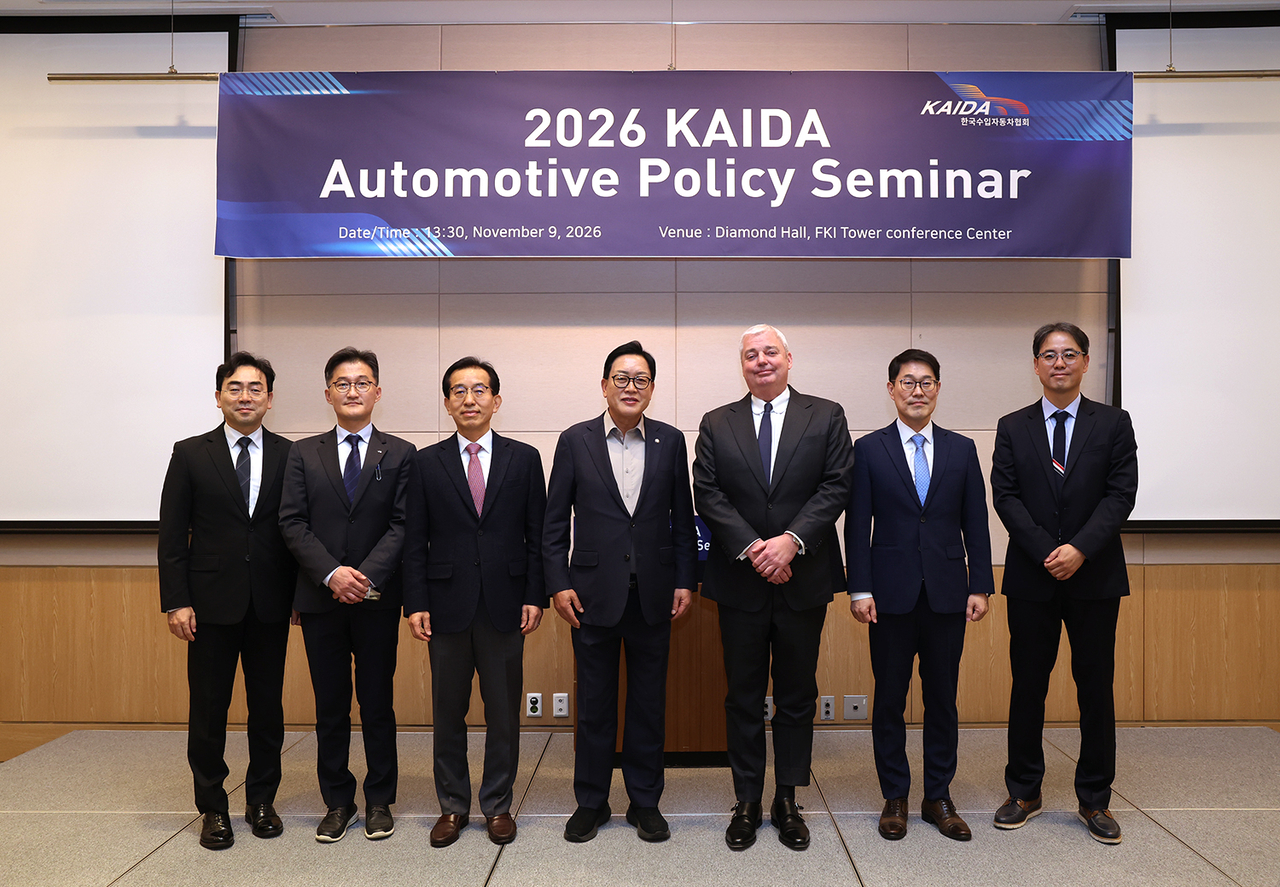
The Korea Automobile Importers & Distributors Association (KAIDA) held its 2026 KAIDA Automotive Policy Seminar Monday at the FKI Tower Conference Center in Yeongdeungpo-gu, Seoul. Min Kyung-chan, director of the Korea Transportation Safety Authority's Automotive Safety Research Institute (KATRI), said during the autonomous driving session that "the regulatory framework is shifting toward the government evaluating whether manufacturers are properly fulfilling those responsibilities and whether they have the capacity to do so."
Organizational audits every three years, mandatory incident reporting after vehicles go on sale
The existing Level 3 standard — UN Regulation No. 157 — covers only highway autonomous driving. It evaluates vehicles against a defined set of test items and scenarios, with pass-or-fail determined by predetermined threshold values.
The new international standard for automated driving systems (ADS) adopted by the UN World Forum for Harmonization of Vehicle Regulations (WP.29) last June takes a different approach. It covers all road types, including urban roads, and extends to fully driverless vehicles, with no government-set test thresholds. Because the range of possible driving situations is virtually limitless, case-by-case verification is not feasible. The new standard is scheduled to take effect in January 2027.
Instead, manufacturers will be required to demonstrate safety across the entire lifecycle of a vehicle. They must establish a safety management system (SMS) and submit to audits covering organizational capability and safety culture, with re-audits required every three years. For each vehicle, manufacturers must submit a safety case — a structured argument that the vehicle is safe, supported by evidence such as test results and real-world driving data. After a vehicle goes on sale, incidents must be reported immediately and annual safety audit results must be submitted.
The standard also accounts for risks that arise from large-scale deployment. When thousands of vehicles operate simultaneously, problems such as communication failures can cascade across the entire fleet. "A problem occurring in one autonomous vehicle is not just that vehicle's individual problem — it can adversely affect all vehicles in operation and trigger large-scale social disruption," Min said.
The government plans to adapt the international standard to domestic conditions. It has already launched a pilot program with 200 autonomous vehicles in Gwangju and plans to scale up to around 3,000 vehicles across five or six pilot cities, including Gwangju, next year. "We plan to institutionalize domestic autonomous vehicle safety standards based on the results obtained through the pilot process," Min said.
ACEA: Korea is a top-3-to-5 market for European members; South Korea must accelerate adoption of UN regulations
Pierre Millet, chief technology officer of the European Automobile Manufacturers' Association (ACEA), who presented after Min, also said autonomous vehicle safety is "something that must be proven, not assumed." Because it is impossible to test every driving scenario, he explained, vehicle approval combines track and real-road testing with simulation and a manufacturer's safety case. Europe is pursuing unrestricted Level 4 general type approval by 2027.
Millet identified business viability, rather than technology, as the main obstacle to advanced autonomous driving. While vehicle approval is handled at the EU level, operating regulations vary by member state, making it extremely difficult to obtain permits for cross-border operations such as freight transport.
He also said the center of gravity in autonomous driving is shifting from personal vehicles to commercial operations. Europe in particular faces a severe shortage of truck and van drivers, he noted, making long-haul freight transport the most likely sector for the first large-scale commercial deployment. As the market polarizes between Level 2 driver-assistance systems and Level 4 high-automation vehicles, manufacturer interest in Level 3 — which carries costs comparable to Level 4 — is waning, he added.
Millet also highlighted the importance of the Korean market. He said Korea is the EU's seventh-largest automotive export market overall, but ranks third to fifth for many of its member companies, and described it as a market with far stronger demand for premium vehicles and autonomous driving technology than Europe. He noted that progress had been made this year on revising the automotive annex to the Korea-EU free trade agreement, but urged South Korea to move faster in adopting UN regulations.
eyre@heraldcorp.com