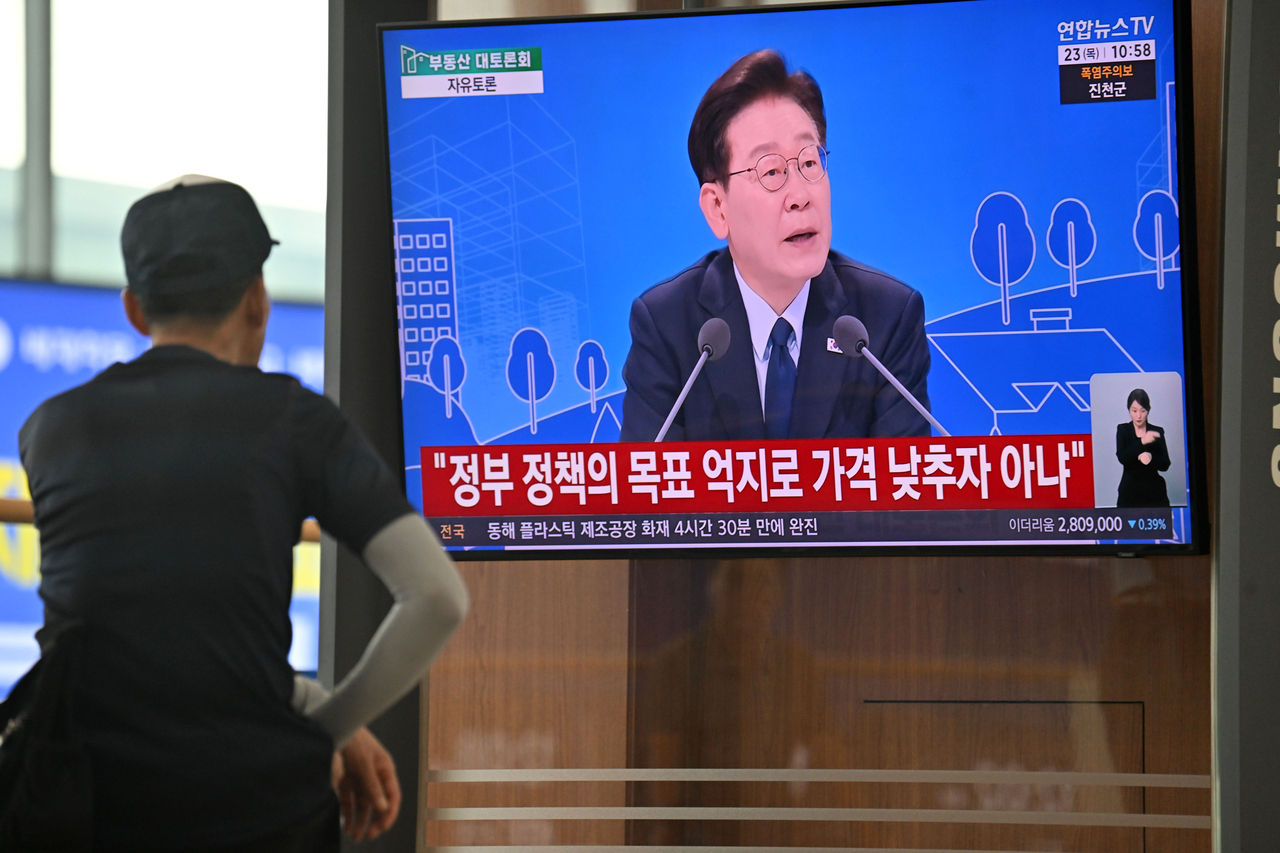
I'm not sure whether to limit the capital gains tax exemption for single-home owners to once in a lifetime, but giving unlimited opportunities does seem problematic. It's a very valid point. We could limit it by the number of times, or cap it at a total amount.
President Lee Jae-myung's indication Thursday at a public forum on real estate policy that he would review a proposal to cap the capital gains tax exemption for single-home owners — either by frequency or total amount — has drawn intense market attention to the prospect of the measure becoming reality. The proposal is widely interpreted as an effort to prevent the single-home exemption from being used as a vehicle for asset accumulation and wealth inequality through repeated home upgrades.
However, critics warn that if such a policy were pursued, it could restrict freedom of residential movement at a time when upgrading to a larger home or a better neighborhood has become an essential path for single-home owners seeking to improve their living conditions at each stage of life. There are also concerns that the policy could worsen the phenomenon of properties being locked out of the market.
According to government and real estate industry sources Friday, related ministries overseeing real estate taxation — including the Ministry of Economy and Finance — are expected to review whether to impose a frequency or total-amount cap on the capital gains tax exemption, which currently allows single-household, single-home owners to sell a property free of capital gains tax on proceeds up to 1.2 billion won ($817,000). The review follows remarks made at Thursday's forum, which Lee presided over.
Lee Gwang-su, head of the real estate consultancy Gwangsu's Bokdeokbang, argued at the forum that the capital gains tax exemption for single-household, single-home owners should be limited to once in a lifetime. "By capping it at once, we can encourage people to make rational choices about home purchases and ask themselves, 'Am I going to live in this house for a long time?'" he said. Lee responded that the argument "makes sense" and directed policy officials to review the proposal.
![An apartment complex in central Seoul. [Herald DB]](https://wimg.heraldcorp.com/news/cms/2026/07/24/news-p.v1.20260723.662056ebaa314ad78e81737e2cc0b203_P1.jpg)
Under current law, a single-household, single-home owner who has held a property for at least two years is exempt from capital gains tax on sale proceeds up to 1.2 billion won; for properties sold above that threshold, tax is levied on the portion of the gain attributable to the amount exceeding 1.2 billion won. If the property was located in a designated adjustment zone at the time of purchase, the owner must also have lived there for at least two years to qualify for the exemption. At present, there is no limit on how many times an owner can claim the benefit, provided the holding and residency requirements are met — and it is that unlimited nature that the government now says it will examine.
The government's sympathy for the proposal reflects a judgment that repeated home upgrades exploiting the single-home exemption have deepened the so-called "prime single home" phenomenon — the preference for concentrating wealth in one high-value property. At Thursday's forum, Lee said the prime-single-home trend "has caused serious problems in our country" and "has created opportunities for efficient speculation."
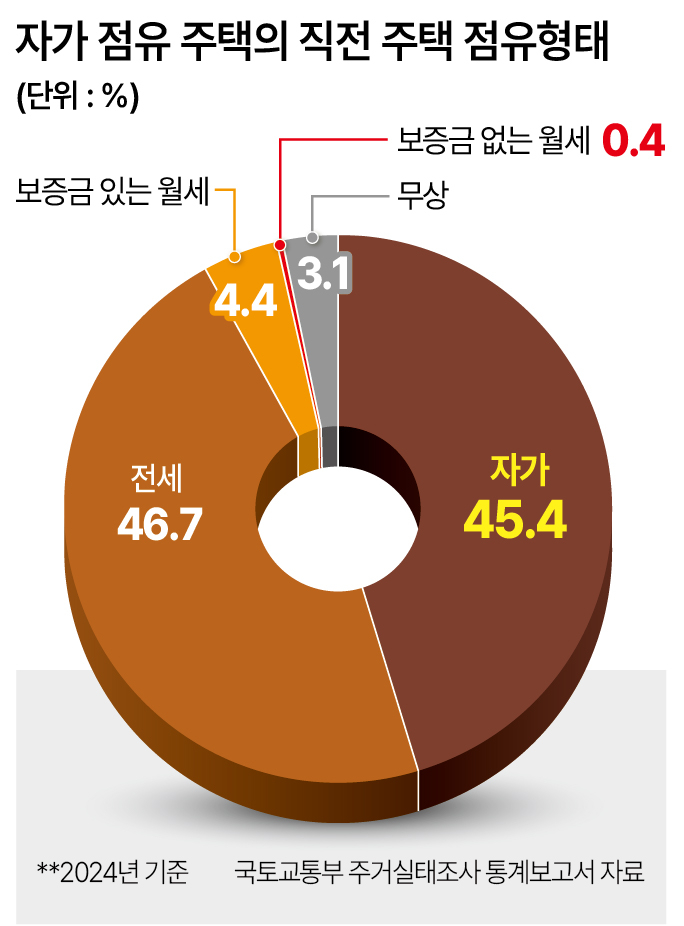
If the proposal becomes reality, analysts expect a growing number of people to abandon or delay plans to move. Home upgrades already account for close to half of all transactions in the market. According to the Ministry of Land, Infrastructure and Transport's 2024 Housing Survey statistical report, released in January, 45.4 percent of owner-occupiers had also been owner-occupiers in their previous home. While the figure includes cases of multi-home owners changing their primary residence or purchasing an upgrade, single-home owner moves are estimated to make up the majority. Should the cap on the single-home exemption take effect, that share is expected to fall.
Oh Jong-hyun, head of the tax research division at the Korea Institute of Public Finance, cautioned at Thursday's forum that "the single-household, single-home capital gains tax exemption exists to guarantee the freedom of residential movement for the vast majority of citizens," adding that "a blanket restriction aimed at speculation could harm law-abiding people who genuinely need to move, so the approach must be balanced."
Experts note that single-home upgrades serve as a natural housing ladder tied to life milestones such as marriage and childbirth, and that restricting them could increase the housing burden on genuine end-users.
Song Seung-hyun, head of the urban economics consultancy Dosi wa Gyeongje, said the current market structure follows a pattern in which people "start with a 33-square-meter unit, move up to a 59-square-meter unit when they marry, then shift to an 84-square-meter unit when a child is born — gradually upgrading in size and neighborhood according to their life stage. This ladder would be cut off entirely." He added that "if a frequency cap is introduced, the turnover cycle will lengthen and the volume of properties circulating in the market will inevitably shrink."
A real estate expert who requested anonymity said buyers have a kind of hope that once they own a home, they will eventually move up to a better one, and that restricting that "is unprecedented anywhere in the world." The expert warned the policy "could infringe on the freedom of residential movement."
Some observers also suggest the measure could, contrary to the government's intent, actually deepen the prime-single-home phenomenon.
Song said that "if the exemption is granted only once, people will need to aim for a good neighborhood and a mid-sized unit from the outset in order to use that one benefit to move up to a premium location." He warned that "as gradual residential upgrading becomes impossible, wealth polarization will widen and the barrier to entering prime areas will only rise higher — the opposite of what the policy intends."
hwshin@heraldcorp.com