![Kia vehicles, including the new Sportage and Sorento 4x4, are displayed at the Kia exhibition booth set up for the Rio Open 2026 at the Jockey Club in Rio de Janeiro, Brazil, in February. [Kia Brazil]](https://wimg.heraldcorp.com/news/cms/2026/07/27/news-p.v1.20260727.de8d09828a9a446ab95aba3046e80335_P1.jpg)
Kia is considering building its first local production factory in Brazil — a move that could resolve a tax dispute worth about 6 billion reais (approximately 1.7 trillion won) tracing back to a failed factory project by its former affiliate Asia Motors in the 1990s, while shifting the company's Brazil operations from an import-and-sales model to a full production setup.
According to local media including CNN Brazil, the automotive magazine Quatro Rodas and Auto Esporte, Kia is in talks with Brazil's federal and state governments about building a finished-vehicle factory in Piracicaba, São Paulo state, with production targeted to begin in 2028.
The employment figures being discussed locally stand at roughly 5,000 direct jobs and about 15,000 indirect positions in parts, logistics and retail. Senior Kia executives are in discussions with Piracicaba city officials on the factory site, investment terms and local government support.
![A Kia vehicle is seen on a street in Salvador, Bahia state, Brazil, on June 11, 2020. [123rf]](https://wimg.heraldcorp.com/news/cms/2026/07/27/news-p.v1.20260727.fc637e58f3ee4ea38d8c84ab256a7bf5_P1.jpg)
Kia production base next to Hyundai Motor factory
Piracicaba has emerged as the leading candidate because Kia could leverage Hyundai Motor's existing production infrastructure there. Hyundai Motor entered the Brazilian market in 1992 and began operating its Piracicaba factory in 2012, where it currently produces the locally tailored HB20 subcompact and the Creta SUV.
An automotive industrial complex has grown up around the Hyundai Motor plant in Piracicaba, with parts suppliers and logistics companies clustered nearby. A Kia factory in the same area would allow the two brands to share portions of their parts supply chain, logistics facilities, and research and workforce operations. The location is also considered well-suited for exports to other South American markets beyond Brazil's domestic demand.
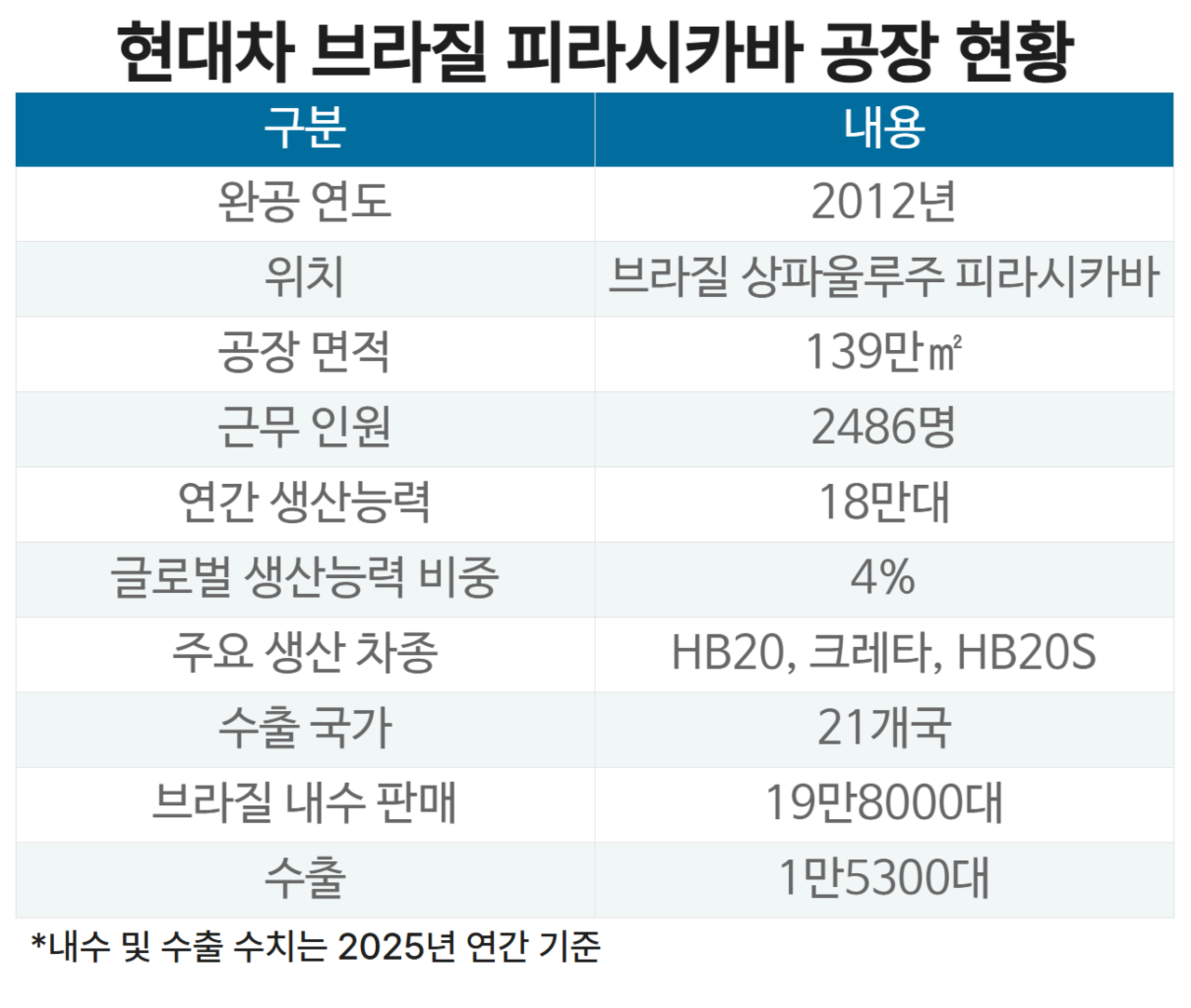
After production facility upgrades, the Hyundai Motor Piracicaba plant now has an annual capacity exceeding 215,000 vehicles. Local media reported that the existing factory has limited room for further expansion due to site constraints, raising the possibility that a new Kia plant could absorb some of Hyundai Motor's production volume as well.
If a Kia factory is established, Hyundai Motor Group would secure its second finished-vehicle production base in Brazil.

Could a local factory end a 30-year tax dispute?
Whether a local factory would also put an end to a tax dispute stretching back more than 30 years is drawing attention. In the 1990s, Asia Motors — then a Kia affiliate — received benefits including import tariff exemptions in exchange for a commitment to build a commercial vehicle factory in Bahia state.
When the Asian financial crisis and Kia Group's financial difficulties derailed those plans, the Brazilian government moved to claw back the tax benefits it had granted on the condition that the factory would be built. With interest and penalties factored in, the outstanding liability is now estimated at around 6 billion reais.
![Hyundai Motor's Piracicaba factory in Brazil. [Hyundai Motor]](https://wimg.heraldcorp.com/news/cms/2026/07/27/news-p.v1.20260722.8ac721661f7c4bd4a0132b872079a0bc_P1.jpg)
Brazilian tax authorities and Kia have been at odds over whether the liability was properly inherited by the current entity. Brazil's Superior Court of Justice sent the roughly 6-billion-reais tax enforcement case back to a lower court in 2023.
The arrangement now under discussion would have the Brazilian government reduce or waive the debt in exchange for Kia building a finished-vehicle factory.
Jose Luis Gandini, chairman of Kia's Brazil subsidiary, told local media that "if the government waives the debt, Kia will build the factory and I will step back from the business," while adding that "nothing has been decided yet." Some outlets reported that the debt waiver and factory construction were in effect already agreed upon, but neither Kia nor the Brazilian government has made an official announcement.
34 years of imports, starting with the Besta
If the factory is confirmed, Kia's business structure in Brazil would change significantly. Kia signed an official sales agreement with Grupo Gandini in 1992, shortly after Brazil opened its auto market to imports, and began full commercial operations the following year.
The first imported models were the Besta van and the Ceres pickup truck, followed by the K-3700 light commercial vehicle and the Sportage SUV, which helped raise the brand's profile. The Besta in particular was a major hit in Brazil's van market during the 1990s.
Through the 2000s, Kia expanded its lineup with passenger and SUV models including the Cerato, Soul, Sportage and Sorento. Its peak came in 2011, when wholesale sales reached 80,000 units and consumer registrations hit 77,000 — making it one of the largest Kia import-and-sales operations in the world at the time.
That same year, however, the Brazilian government imposed an additional 30-percentage-point excise tax on imported vehicles from automakers with insufficient local production. A subsequent automotive industry policy called Inovar-Auto, introduced in 2012, capped Kia's import volume at 4,800 units a year. That regime remained in place through the end of 2017.
Kia's cumulative sales in Brazil have now surpassed 460,000 units and its dealer network stands at around 70 locations, but the brand has not recovered to its 2011 sales levels.
![President Lee Jae Myung raises a toast with attendees at a Global AI Leaders Dinner held at The Ramp restaurant in San Francisco on Friday (local time). From left: Rani Borkar, president of Microsoft Azure Hardware; Jensen Huang, CEO of Nvidia; President Lee Jae Myung; Hock Tan, CEO of Broadcom; Lee Jae-yong, chairman of Samsung Electronics; and Euisun Chung, chairman of Hyundai Motor Group. [Yonhap]](https://wimg.heraldcorp.com/news/cms/2026/07/27/rcv.YNA.20260725.PYH2026072502840001300_P1.jpg)
Gandini import arrangement may also be up for review
Local media reported that Kia's headquarters is considering either taking direct control of its Brazil operations or integrating local management at the Hyundai Motor Group level.
If headquarters takes over the business, it could consolidate not only product imports, pricing and dealer network management, but also production and research and development. Local reports also mention the possibility of Hyundai Motor and Kia sharing some sales and service facilities. Gandini, however, drew a line, stressing that he remains Kia's official import and sales operator in Brazil and that no transfer of operating rights has been finalized.
Kia is also expanding its product lineup in Brazil this year. New models planned for introduction include the K4 sedan and hatchback, the Tasman pickup truck, the EV3 compact electric SUV, and the new Sportage and Sorento. The K4 will initially be sourced from production in Mexico, and which models will eventually be built at the Brazilian factory has not been determined.
![President Lee Jae Myung and first lady Kim Hye-kyung greet welcoming officials at an air force base in Brasilia on Sunday (local time) as part of a state visit to Brazil. [Yonhap]](https://wimg.heraldcorp.com/news/cms/2026/07/27/rcv.YNA.20260727.PYH2026072700360001300_P1.jpg)
Local production would lower the burden of import tariffs and logistics costs while allowing Kia to expand the range of models it offers. Brazil's green automotive industry policy, known as Mover, provides financial credits for local research and development and investment in advanced production facilities. If Kia presents an investment plan that includes eco-friendly vehicles or electrification component production, it could be eligible for policy support under the program — though whether Kia will participate in Mover has not yet been confirmed.
Some observers note that with Hyundai Motor Group Chairman Euisun Chung visiting Brazil from Sunday (local time) through Wednesday as part of President Lee Jae Myung's economic delegation, discussions over the new Kia factory could gain momentum.
A Kia official said "nothing has been confirmed yet" regarding the possibility of building a local factory.
kwater@heraldcorp.com