"It is no exaggeration to say this truly is South Korea's Golden Age." — Nvidia CEO Jensen Huang, Friday
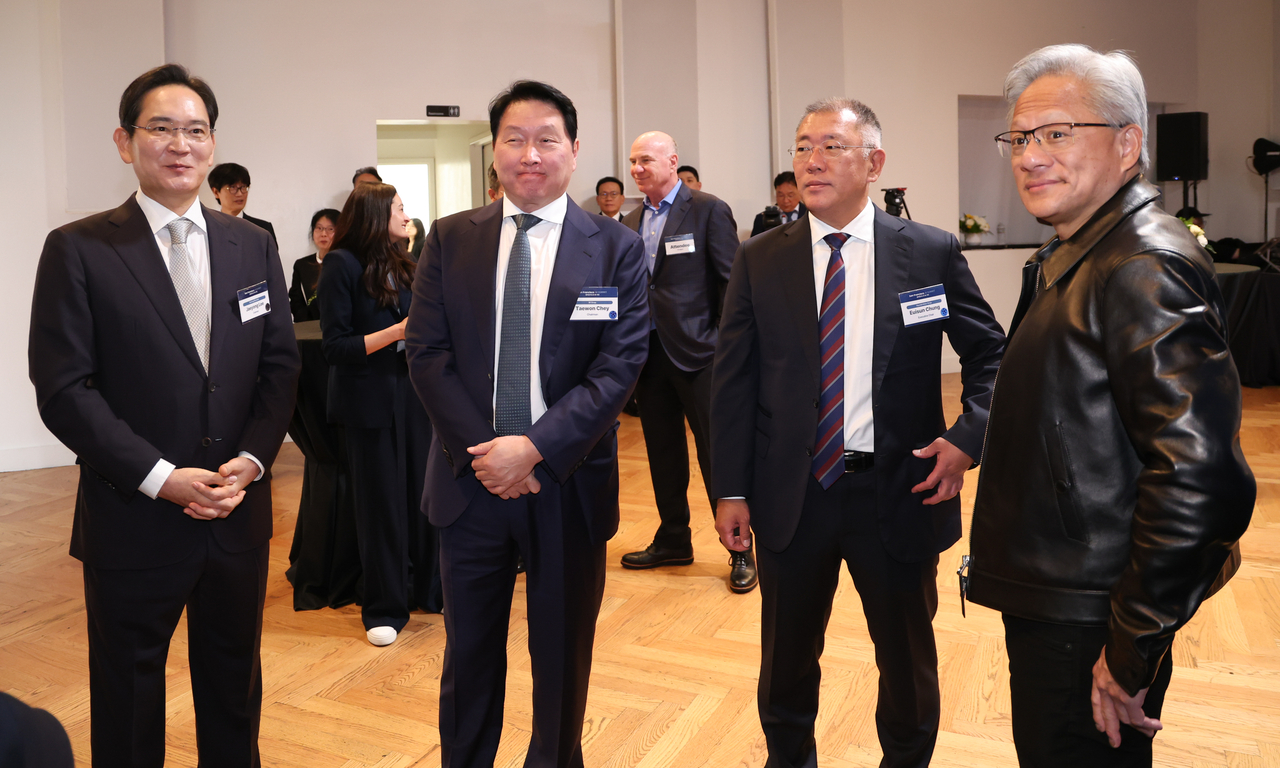
Samsung Electronics and SK Hynix have agreed to pursue semiconductor cooperation worth a combined $950 billion over five years with major Big Tech companies, striking the deals in San Francisco — the epicenter of the AI revolution.
Semiconductors are widely regarded as the heart of the AI industry, and analysts say South Korea is drawing more global attention than ever, given that these two companies together supply the vast majority of the world's AI chips, including high-bandwidth memory (HBM).
President Lee Jae Myung on Saturday unveiled the "San Francisco AI Declaration," laying out a vision for South Korea as a core nation in the global AI supply chain. The move signals his determination to further strengthen the competitiveness of South Korea's world-class semiconductor industry.
▶Samsung Electronics Chairman Lee Jae-yong used the San Francisco AI Summit to lift the competitiveness and growth potential of the company's core businesses — spanning memory chips, foundry services and enterprise generative AI — by a full notch, industry observers say.
According to industry sources Monday, Lee met in rapid succession with leading global AI players in Silicon Valley on Friday and Saturday — including Nvidia, Broadcom, OpenAI and Anthropic — to consolidate Samsung's position in the memory chip business while exploring opportunities to expand its foundry operations.
Samsung is the only company in the world with integrated capabilities across memory, foundry and advanced packaging, and industry observers say Lee made full use of that advantage. The meetings are seen as helping ease concerns about a potential peak in the memory cycle while positioning Samsung for long-term growth across its entire semiconductor business.
In particular, the $200 billion mega-partnership with fabless chip designer Broadcom is seen as a springboard for additional cooperation with other Big Tech companies down the line.
OpenAI and Anthropic — both of which Lee met during the trip — are also Samsung Electronics memory chip customers and potential foundry partners. OpenAI had already pledged a memory-and-foundry alliance following a meeting between Lee and CEO Sam Altman in South Korea in October last year.
Anthropic, best known for its generative AI model Claude, is also in discussions with Samsung's foundry division about producing AI chips using a 2-nanometer process. The company has been deepening its ties with Samsung more broadly, including signing a strategic partnership with Samsung SDS to identify new AI business opportunities in South Korea.
▶SK accelerates all-fronts AI cooperation with Nvidia=SK Group will pursue advanced memory chip supply cooperation worth a total of $750 billion over the next five years with global Big Tech companies including Nvidia — a sweeping collaboration covering AI memory, AI factories and data centers.
SK reached agreements on Friday at the San Francisco AI Summit to cooperate with Nvidia, Microsoft and Anthropic on AI infrastructure.
SK Group and Nvidia agreed to pursue comprehensive cooperation to build AI infrastructure worth more than $500 billion, covering everything from AI factory construction to AI memory supply. The two companies signed a letter of intent to that effect. SK Telecom will receive next-generation graphics processing units (GPUs) from Nvidia to build South Korea's largest AI factory, with a capacity of 2 gigawatts (GW).
SK Telecom plans to build the AI factory in stages starting next year, deploying Nvidia's DSX platform — its full-stack AI factory architecture — and introducing the next-generation AI computing system "Vera Rubin," equipped with SK Hynix's HBM4, the sixth-generation high-bandwidth memory chip. SK Hynix will supply AI memory to Nvidia on a long-term basis.
SK Hynix also reached a long-term memory supply agreement with Microsoft, with both sides agreeing to supply server memory optimized for AI workloads to Microsoft's data centers over the medium to long term. SK Telecom and Anthropic signed a comprehensive MOU to cooperate on building a gigawatt-scale AI data center in South Korea.
▶The success of the government's "AI Top 3" strategy hinges on how quickly South Korea can translate its world-class manufacturing competitiveness into strength in AI infrastructure and services, analysts say.
South Korea holds roughly 80 percent of the HBM market, effectively dominating the core memory segment of the AI chip sector. Process and sensor-control technologies accumulated over many years in electronics, telecommunications and manufacturing have fed directly into AI patents, building up a vast intellectual property portfolio. South Korea's competitive edge could become even more pronounced when the era of "physical AI" — centered on factory equipment and robots — fully arrives.
Yet South Korea still lags significantly behind US Big Tech in GPUs, the core of AI computation, and in the massive infrastructure needed to connect it all. With Nvidia dominating the GPU market, companies such as Microsoft, Google and Amazon are pouring tens of trillions of won to around 100 trillion won ($68.2 billion) annually into building AI data centers. By contrast, the AI investment scale of South Korea's leading companies — including Naver, LG Group's AI research institute and Upstage — remains in the trillions of won, a significant gap in scale.
Unlike the United States, which funnels AI services to the world through Google Search, Apple's iPhone and social media platforms such as Facebook, South Korea faces the additional challenge of an AI ecosystem largely confined to a Korean-language domestic market.
Spreading AI adoption across industry is just as important as developing cutting-edge technology. Key indicators from the OECD and other bodies show that AI adoption among South Korean companies is rising steeply, but small and medium-sized enterprises with fewer than 250 employees still trail major economies such as Germany and Ireland. Many are struggling with digital transformation due to data standardization challenges and high upfront costs.
joze@heraldcorp.com
keg@heraldcorp.com