![The yen exchange rate is displayed on a board at Hana Bank's dealing room in Jung-gu, Seoul, on Thursday, when the yen fell to its lowest level in about 40 years. On Sunday, the yen entered the 163-per-dollar range in New York foreign exchange trading — its weakest level since December 1986, marking a 39-year, seven-month low. [Yonhap]](https://wimg.heraldcorp.com/news/cms/2026/07/27/rcv.YNA.20260723.PYH2026072316770001301_P1.jpg)
"Get inflation up to 2 percent."
That was the Bank of Japan's defining mandate 13 years ago. To escape a prolonged deflationary spiral, the central bank flooded the economy with money — and when prices still refused to rise, it pushed interest rates into negative territory. It took more than a decade to build a Japan where prices actually go up.
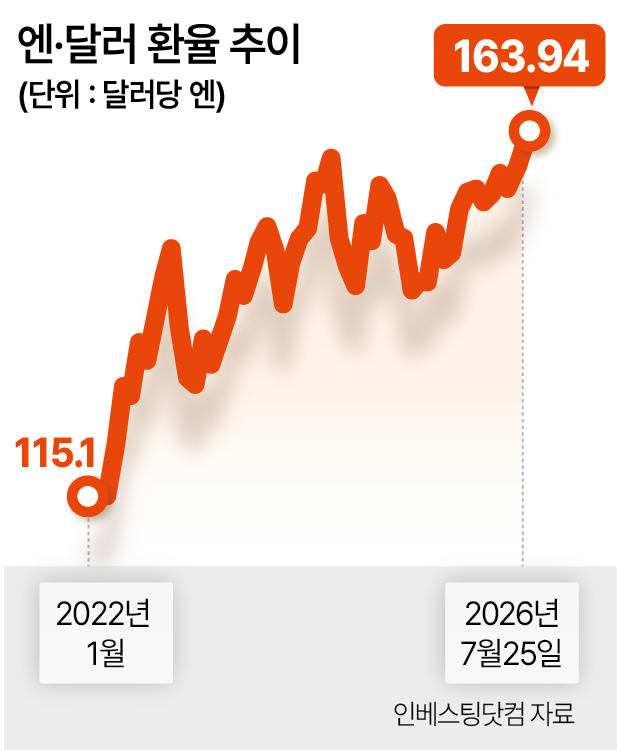
Now the BOJ's dilemma has flipped. The yen has fallen to its lowest level in 40 years, and Middle East-driven oil prices are surging on top of that, raising the risk that import prices will spike again. With Japanese companies passing higher costs on to consumers faster than ever, a new consensus is forming inside the BOJ: the priority is no longer pushing inflation up, but keeping it stable near 2 percent.
The BOJ's monetary policy meeting Thursday through Friday is widely expected to hold the benchmark interest rate at the current 1 percent. But market attention has already shifted to the next quarter-point move. If yen-driven price pressures persist, there is growing speculation that an additional rate hike — originally expected around December — could be brought forward to before October.
BOJ's 2% inflation goal took 13 years — now the worry has reversed
The BOJ formally adopted its 2 percent price stability target in January 2013, at a time when Japan was struggling to shake off years of deflation and sluggish growth.
Haruhiko Kuroda, who took over as BOJ governor that April, launched what became known as quantitative and qualitative easing. The unprecedented program involved large-scale government bond purchases that expanded the monetary base by 60 trillion to 70 trillion yen ($428 billion) a year, with the goal of hitting the 2 percent inflation target within roughly two years.
That fight against deflation, meant to last two years, dragged on for more than a decade.
In 2016, the BOJ cut its benchmark interest rate to minus 0.1 percent. That same year it introduced yield curve control, in effect capping the 10-year government bond yield. The aim was to encourage businesses and households to spend, creating a virtuous cycle in which wages and prices would rise together.
![A Japanese flag flies atop the Bank of Japan headquarters in central Tokyo. The photo was taken June 16, 2025. [AFP]](https://wimg.heraldcorp.com/news/cms/2026/07/27/rcv.YNA.20260717.PAF20260717128201009_P1.jpg)
The turning point came after COVID-19. Global supply chain disruptions and Russia's invasion of Ukraine sent raw material prices surging, and inflation finally began to take hold in Japan. As wage growth followed, the BOJ last year began a full-scale normalization of monetary policy.
Last month it raised the benchmark interest rate from 0.75 percent to 1 percent — the highest level since 1995, a span of 31 years. Yet even as rates rose, the yen moved in the opposite direction.
The yen weakened to 163.98 per dollar on Thursday, its lowest level in about 40 years since November 1986. As of 3:40 p.m. Friday it stood at 163.94, closing in on the 164 threshold.
What worries the BOJ is less the exchange rate number itself than the channel through which a weak yen feeds into prices.
Japan imports the vast majority of its energy, including crude oil and natural gas. The weaker the yen, the more Japanese companies pay in local currency for the same volume of imports.
On top of that, the conflict involving Iran has pushed international oil prices higher. Japan is effectively absorbing both a rise in dollar-denominated oil prices and a fall in the yen's value at the same time.
In June, Japan's crude oil import volume fell 13.7 percent from a year earlier — yet the value of those imports jumped 59.3 percent. Total import value hit a record 11.3 trillion yen. Japan was not buying more oil; higher prices and a weaker yen simply inflated the bill.
The more significant shift is in how companies are responding. According to an economic white paper the Japanese government released on Thursday, Japanese companies have been passing higher costs on to consumer prices faster since the recent Middle East conflict than they did after Russia's invasion of Ukraine in 2022.
For years, Japanese companies had a strong tendency to absorb rising costs rather than raise prices, fearing customers would walk away. Even when raw material costs climbed, it took considerable time for those pressures to reach the final consumer price.
That pattern is now breaking down. Years of rising prices and wages together have lowered the psychological barrier to price increases. Japan is becoming an economy where raising prices in response to higher costs is simply the norm.
For the BOJ, this is a double-edged sword. The "economy where prices rise" it spent so long trying to create has finally arrived — but now external shocks like a weak yen or a sudden spike in oil prices can feed through to consumer prices far more quickly than before.
Weak yen → import prices → consumer prices: is a rate hike to 1.25% coming sooner?
Looking at consumer prices alone, it is difficult to say Japan is experiencing serious inflation.
Japan's core consumer price index — excluding fresh food — rose 1.6 percent year-on-year in June, falling short of the BOJ's 2 percent target for the fifth consecutive month.
But different signals are emerging at the production stage. Wholesale prices, which reflect business-to-business transaction prices, rose 7.1 percent year-on-year in June — the highest rate since March 2023.
The BOJ must look beyond the current 1.6 percent reading to what lies ahead. If the costs building up at the production stage — driven by a weak yen and high oil prices — flow through to consumer prices via faster corporate pass-throughs, the inflation picture could change quickly.
That is why some BOJ officials believe that as underlying inflation approaches 2 percent, the central bank's role must also evolve.
In the past, the BOJ's greatest fear was prices falling again — the deflationary trap in which companies refused to invest no matter how low rates went, wages stagnated, and consumers put off purchases expecting goods to be cheaper tomorrow than today.
Now the central bank must manage the risk on the other side as well. If a weak yen and rising global oil prices combine with faster corporate price pass-throughs, inflation could accelerate beyond the BOJ's projections.
Financial markets have begun pricing in this shift. Markets had originally expected the BOJ to raise rates at roughly six-month intervals. A Bloomberg survey conducted ahead of last month's rate hike showed about 70 percent of economists forecast that pace, pointing to the next hike around December.
But with the yen approaching 164 per dollar, that calculus has changed. The overnight index swap market now prices in roughly a 72 percent probability of an additional BOJ rate hike by October — suggesting a move to 1.25 percent could come sooner than expected.
![US Treasury Secretary Scott Bessent. [EPA]](https://wimg.heraldcorp.com/news/cms/2026/07/27/news-p.v1.20260722.6dd7d77a3e08472a88a9e859bf3d0c24_P1.jpg)
The United States is also lending weight to the BOJ's monetary policy normalization.
In its semiannual currency report released Thursday, the US Treasury kept Japan on its currency monitoring list and detailed the yen's depreciation at length. The yen has fallen 51 percent against the dollar in both real effective exchange rate and bilateral terms from late 2011 through the end of April this year.
The Treasury particularly noted that "yen weakness has persisted even as the US-Japan interest rate differential has narrowed," and went on to say that the BOJ's monetary policy normalization would help stabilize inflation expectations and reduce excessive exchange rate volatility.
sjy@heraldcorp.com