Consumer expectations for apartment price increases this month hit their highest level in nearly five years, ahead of the government's planned real estate policy announcement. The data suggests more consumers believe housing prices will keep rising despite government measures and monetary tightening.
According to the Bank of Korea's July 2026 Consumer Sentiment Survey released Tuesday, the composite consumer sentiment index (CCSI) rose 0.2 points from the previous month to 106.8. The index fell for two consecutive months in March and April amid the fallout from the Iran war, but has climbed for three straight months since June, driven largely by strong semiconductor-led export performance.
"Despite a deterioration in perceived economic conditions due to falling share prices and rising inflation, consumer sentiment rose for three consecutive months on the back of strong exports and investment centered on semiconductors, as well as expectations of wage increases," said Lee Heung-hu, head of the Bank of Korea's economic sentiment survey team.
The CCSI is a composite indicator of consumer sentiment toward economic conditions. It is calculated using six consumer trend indices (CSI) — current living standards, living standards outlook, household income outlook, consumer spending outlook, current economic assessment and future economic outlook. A reading above 100 indicates consumer sentiment is more optimistic than the long-term average, while a reading below 100 signals pessimism.
Among the key sub-indices, the current living standards CSI fell 1 point to 93, weighed down by persistently high inflation and declining share prices. "Stock price declines and other factors had a negative effect on consumer sentiment this month, but consumers' optimistic outlook continues as the CCSI remains above its long-term average and has risen for three consecutive months," Lee said.
The household income outlook CSI rose 1 point to 101, supported by wage increase expectations. The future economic outlook CSI held steady at 92, unchanged from the previous month. The Bank of Korea attributed this to upward revisions in growth forecasts by major institutions on the back of favorable semiconductor industry conditions, even as renewed Middle East tensions heightened economic concerns.
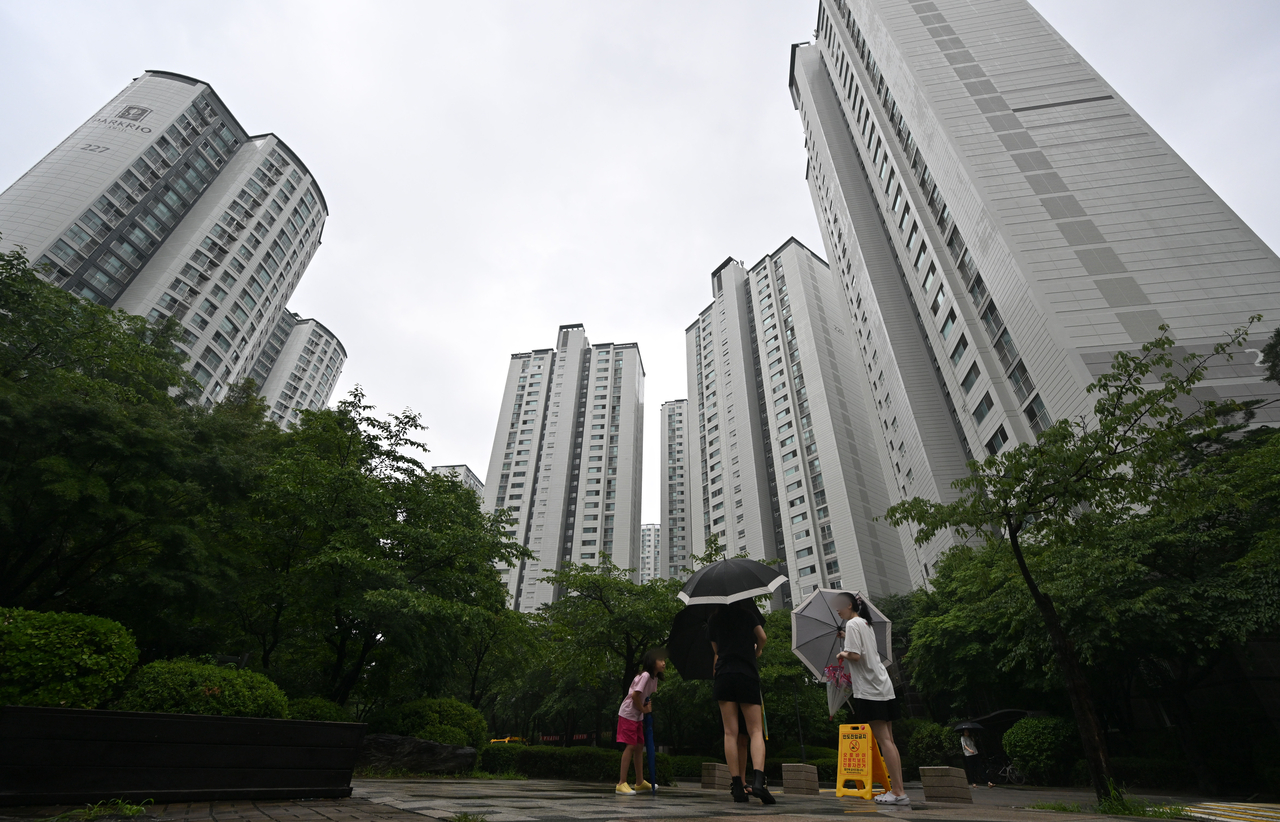
The housing price outlook CSI surged 7 points to 127, driven by continued rises in apartment sale and jeonse prices in Seoul and Gyeonggi Province. A reading above 100 means more consumers expect housing prices to rise than those who do not. After falling from 124 in January to 96 in March, the index has climbed for three consecutive months to reach its highest level since September 2021, when it stood at 128 — a gap of four years and 10 months.
"The recent broadening of housing price gains has influenced consumers' housing price outlook," Lee said. "Loan interest rates have risen with monetary tightening and commercial banks are cutting lending limits — we need to watch how this affects housing price sentiment with a lag."
The government is set to announce a comprehensive real estate package covering supply, financing and taxation. Market attention is focused on how strictly jeonse loan regulations will be applied to non-resident single-home owners. Prime Minister Han Seong-sook, speaking Monday at a public forum on real estate policy hosted by the Korea Chamber of Commerce and Industry, said the housing issue "must be resolved" and described it as "a difficult task that requires listening carefully to the diverse concerns of each citizen and finding common ground."
The one-year ahead expected inflation rate — consumers' forecast for consumer price growth over the next year — came in at 2.7 percent, down 0.1 percentage point from the previous month as domestic fuel prices fell and the won's weakness eased. The three-year ahead expected inflation rate fell 0.1 percentage point to 2.6 percent, while the five-year ahead figure held steady at 2.6 percent.
kimstar@heraldcorp.com