![[Created using ChatGPT]](https://wimg.heraldcorp.com/news/cms/2026/07/28/news-p.v1.20260728.9aa7057676d64039b27f3379a8202af1_P1.png)
Nearly 120,000 financially vulnerable borrowers shut out of licensed moneylender loans last year are estimated to have turned to illegal private lending, with the total amount borrowed reaching as much as 1.55 trillion won ($1.06 billion). As the government's tightened debt service ratio regulations raised borrowing barriers across the formal financial sector, ultra-low-credit borrowers — crowded out by those with relatively better credit scores — appear to have been driven into illegal lending markets outside the regulated system.
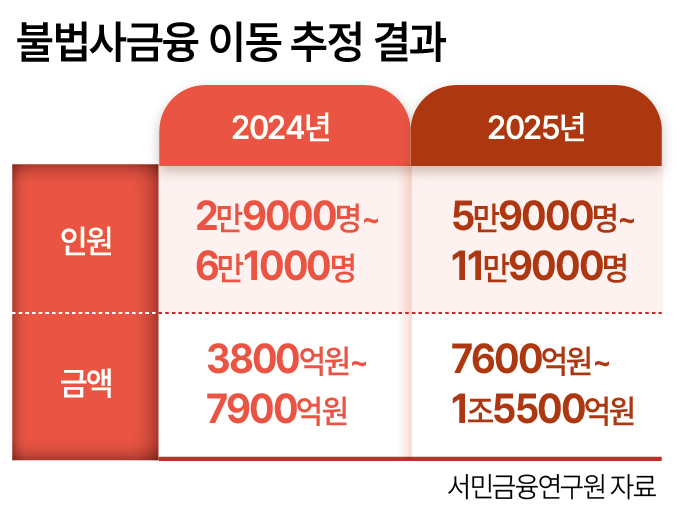
According to a survey report on low-credit borrowers released Tuesday by the Korea Finance Institute for People, an estimated 59,000 to 119,000 low-credit individuals who had used licensed moneylenders last year subsequently moved to illegal private lenders. The institute said the wide estimated range reflects the fact that the survey was conducted remotely, as low-credit borrowers tend to avoid responding or conceal information due to psychological concerns about credit information exposure and the stigma associated with their financial status.
The total amount borrowed through illegal private lending by this group is estimated at between 600 billion and 1.55 trillion won — nearly double the figures recorded in 2024, when an estimated 29,000 to 61,000 people borrowed between 380 billion and 790 billion won through such channels.
The Korea Finance Institute for People attributed the surge to a balloon effect rippling across the broader lending market. As stricter DSR regulations and other government measures raised the bar for loans at first-tier banks, borrowers with relatively better credit scores migrated to second-tier financial institutions and licensed moneylenders. As a result, ultra-low-credit borrowers who had previously relied on moneylenders — the last resort of the low-income lending system — were pushed out even from that option and into illegal private lending.
The number of applicants who approached licensed moneylenders — either migrating from the formal financial sector or seeking new loans — surged 38.7 percent in 2025 to 860,000, up from 620,000 in 2024. With more applicants competing for the same pool of funds, the loan approval rate for borrowers in the bottom 50 percent of individual credit scores fell 0.5 percentage point from the previous year to 9.1 percent.
As the formal financial sector exhausted its capacity to absorb marginal borrowers, the rate of migration to illegal private lending rose sharply — from 5.2 percent in 2024 to 7.5 percent in 2025, the institute said.
Jo Seong-mok, president of the Korea Finance Institute for People, said the number of low-credit borrowers who moved from licensed moneylenders to illegal private lenders nearly doubled last year in both headcount and volume, adding that this "suggests that illegal lending users are experiencing severe financial distress and significant additional cost burdens." He warned that driving low-income households into a market where interest rates average more than 500 percent annually "causes enormous harm to individuals and society as a whole."
The rejection rate for loan applications at licensed moneylenders stood at 59.4 percent. Among those rejected, more than half — 50.7 percent — were ultimately unable to secure alternative funding.
The failure to obtain funds is translating into psychological and behavioral crises among vulnerable borrowers. Some 45.6 percent of those who failed to secure financing said they had "lost the will to live, including experiencing worsening depression." Among borrowers in their 20s, more than four in 10 — 41.7 percent — said they would "find money even through dishonest means," suggesting that young people facing financial distress are at heightened risk of exposure to crime or dangerous behavior.
The problem of borrowers unwittingly falling into illegal lending because they cannot distinguish licensed moneylenders from illegal operators was also flagged as serious. Among illegal lending users, 49.1 percent said they did not know the lender was unlicensed at the time of borrowing — more than double the 22.3 percent recorded two years earlier. In fact, 55.8 percent of respondents said they could not tell a licensed moneylender from an illegal lender based on the business name alone.
By far the most commonly reported harm from illegal private lending was excessive interest charges exceeding the legal cap of 20 percent, cited by 35.1 percent of respondents.
However, while the share of excessive interest complaints declined in percentage terms, reports of "relentless illegal debt collection" (17.5 percent) and "disclosure of debts to family members, acquaintances or other third parties" (14.0 percent) surged. This indicates that illegal lenders are resorting to increasingly predatory collection tactics — including privacy violations and intimidation — beyond simply charging high interest rates.
Jo said that "a significant number of those unable to access licensed moneylenders turn to illegal private lending, and these debt problems are also spilling over into family conflict and the breakdown of trust," adding that it is urgent to build a post-rejection counseling and financial safety net that automatically connects borrowers to policy finance programs, debt restructuring, and welfare and self-sufficiency support.
The survey covered 977 low-credit borrowers — those with credit ratings of 6 to 10 — who had used or were currently using licensed moneylenders or illegal private lenders within the past three years.
ehkim@heraldcorp.com