![A Hyundai WIA researcher conducts an air-conditioning system test at the company's thermal management testing facility in Uiwang, Gyeonggi Province. [Hyundai WIA]](https://wimg.heraldcorp.com/news/cms/2026/07/28/news-p.v1.20250725.1a46755978804b64b61624d9bb220b83_P1.jpg)
Hyundai WIA plans to invest 1.7 trillion won ($1.16 billion) over the next three years to reinvent itself from an engine-parts maker into a thermal management and robotics company. Having already sold its machine tool business, the company is now considering restructuring its defense portfolio as well to fund the push — with a goal of lifting new businesses' share of total sales from 3 percent today to 21 percent by 2034.
According to industry sources, Hyundai WIA plans to invest about 1.7 trillion won in new businesses — including integrated thermal management systems and mobility solutions — from this year through 2028. That works out to an annual average of 566.3 billion won, roughly 69 percent more than the 335.8 billion won annual average invested between 2023 and 2025. After concentrating front-loaded investment during this period, the company intends to bring its annual investment down to around 300 billion won from 2029 onward.

Hyundai WIA laid out its investment priorities in detail during a second-quarter earnings conference call on Friday. The company will channel more than 1 trillion won into its integrated thermal management business to build overseas production bases and electric compressor mass-production lines, while expanding research and development of next-generation thermal management technology. About 400 billion won will go toward robotics and manufacturing and logistics automation — covering smart manufacturing and logistics, integrated control systems, and smart parking. The company is also reviewing equity investments in AI and software firms.
Through these efforts, Hyundai WIA aims to raise the share of new businesses — thermal management, robotics and automation — in total sales from the current 3 percent to 7 percent by 2028, 14 percent by 2031, and 21 percent by 2034.
![A demonstration vehicle featuring Hyundai WIA's future air-conditioning system on display at CES 2026 in Las Vegas. [Hyundai WIA]](https://wimg.heraldcorp.com/news/cms/2026/07/28/news-p.v1.20260106.17b31e760778437ab17994a20dffd3d1_P1.jpg)
Thermal management systems are the growth engine Hyundai WIA has identified as central to riding the electric vehicle boom. The company plans to scale its thermal management production capacity from 300,000 units this year to 500,000 in 2027 and 1 million by 2028 — more than tripling output in just three years since it began mass production last year. It is also preparing a mass-production line for electric compressors, a key component in EV thermal management systems.
The thermal management business is already growing rapidly. Hyundai WIA's thermal management sales in the second quarter surged 305.1 percent year-on-year, driven by higher air-conditioning volumes. Overall second-quarter sales rose 8.0 percent to 2.35 trillion won, though operating profit fell 10.6 percent to 50.4 billion won, weighed down by upfront investment and early operating costs in the thermal management business as well as a decline in production volumes from Russia.
The company is currently expanding overseas production bases and order volumes simultaneously. Hyundai WIA began mass-producing coolant modules at its Slovak subsidiary this year and is preparing to produce air-conditioning systems for internal combustion engine and hybrid vehicles in India.
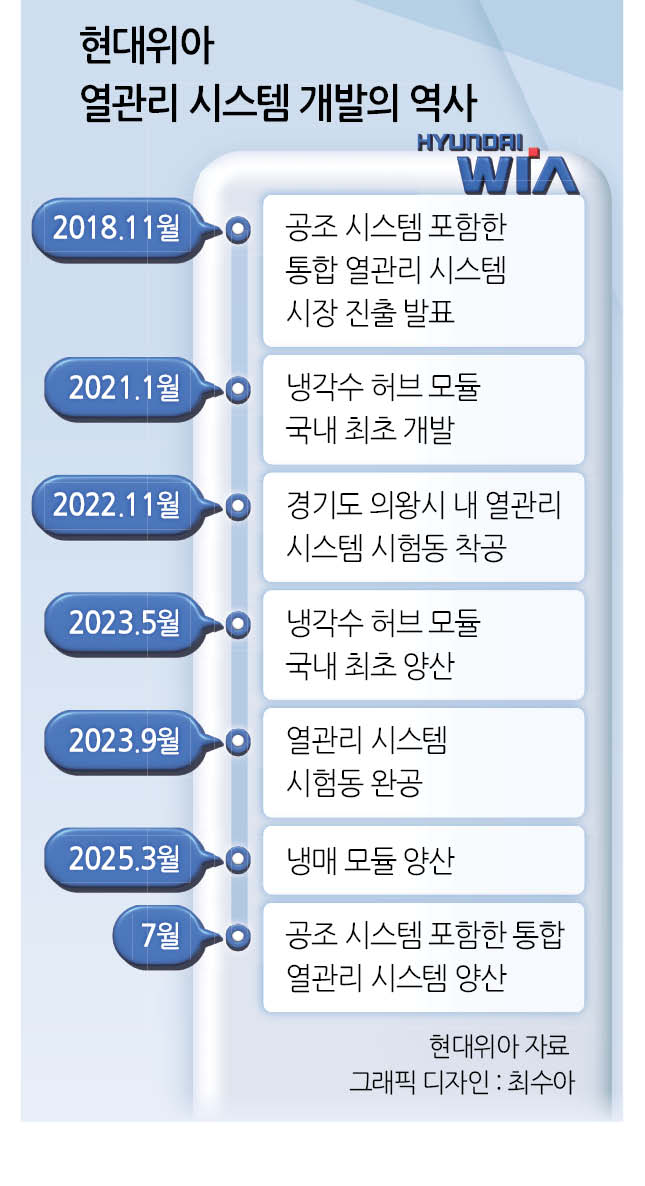
Hyundai WIA currently supplies thermal management products for Kia's purpose-built vehicle, the PBV PV5. Starting next year, it plans to expand air-conditioning system supply to the PV7 and the SX3, the successor to the Hyundai Motor Kona. In 2028, the company will supply thermal management products for software-defined vehicles it has already secured orders for, and will also pursue orders for Hyundai Motor Group's next-generation EV-dedicated EM platform.
![Hyundai WIA's integrated thermal management module unveiled at CES 2026 in Las Vegas. [Hyundai WIA]](https://wimg.heraldcorp.com/news/cms/2026/07/28/news-p.v1.20260107.bd69971bb6b9472ea0487b1a607f4ef0_P1.jpeg)
Securities analysts project Hyundai WIA's thermal management sales — about 50 billion won last year — will reach 100 billion won this year and up to 250 billion won next year. From 2028, when major order volumes move into full mass production, the fixed-cost burden is expected to ease, raising the likelihood of the business reaching breakeven.
Hyundai WIA aims to expand beyond supplying individual air-conditioning components into a full-service integrated thermal management company, targeting a place among the global top three by 2031. The company also plans to increase R&D investment to develop next-generation heating and cooling technologies, including AI-powered distributed air-conditioning systems.
Over the medium to long term, Hyundai WIA has set a target of handling 30 percent of all thermal management orders and 50 percent of EV thermal management orders placed within Hyundai Motor Group — an aggressive goal given that its current in-group supply share remains in the single digits.
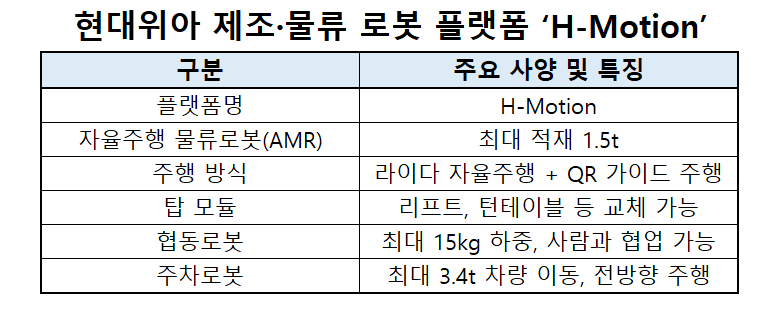
On the robotics side, Hyundai WIA is focusing on factory and logistics automation rather than developing its own humanoid robots. Drawing on experience gained from participating in the construction of Hyundai Motor Group's Singapore Global Innovation Center and its HMGMA plant in Georgia, the company plans to expand its "AI factory" systems integration business, which connects and centrally manages robots and logistics equipment on the factory floor.
The plan is to link industrial, collaborative and logistics robots into a single system and apply AI-based integrated control to automate production and logistics processes. The company is also pursuing a smart parking integration business that combines parking robots, parking facility design, EV charging and fire-response monitoring.
With Hyundai Motor Group set to build large-scale production and research hubs in the Saemangeum area and the Yeongnam region, Hyundai WIA sees growing opportunities to win robotics and logistics automation orders. Beyond automotive plants, the company aims to broaden its customer base to general manufacturing and overseas automaker logistics markets.
![A parking robot lifts and moves an SUV during a demonstration event held last year at Hyundai WIA's research center in Uiwang, Gyeonggi Province. [Hyundai WIA]](https://wimg.heraldcorp.com/news/cms/2026/07/28/news-p.v1.20251110.ffeab6d9db6b45978fb4414e23993d3a_P1.jpg)
Hyundai WIA plans to fund the investment through the sale of non-core businesses. Having sold its machine tool business for about 340 billion won last year, the company is now reviewing options for further portfolio restructuring, including its defense business. Securities analysts estimate the defense unit's sale value at between 370 billion won and 880 billion won.
Hyundai WIA expects the profitability of its thermal management business to improve after 2028, when mass production of major order volumes ramps up and fixed-cost pressure eases. Jang Moon-su, an analyst at Hyundai Motor Securities, said whether the company can translate its business restructuring — including a potential defense unit sale — into a concrete group growth strategy centered on thermal management and robotics will be the key driver of its share price. He added that beyond smart manufacturing, logistics and parking solutions, the company needs to expand into higher-value-added segments within its robotics strategy.
kwater@heraldcorp.com