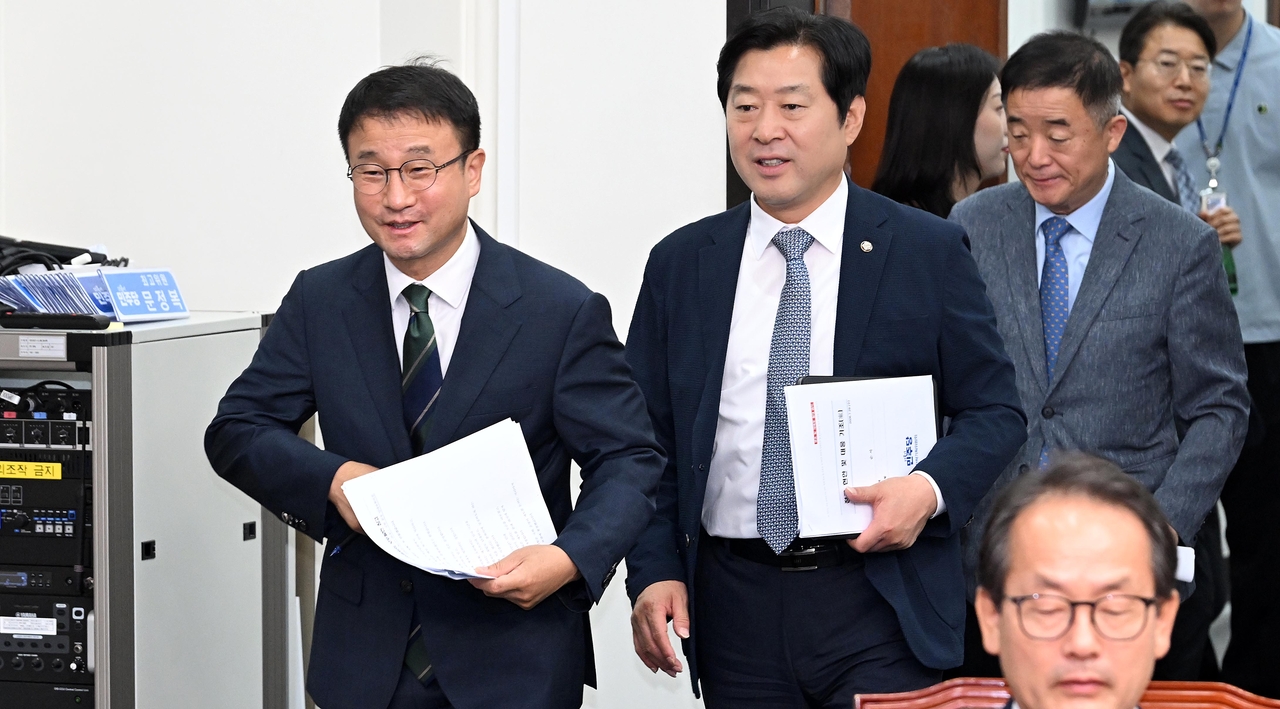
The Democratic Party of Korea has signaled it will push through amendments to the Criminal Procedure Act abolishing prosecutors' supplementary investigation powers, as well as a revision to the National Assembly Act shortening the fast-track review period, while the People Power Party has vowed to use every procedural tool available — including a filibuster — to block the legislation.
The Democratic Party is preparing to counter by shortening the July extraordinary session, leveraging its ruling bloc's more than 180 seats, setting the stage for an intense legislative battle over the bills' passage in a plenary vote.
Rep. Seo Yeong-gyo of the Democratic Party, who chairs the National Assembly's Legislation and Judiciary Committee, said Wednesday on SBS Radio that the Criminal Procedure Act amendment would be taken up at a full committee meeting Wednesday morning and sent to a plenary session Thursday.
The Legislation and Judiciary Committee convened a full meeting Wednesday to vote on the Criminal Procedure Act amendment, which the ruling party had pushed through a subcommittee Tuesday. The bill's core provision bans prosecutors from conducting direct investigations, including supplementary investigations. Instead, prosecutors could request that judicial police officers carry out supplementary investigations, which police would be required to complete within two months. Prosecutors could also demand reinvestigation of cases that police declined to refer, and victims, complainants and accusers could file objections.
PPP members of the Legislation and Judiciary Committee boycotted Tuesday's subcommittee vote and held a press conference Wednesday morning, denouncing what they called the Democratic Party's "legislative rampage" in abolishing supplementary investigation powers, which they said would "tear down the last judicial safety net for the public." The PPP also plans to submit a request to form an agenda-coordination committee — a body composed of three lawmakers from each side that deliberates on contested bills for up to 90 days. Critics note, however, that the mechanism could be rendered meaningless if the opposition-designated seats are filled by pro-government lawmakers from parties such as the Rebuilding Korea Party.
The Democratic Party also plans to pass a National Assembly Act amendment at Thursday's plenary session that would shorten the maximum fast-track review period from 330 days to 90 days.
The National Assembly's Management Committee cleared the bill at a subcommittee meeting Tuesday and placed it on the agenda for a full committee meeting Wednesday. Under current law, fast-tracked bills undergo review for up to 180 days in a standing committee, 90 days in the Legislation and Judiciary Committee, and 60 days on the plenary floor. The amendment would cut those periods to 60 days in a standing committee, 30 days in the Legislation and Judiciary Committee, and immediate scheduling for a vote at the first plenary session after referral.
Han Byung-do, the Democratic Party's acting leader and floor leader, said at a supreme council meeting Wednesday that the revision was meant to "correct the contradiction of bills taking nearly a year to pass and to reform a system that has already lost its purpose back to its original intent." He added that "the PPP's repeated boycotts and foot-dragging are precisely why institutional reform is needed to keep the National Assembly functioning on time."
The PPP plans to respond with a filibuster. The party solicited sign-ups from lawmakers wishing to participate Tuesday and notified members to remain on standby within the Assembly grounds through midnight Friday.
Meanwhile, the Democratic Party is considering shortening the July extraordinary session — currently scheduled to run through Aug. 4 — to Friday, which would automatically end any filibuster.
The move is seen as taking into account the schedule of the Democratic Party's regional primary elections for its leadership convention, which begin Saturday. Ending a filibuster requires approval from at least three-fifths of all sitting lawmakers, but changing the session length requires only a simple majority. Once a session expires, any ongoing filibuster ends automatically, and a vote must be held at the first plenary session of the next session.
addressh@heraldcorp.com
thanks@heraldcorp.com