![An aerial view of the Raemian One Bailey apartment complex in Banpo-dong, Seocho-gu, Seoul. [Herald DB]](https://wimg.heraldcorp.com/news/cms/2026/07/30/news-p.v1.20241226.85d04be952c645fbb4376dade08fdd12_P1.jpg)
"Home prices have risen a lot, so they're telling me to pay more tax — but when I bought this place more than a decade ago, I never expected prices to climb this high, and I haven't cashed out any gains," said a woman in her 40s living in Seocho-gu, Seoul, who asked to be identified only by her surname, A. "I guess I'll have to set aside 2 million won ($1,380) every month, like paying rent."
With a tax reform package targeting high-value homes, multi-home owners and single-home owners who do not live in their properties set to be announced soon, simulations show that applying the surcharge rate of the comprehensive real estate tax — known as jongbusae — to owners of two or fewer homes could increase the tax burden on ultra-luxury properties in Gangnam, Yongsan and Seongsu-dong by roughly 30 to 80 percent. On top of that, if the fair market value ratio is raised above the current 60 percent, the taxable base itself would expand, pushing the actual increase even higher.
According to related ministries and the real estate industry Thursday, the government is reviewing a plan to apply the same surcharge rate currently imposed on owners of three or more homes to those holding two or fewer.
Under current law, owners of two or fewer homes and those of three or more homes face the same maximum rate of 1 percent on taxable bases up to 1.2 billion won ($828,000). Above that threshold, the rates diverge: for taxable bases between 1.2 billion and 2.5 billion won, the rates are 1.3 percent and 2.0 percent, respectively; between 2.5 billion and 5 billion won, 1.5 percent and 3.0 percent; between 5 billion and 9.4 billion won, 2.0 percent and 4.0 percent; and above 9.4 billion won, 2.7 percent and 5.0 percent. The government intends to eliminate the distinction by number of homes and apply the higher surcharge rate uniformly.
Acro Seoul Forest owner's bill jumps from 95.64 million to 173.88 million won; two-home owners also face varying increases
If the surcharge rate is extended to owners of two or fewer homes, property tax burdens — combining the comprehensive real estate tax and the standard property tax — are expected to rise sharply in high-value residential areas including Gangnam and other parts of Seoul. Single-household owners with a publicly assessed home value of 3.2 billion won (market value of roughly 4.6 billion won), the threshold at which the taxable base exceeds 1.2 billion won, would begin to face the surcharge.
A simulation commissioned from Hong Ja-young, a tax consulting manager at Woori Bank's WM Business Strategy Division, found that if the surcharge is applied, comprehensive real estate tax bills on ultra-luxury apartments in Banpo, Samseong and Seongsu-dong would rise by anywhere from several million to tens of millions of won.
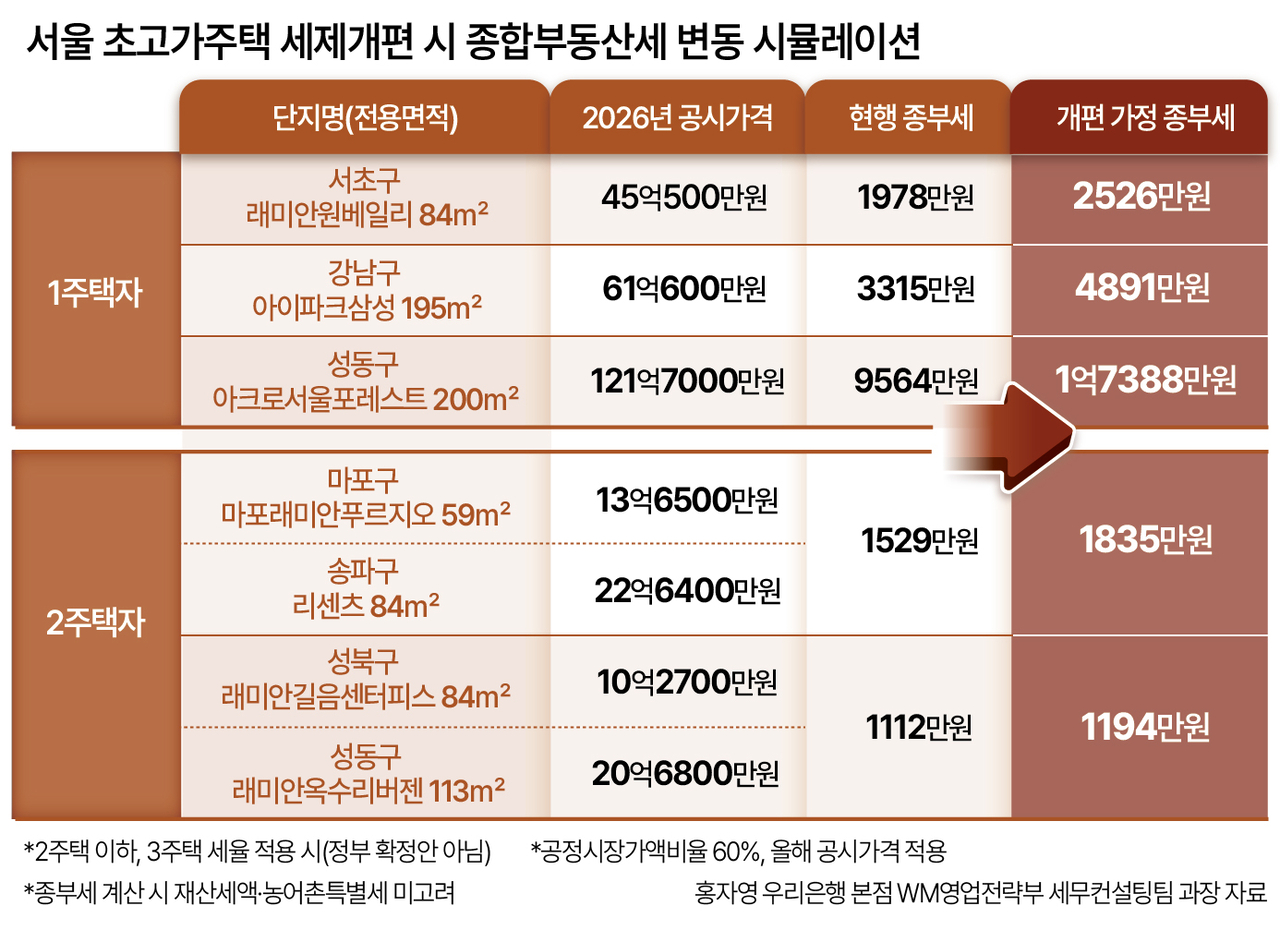
A single-home owner holding an 84-square-meter unit at Raemian One Bailey in Banpo-dong, Seocho-gu would see their comprehensive real estate tax bill rise about 30 percent — from 19.78 million won to 25.26 million won — under the reform. The simulation is based on this year's publicly assessed value of 4.505 billion won and a fair market value ratio of 60 percent; if next year's assessed value increases are factored in, the bill would climb even higher than 25.26 million won.
For a single-home owner of a 195-square-meter unit at Ipark Samseong in Samseong-dong, Gangnam-gu — publicly assessed at 6.106 billion won — the tax would rise from 33.15 million won to 48.91 million won, an increase of about 16 million won, or 47.5 percent. The 200-square-meter unit at Acro Seoul Forest in Seongsu-dong, Seongdong-gu carries a publicly assessed value of 12.17 billion won; under the surcharge, its comprehensive real estate tax would surge from 95.64 million won to 173.88 million won — a jump of about 78 million won, or 81.8 percent.
Two-home owners would also see varying increases depending on the combined publicly assessed value of their properties. An owner holding a 59-square-meter unit at Mapo Raemian Prugio in Ahyeon-dong, Mapo-gu and an 84-square-meter unit at Ricenz in Jamsil-dong, Songpa-gu would face a 20 percent increase, with their bill rising from 15.29 million won to 19.35 million won. A two-home owner with a combined assessed value of about 3.1 billion won — holding an 84-square-meter unit at Raemian Gireum Centerpiece in Gireum-dong, Seongbuk-gu and a 113-square-meter unit at Raemian Oksu Rivergen in Oksu-dong, Seongdong-gu — would see a more modest increase of 7.4 percent, from 11.12 million won to 11.94 million won.
Value over volume: Government shifts to asset-based system, with fair market value ratio set to rise
The government's push to restructure the comprehensive real estate tax around property value rather than the number of homes owned stems from a judgment that owners of multiple low-value homes are paying more tax than owners of a single high-value home. Officials believe this distortion has fueled the preference for owning one premium property — a phenomenon widely described in Korea as "one solid home" investing.
At a national public forum on real estate policy chaired by President Lee Jae-myung on Thursday, Kang Seong-hun, a professor of public policy at Hanyang University who led the session on taxation, said the current system creates an imbalance. "Under the current regime, if you compare one home worth 3 billion won with three homes worth 1 billion won each, the single-home owner faces a lower tax rate," he said. "From the standpoint of tax equity, we should apply rates based on the value of the homes held, not the number."
![A real estate agency in the Gangnam area of Seoul on Wednesday. [Yonhap]](https://wimg.heraldcorp.com/news/cms/2026/07/30/rcv.YNA.20260729.PYH2026072916460001300_P1.jpg)
In addition to extending the surcharge to owners of two or fewer homes, the government is also examining a plan to raise the fair market value ratio to 70 percent for single-home owners and 80 percent for multi-home owners. The taxable base is calculated by subtracting the basic deduction — 1.2 billion won for single-home owners and 900 million won for multi-home owners — from the publicly assessed value, then multiplying by the fair market value ratio. A higher ratio would therefore push actual tax bills well beyond the figures shown in the simulation. However, in light of recent home price increases, the government plans to raise the basic deduction for single-home owners from 1.2 billion won to 1.4 billion won.
Separate from the goal of achieving tax equity and curbing the preference for a single premium property, concerns have also been raised that higher tax burdens could ultimately destabilize the lease market.
Kim In-man, director of the Kim In-man Real Estate Economic Research Institute, said heavier taxes on non-resident single-home owners and multi-home owners could be passed on to tenants. "The jeonse and monthly rent market is already unstable, and if the tax burden is tightened, measures to protect tenants need to be put in place at the same time," he said. He added that policymakers should also distinguish among those subject to higher property taxes. "Someone who recently bought a home for 5 billion won has the financial capacity to absorb the higher holding tax," he said. "But someone who bought a home for 500 million won 20 years ago and saw it rise to 5 billion won through reconstruction may not have enough cash on hand."

hwshin@heraldcorp.com