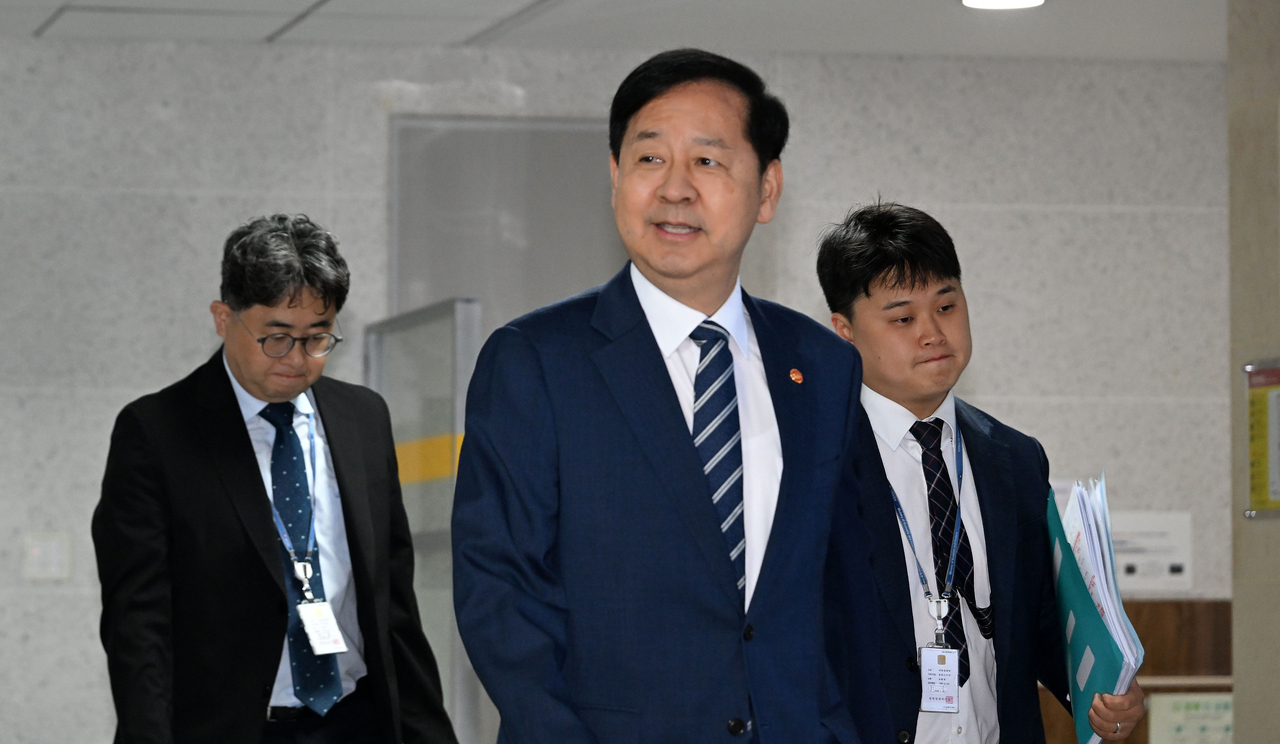
The Democratic Party of Korea and the government held a closed-door party-government meeting Thursday morning at the National Assembly members' office building in Seoul, conducting final consultations on the second-half tax reform package — including real estate-related taxes — ahead of its planned announcement in early August.
The Democratic Party sent Han Byung-do, the party's acting leader and floor leader, along with policy committee chair Han Jeong-ae and lawmakers from the relevant standing committee, the National Assembly's Finance and Economy Planning Committee. The government was represented by Deputy Prime Minister and Minister of Economy and Finance Koo Yun-cheol and tax bureau chief Jo Man-hee, among others.
The most contentious issue in the second-half tax reform package is a proposed increase in the property holding tax. President Lee Jae Myung had directly raised the possibility of a hike at a public forum on real estate policy on July 23, saying, "If we had normalized the property holding tax in the past, prices would not have risen this far," and adding that rates would need to rise "at least threefold" to reach the level typical of advanced countries.
Attendees left immediately after the meeting without disclosing any specifics. Oh Gi-hyeong, the ruling party's floor whip on the Finance and Economy Planning Committee, told reporters only that "there will be no additional party-government consultations."
Political circles expect the property tax overhaul to focus on differentiation based on home prices and ownership purpose, rather than a uniform rate increase.
Among the options under serious consideration is raising the basic deduction threshold for the comprehensive real estate tax on single-home households — currently set at a publicly assessed value of 1.2 billion won ($828,000) — to reduce the number of taxpayers subject to the levy, while imposing a heavier burden on ultra-high-priced properties. Under the current system, the comprehensive real estate tax is calculated by adding up the publicly assessed values of all homes owned, subtracting the basic deduction — 1.2 billion won for single-home owners and 900 million won for multi-home owners — and applying the tax rate to the remainder.
Within the Democratic Party, however, voices have emerged warning that supply-side real estate measures are needed. Observers note the concern is not unrelated to the June 3 local elections, in which voters in Seoul's Gangnam three districts and the Han River belt — areas sensitive to real estate issues — swung heavily toward the People Power Party. Song Yeong-gil, a candidate in the ongoing party leader primary, also criticized the approach, saying, "It's been a year in power — we need to focus on housing supply. How can you rein in real estate by just hitting it with taxes and financial regulations?"
Meanwhile, Deputy Prime Minister Koo, at a Finance and Economy Planning Committee briefing at the National Assembly on Wednesday, was asked by People Power Party lawmaker Lee Jong-wook whether it had not been President Lee Jae Myung's campaign pledge not to use taxes to control home prices. Koo said "the Lee Jae Myung government does not use real estate taxation to control home prices," and added that the purpose of the tax reform plan is to normalize real estate transactions and stabilize the market.
bigroot@heraldcorp.com
sunpine@heraldcorp.com