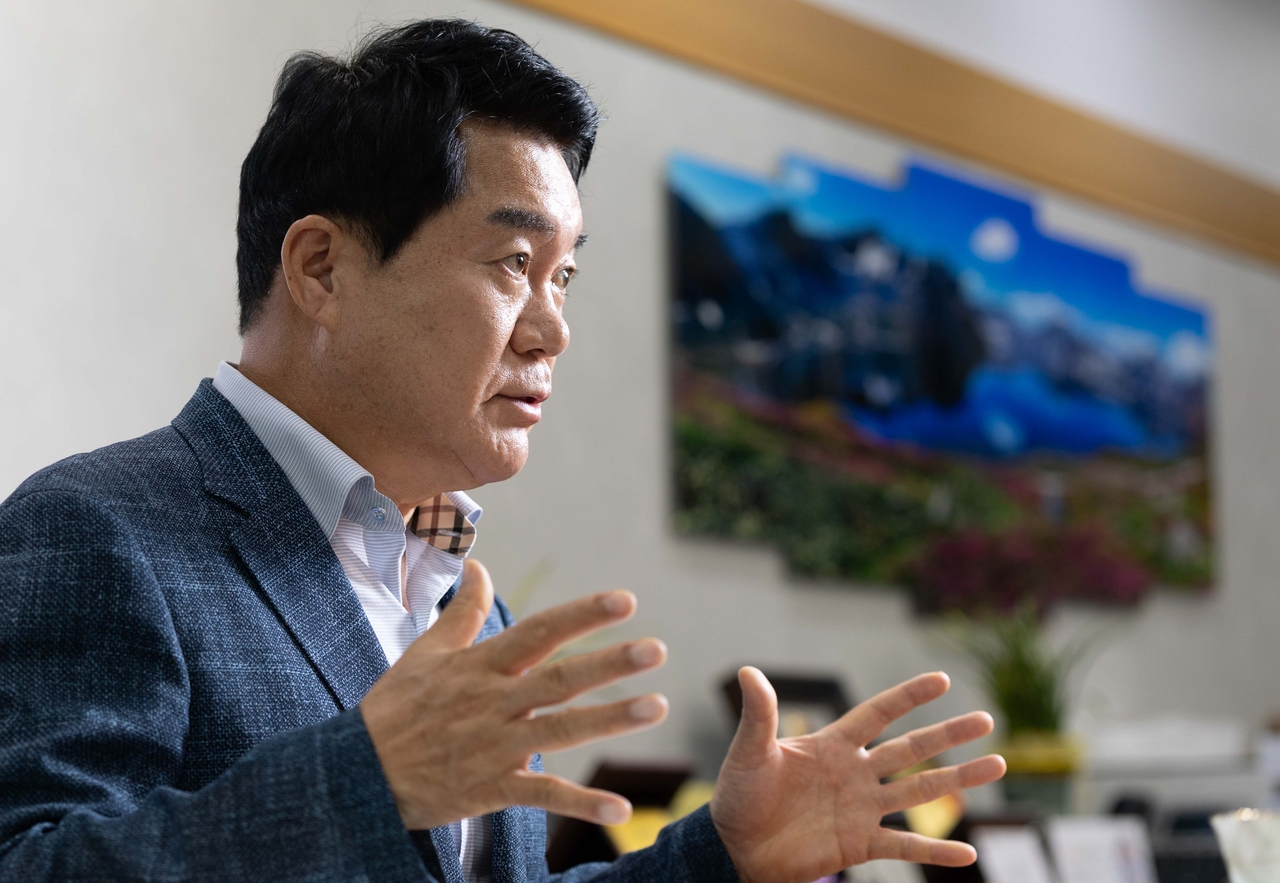
"I will turn all of Gwanak-gu into a garden and raise the city's brand value."
Gwanak-gu District Mayor Park Jun-hee has long pursued a vision of "a Gwanak where flowers and trees greet you when you open a window and water flows through the streets," steadily expanding healing spaces within the urban landscape. Gwanaksan — once blighted by illegal structures, industrial waste and household garbage — now hosts 24 dedicated healing spaces, including a hydrangea garden and a park golf course. The Dorimcheon stream has been reborn as the ecological waterway "Byeolbit Naerin-cheon" and become a local landmark. In his third term, Park plans to take that transformation further with the "Gwanaksan Sky Forest Trail Project."
Youth policy is another defining pillar of his administration. Gwanak-gu was the first basic local government in the country to establish a dedicated youth policy division (in 2018) and a youth culture bureau (in 2022), and political circles have credited the district with laying the groundwork for the central government's current push to create a minister-level youth affairs ministry. For his third term, Park is taking youth policy a step further with a "youth participatory budget quota system." "I will focus on positioning youth as the architects of policy, not merely its recipients," he said, "and I will give young people direct authority over budget execution." The Herald Business sat down with Park on July 21 to hear his blueprint for his third term. The following is an edited transcript of the interview.
— You were re-elected by a margin of more than 20 percentage points, becoming Gwanak-gu's first three-term district mayor.
▶ I see it as both an affirmation of what we have accomplished and a solemn mandate from residents to press forward without wavering toward a greater future for Gwanak. I will not rest on past achievements. I will begin this third term with an even deeper sense of responsibility, honoring the trust and expectations our residents have placed in us.
— Gwanak-gu recently ranked first in the government's joint performance evaluation, the only autonomous district in Seoul to achieve the top rating for four consecutive years.
▶ I see it as meaningful recognition of the policies we have consistently pursued to improve residents' quality of life, and as proof once again of Gwanak-gu's administrative capacity and policy-execution ability.
— What are your goals and governing priorities for your third term?
▶ Continuing from my second term, the core goal of my third term is "a Gwanak-gu where everyone thrives together." We will carry out the six major objectives and 58 tasks approved by the policy planning committee. The total budget required is 1.49 trillion won ($1.04 billion). Of that, 77.5 percent will be concentrated in the "sustainable and safe healing-garden city" category. I am determined to deliver on the promise of "Gwanak's great leap forward — the completion of a greater Gwanak."
— How will the "healing-garden city" vision develop?
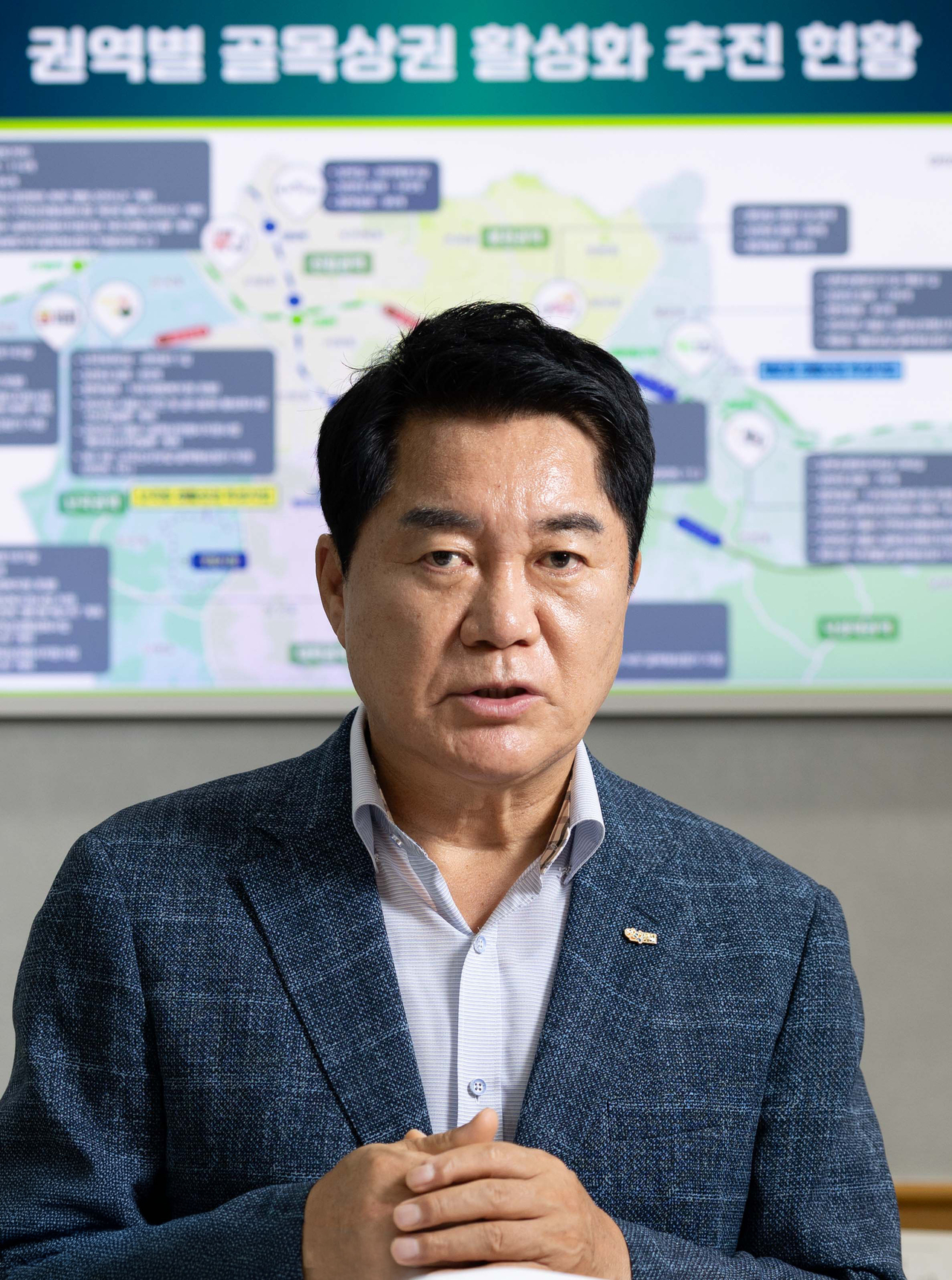
▶ In my third term, I intend to push ahead in earnest with the Gwanaksan Sky Forest Trail Project to complete the healing-garden city vision. We will connect 24 specialized parks into a single green corridor, building an urban green welfare network that every resident can enjoy. The plan is to create a "sky forest trail" stretching 22.88 kilometers from Sadang Station through Gwanaksan, a nature recreation forest and on to Nangok Intersection, targeting completion in 2030. We will transform Gwanaksan from a mountain you simply look at into one you walk through — from a passing backdrop into a destination where people linger. Alongside this, we are on track to establish Seoul's first nature recreation forest in the southern part of the city on Gwanaksan, targeting completion in 2028.
— Why did you adopt the "healing-garden city" concept?
▶ Some people say pursuing a healing-garden city is wasteful or a misuse of the budget. Road resurfacing driven by depreciation is spending that disappears without a trace. Planting flowers, planting trees, transforming forests — that becomes an asset. Seongdong-gu built Seoul Forest well, and apartment values around it rose. I want to raise the city's brand value through gardens and let residents feel genuine happiness when they see them. In the United Kingdom, doctors sometimes prescribe 30 hours in a garden as part of treatment for depression and other mental health conditions. In four years, I want all of Gwanak-gu to be a garden — and to raise the value of this city through that.

— Gwanaksan has been drawing large numbers of visitors as one of Seoul's most prominent hiking destinations.
▶ We are building a "Gwanaksan full course" that goes beyond a simple one-time hike, giving visitors a reason to stay after they descend — dining, festivals and performances. Centered on the main hiking routes, we are developing distinct commercial identities for each area: the Sadang and Namhyeon zone as a "restorative gourmet district," the Nakseongdae and Seoul National University entrance zone as a "local hip-stay" hub anchored by Sharosugil, and the Sillim and Nokdu zone as a "starlight waterfront food and festival" space linked to Byeolbit Naerin-cheon. Around Byeolbit Naerin-cheon and Euddeum Park, we are also expanding cultural programming — youth busking, outdoor sculpture exhibitions and musical fountains.
— You have established a rapid-support task force for redevelopment and reconstruction projects, reporting directly to you. What was the thinking behind that?
▶ In the field, insufficient coordination on infrastructure often leads to project-plan revisions or litigation, and disputes over zone boundaries — such as access roads — and the process of reconciling competing resident interests frequently cause delays. Getting ahead of these issues and resolving problems quickly at each stage required reorganizing the structure.
— Doesn't that also require cooperation from the Seoul Metropolitan Government?
▶ It is a problem when redevelopment and reconstruction projects drag on for 15 or 20 years. In Seongnam, Osan and Gwangmyeong, urban planning decisions are not made at the Gyeonggi Province level — permits are handled at the basic local government level. Seoul, citing concerns about uncontrolled development, has taken full control of all redevelopment and reconstruction projects. In Gwanak-gu alone, 32 projects are currently under way. Across all of Seoul, the number exceeds 560. Delays are inevitable. Through the Seoul district mayors' council, I will formally request that the Seoul Metropolitan Government adopt a realistic approach to purchasing rental housing and transfer permit authority over projects of fewer than 500 units to the autonomous districts.
— Gwanak-gu has the highest proportion of young residents of any district in the country. You must have a particular reaction to the central government's push to establish a minister-level ministry dedicated to youth affairs.
▶ Honestly, it felt like something I had been waiting for, and I was genuinely grateful. We have been consistently urging the central government to create a dedicated ministry. I raised it repeatedly when I met with then-Prime Minister Kim Min-seok as well. Establishing a dedicated youth ministry is a calling of the times — it is about breaking down the silos between ministries and ensuring continuity in youth policy. Gwanak-gu is the country's largest youth city, with young people making up 41.7 percent of the population, and I am confident we can work alongside the central government to advance sustainable youth policy in step with this change.
— How will youth policy change in your third term?
▶ In my third term, I will focus on positioning youth as the architects of policy, not merely its recipients. Youth policy must move beyond simple support — young people need to participate as genuine agents of that policy. Gwanak already has a "youth network" and a "youth policy committee," and the policies they propose account for nearly 50 percent of what we incorporate into district governance. We will pursue a youth participatory budget quota system — where young people deliberate and allocate funds directly — along with a committee-level youth quota system and a youth-proposal accountability system. In particular, through the youth participatory budget quota system, I want young people to be the ones who shape policy, not simply the ones it is shaped for.
— Are you saying you will give young people not just a role in policymaking but actual authority over budget execution?
▶ That is correct. I want young people to participate as independent agents — to build the policies themselves and to have a say in how the budget is allocated.
cook@heraldcorp.com