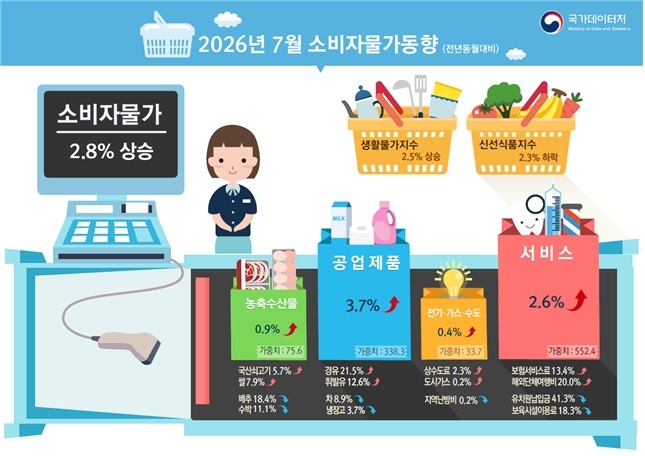
South Korea's consumer price inflation slowed to 2.8% in July, returning to the 2% range for the first time in three months.
Stabilizing global oil prices helped ease the pace of petroleum product increases, but energy costs — including diesel and gasoline — remained elevated. Prices for some food items such as green onions, rice and eggs continued to climb sharply.
The Ministry of Statistics released its July 2026 consumer price trends report Tuesday, showing the consumer price index at 119.77 (base year 2020=100), up 2.8% from the same month last year. Inflation had run at 3.1% in May and 3.2% in June before easing into the 2% range in July.
Core inflation, which excludes food and energy, rose 2.6% year-on-year, while the index excluding agricultural products and petroleum products gained 2.5%. The lifestyle price index rose 2.5%, while the fresh food index fell 2.3%.
Among individual categories, petroleum products posted sharp year-on-year gains — diesel rose 21.5%, kerosene 20.5% and gasoline 12.6%. In agricultural, livestock and fishery products, green onions led with an 18.3% increase, followed by imported beef (up 8.7%), rice (7.9%), eggs (7.5%), mackerel (7.0%) and domestic beef (5.7%). Prices fell for napa cabbage (down 18.4%), zucchini (15.9%), cucumber (13.8%), watermelon (11.1%) and radish (10.8%).
Service prices rose 2.6% from a year earlier. Personal services climbed 3.5% and rent 1.1%, while dining-out prices advanced 2.6%, maintaining an elevated level.
fact0514@heraldcorp.com