As the government prepares to phase in a 2026 tax reform plan that raises the property tax burden on ultra-luxury homes, non-resident single-home owners and multi-home owners, property tax bills — combining the comprehensive real estate holding tax and property tax — for homes with a publicly assessed value of 4 billion won ($2.8 million) or more are set to jump 40 to 70 percent from current levels. Because the same tax rates will apply based on home value regardless of location, owners of high-priced apartments in metropolitan cities such as Busan and Daegu will also fall within the scope of the targeted tax measures. Even among homes with the same assessed value, the gap in tax increases is expected to widen significantly depending on whether the owner actually lives in the property.
According to the Ministry of Economy and Finance and the real estate industry, the tax reform package the government announced Monday includes four key changes: adjustments to the basic deduction for the comprehensive real estate holding tax — set at 1.4 billion won for owner-occupiers of a single home, 900 million won for non-residents, and 400 million won plus a portion of 500 million won based on the share of owner-occupied housing for multi-home owners; a gradual phase-out of the tiered tax rate system based on the number of homes owned, along with a rate increase for the 600 million to 1.2 billion won taxable base bracket; a rise in the fair market value ratio from 60 to 70 percent; and an increase in the property tax burden cap from 150 to 200 percent. The measures are designed to ease the holding tax burden on genuine end-users while significantly tightening it for non-residents and owners of ultra-luxury or multiple properties.
Acro River Park owner-occupier: 32.23 million → 45.77 million won; non-resident with 5 billion won assessed value faces 80% surge
As a result, property tax bills for single-home owners in high-priced districts such as Gangnam and Yongsan-gu are expected to rise by hundreds of thousands to tens of millions of won. The comprehensive real estate holding tax rate will increase gradually from next year through 2028, and the basic deduction will also be adjusted based on whether the owner resides in the property.
A simulation commissioned from tax accountant Ko Yu-bin, head of Saebyeok Tax Accounting, on how property taxes for high-priced homes in Seoul and regional cities would change under the reform plan found that an owner-occupier of an 84-square-meter unit at Acro River Park in Banpo-dong, Seocho-gu, Seoul — with a publicly assessed value this year of 4.59 billion won — would see their property tax bill rise from the current 32.23 million won (calculated at an 80 percent deduction rate) to 39.56 million won next year (under a cap of 8 million won).
Although the comprehensive real estate holding tax rate will transition gradually from next year through 2028 based on the length of ownership and residency, the simulation does not apply the ownership and residency components. Even so, as the deduction cap is lowered for higher-priced homes — 8 million won in 2027 and 6 million won from 2028 onward — the property tax bill for the same assessed value will surge to 45.77 million won by 2028. The property tax component remains unchanged at 12.06 million won, but the comprehensive real estate holding tax rises sharply under the reform from 20.17 million to 27.5 million to 33.71 million won.
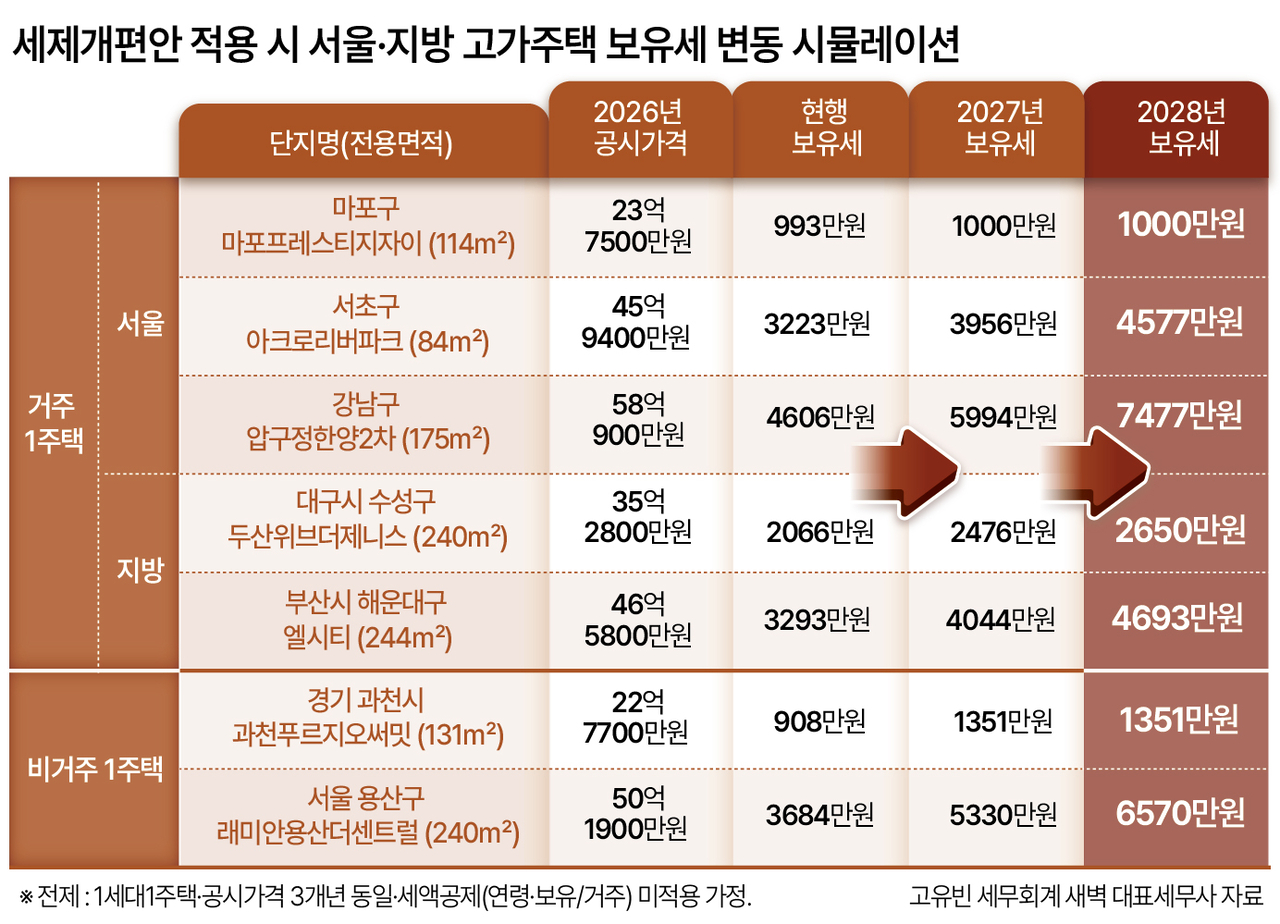
An owner-occupier of a 175-square-meter unit at Apgujeong Hanyang 2-cha in Apgujeong-dong, Gangnam-gu — with a publicly assessed value of 6 billion won — will see their comprehensive real estate holding tax jump 62 percent from current levels by 2028. Their property tax bill this year stands at 46.06 million won, rising to 59.94 million won next year and 74.77 million won the year after, an increase of nearly 30 million won.
For an owner-occupier of a 114-square-meter unit at Mapo Prestige Xi in Yeomni-dong, Mapo-gu — with a publicly assessed value of 2.38 billion won — the property tax bill will barely move, going from the current 9.93 million won to 10 million won in 2027 and remaining at 10 million won in 2028. This reflects the increase in the basic deduction for owner-occupying single-home owners from 1.2 billion to 1.4 billion won; for owner-occupiers with assessed values roughly in the 2 billion to the mid-3 billion won range, the tax burden is expected to decrease slightly or remain largely unchanged.
For non-resident single-home owners, however, the tax increase is steeper even at the same assessed value. An owner of a 131-square-meter unit at Gwacheon Prugio Summit in Gwacheon, Gyeonggi Province — the top-tier complex in the area, with a publicly assessed value of 2.28 billion won, comparable to the Mapo Prestige Xi — who lives elsewhere will see their property tax bill surge 48.8 percent, from the current 9.08 million won to 13.51 million won by 2028.
The same applies to non-resident owners of ultra-luxury single homes. An owner who purchased a 240-square-meter unit at Raemian Yongsan The Central in Hangang-ro 2-ga, Yongsan-gu — with a publicly assessed value of 5.02 billion won — and rents it out will face a property tax bill that climbs from 36.84 million won this year to 53.3 million won next year and ultimately to 65.7 million won, a final increase of 78.3 percent.
"Non-resident single-home owners are the group bearing the heaviest burden under this reform, as their basic deduction has been cut to 900 million won," Ko said. "They will likely consider exit strategies that account for the tax burden, such as converting to owner-occupancy, selling or shifting to a rental arrangement."
Regional ultra-luxury homes also in the crosshairs — Busan's LCT: 32.93 million → 46.93 million won
Because the same taxable base and rates apply based on home value regardless of location, ultra-luxury homes in regional cities with publicly assessed values in the upper mid-3 billion won range and above will also face a sharply higher property tax burden.
The publicly assessed value this year of a 240-square-meter unit at Doosan We've the Zenith in Beomeo-dong, Suseong-gu, Daegu — the top-tier complex in the area — stands at 3.53 billion won. For an owner-occupier, the property tax bill will rise 28.3 percent, from the current 20.66 million won to 24.76 million won in 2027 and 26.5 million won in 2028.
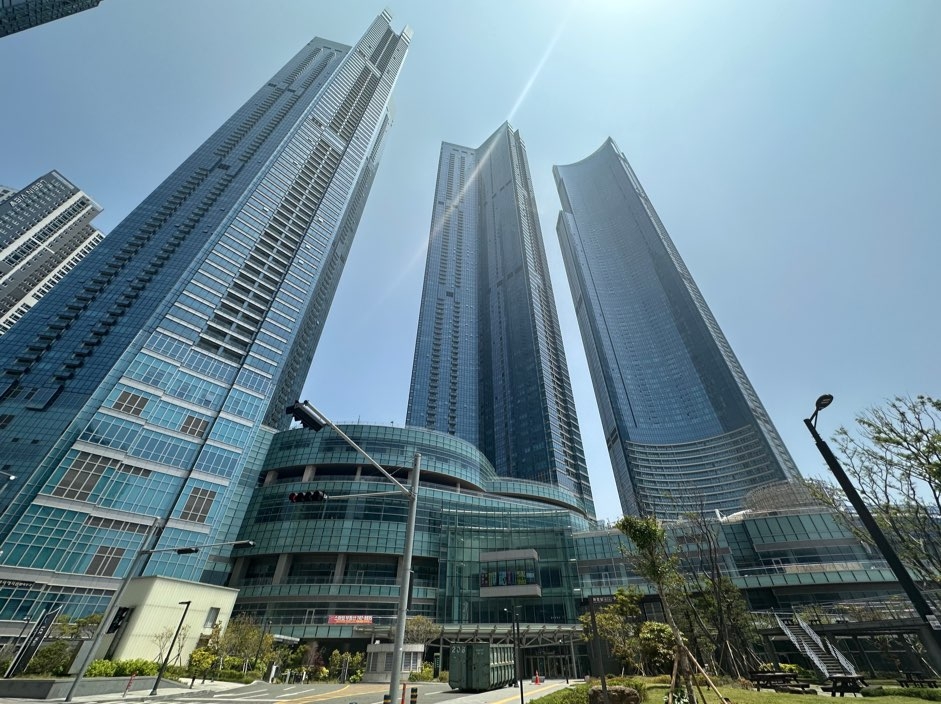
An owner-occupier of a 244-square-meter unit at LCT, a mixed-use residential complex in Jungdong, Haeundae-gu, Busan — with a publicly assessed value of 4.65 billion won — will also see their property tax bill jump 42.5 percent over the same period, from 32.93 million to 40.44 million to 46.93 million won.
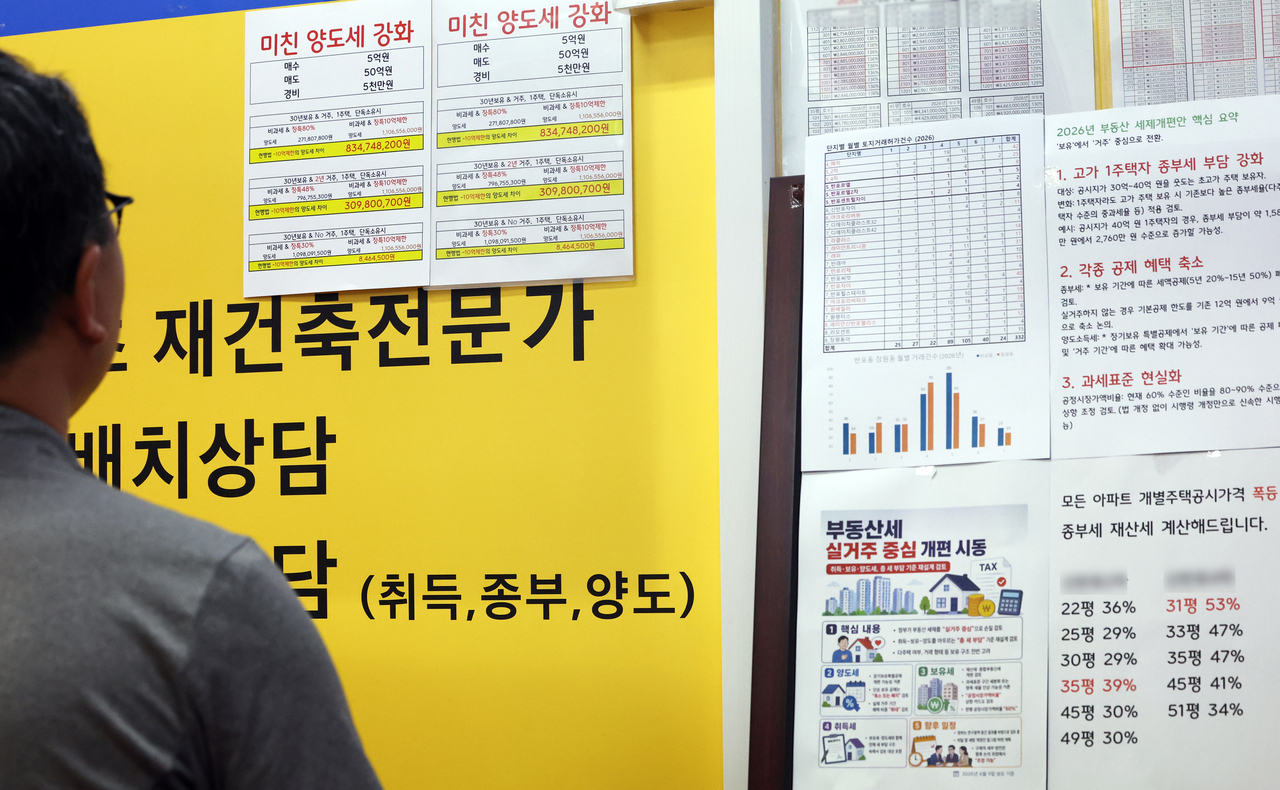
These simulation results are based on this year's publicly assessed values, and actual property tax burdens could rise further depending on future changes in home prices or increases in the assessed-value realization rate.
Experts say the higher property taxes could prompt some older homeowners and multi-home owners to put properties up for sale, but for high-priced homes in Seoul's core districts, the combination of asset scarcity and expectations of price appreciation makes it unlikely that a heavier tax burden alone will drive owners to sell.
"Properties in Seoul's core areas are not interchangeable assets like ordinary investments, so the likelihood of owners in high-demand areas such as Gangnam selling purely because of the tax burden is limited," said Yang Ji-young, a senior adviser at Shinhan Premier Pathfinder. "If anything, a significant number of owners are likely to opt for converting to owner-occupancy, making gifts, or simply holding on to the property."
Some experts also argue that separate tax relief measures are needed for ultra-luxury homes in regional cities, which are now subject to the same assessment standards as properties in the Greater Seoul area.
"The comprehensive real estate holding tax reform was designed around home value rather than location, even though regional real estate markets are relatively sluggish, meaning ultra-luxury homes in regional cities now face the same rate increases as those in Gangnam," said Nam Hyeok-woo, a real estate researcher at Woori Bank. "While some relief is available for lower- and mid-priced homes and multi-home owners in regional areas — such as a relaxed fair market value ratio for single- and two-home owners and special benefits for regional second homes — no such relief applies to ultra-luxury homes in regional cities that happen to carry a high assessed value. It is worth considering whether some degree of relief should be extended to them as well, taking regional conditions into account."
hwshin@heraldcorp.com