![Samsung Electronics began mass production last month of the PM1763, a PCIe 6.0-based enterprise SSD optimized for AI infrastructure. [Samsung Electronics]](https://wimg.heraldcorp.com/news/cms/2026/08/04/rcv.YNA.20260708.PYH2026070801350001300_P1.jpg)
NAND flash memory, long overshadowed by the DRAM boom, posted strong profitability in the second quarter, and analysts expect favorable market conditions to persist as domestic and foreign manufacturers remain reluctant to expand capacity.
Chipmakers are channeling resources into research and development of next-generation, high-performance and high-capacity products aimed at AI demand, shifting the competitive battleground in the NAND market from a capacity race to a technology contest.
Japan's Kioxia signaled continued caution on capital expenditure during its fiscal first-quarter (April–June) earnings call on July 31, saying "strengthening technological advantage takes priority over expansion" and pledging to concentrate investment on performance improvements, power efficiency and quality.
Kioxia has budgeted about 450 billion yen ($2.86 billion) in capital expenditure for fiscal 2026 and plans to hold annual spending at roughly 470 billion yen over the next three years, even as AI-driven NAND demand rises.
Kioxia, which counts NAND as its core business, forecast that supply shortages would persist beyond next year and that NAND prices would continue to climb. The company also set a target of securing 50 percent of its 2028 shipments through long-term supply agreements.
According to market research firm TrendForce, Kioxia held a 13.9 percent share of the NAND market in the first quarter of this year, ranking third behind Samsung Electronics at 31.6 percent and SK hynix at 17.6 percent.
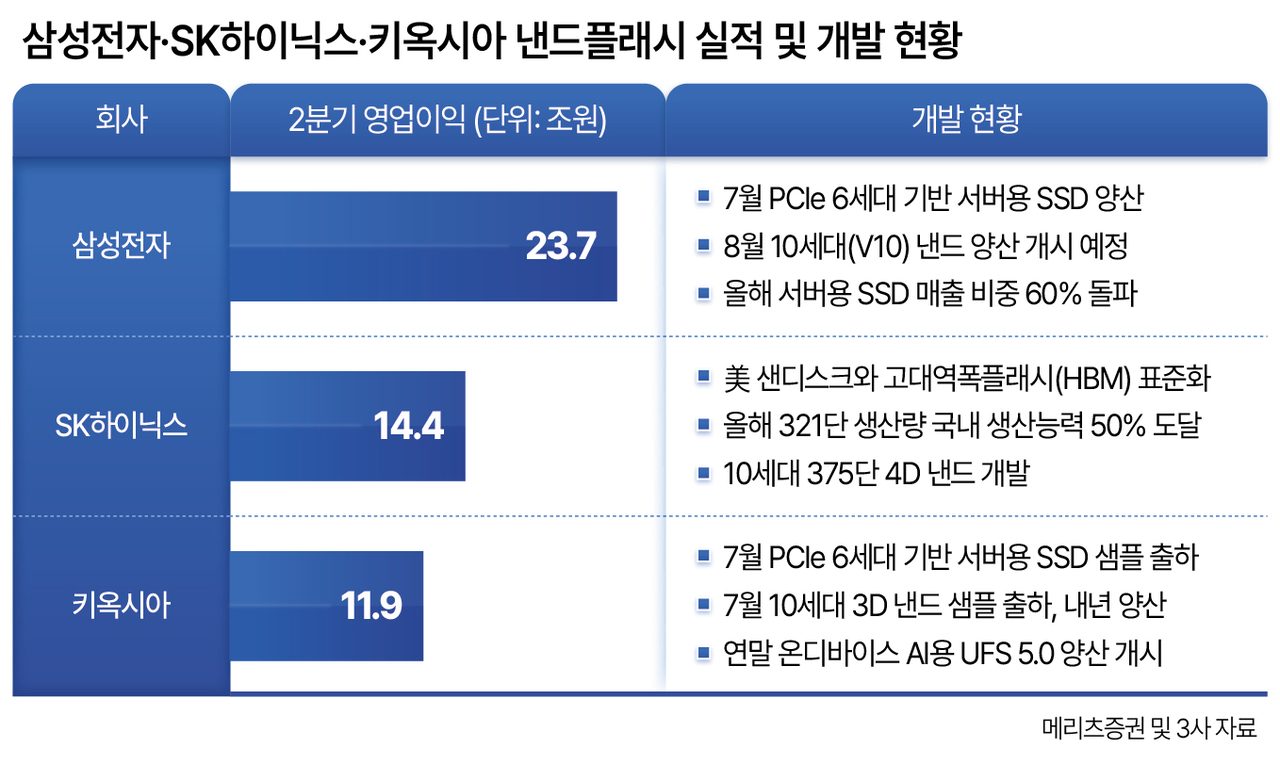
Samsung Electronics and SK hynix are estimated to have posted record second-quarter NAND operating profits of more than 20 trillion won ($14 billion) and more than 10 trillion won, respectively. Kioxia earned 1.31 trillion yen — roughly 11.9 trillion won — over the same period, with an operating profit margin of 74 percent, underscoring the sector's robust health.
The growth at all three companies was driven more by rising average selling prices than by higher shipment volumes. Supply shortages for high-performance enterprise solid-state drives, which have emerged as a critical memory component in AI data centers, have been the primary force pushing NAND prices higher.
Demand for high-capacity enterprise SSDs to store the surging volumes of data generated by expanding AI data centers has spiked, yet the three companies are restraining large-scale capacity additions and managing supply carefully. Analysts attribute that stance in part to the trillion-won losses they suffered from the inventory glut triggered by the NAND oversupply of 2023.
![An enterprise SSD displayed by SK hynix at HPE Discover 2026 in Las Vegas in June. [SK hynix]](https://wimg.heraldcorp.com/news/cms/2026/08/04/news-p.v1.20260804.7e30f8c9255145f49aea349991882420_P1.jpg)
Instead, the companies are focusing on technology upgrades and process improvements to maintain pricing power while meeting demand. Industry leader Samsung Electronics plans to begin mass production of its 10th-generation V-NAND, known as V10, next month. V10 is the industry's first product to stack cells vertically beyond 400 layers, and the first to employ both hybrid bonding and a three-stack architecture in which cells are built up in three separate passes.
Samsung began mass production last month of the PM1763, a PCIe 6.0 enterprise SSD equipped with ninth-generation V-NAND and a new 4-nanometer controller. The drive is drawing attention as the main storage component for Nvidia's AI accelerator Vera Rubin and is expected to be a key growth driver for Samsung's NAND earnings. Samsung will showcase the PM1763 alongside other AI-focused NAND products at FMS 2026, which opens Tuesday (local time) in Santa Clara, California.
SK hynix plans to raise the share of its 321-layer NAND in domestic production capacity to 50 percent by year-end. The company is also working with SanDisk to establish a high-bandwidth flash standard, aiming to stake out an early position in the next-generation AI memory market following its success with HBM.
Kioxia shipped samples of its 10th-generation 3D NAND last month and is targeting mass production in the middle of next year, pending customer qualification. The company will also exhibit a PCIe 6.0 enterprise SSD based on its 10th-generation NAND at FMS 2026.
joze@heraldcorp.com