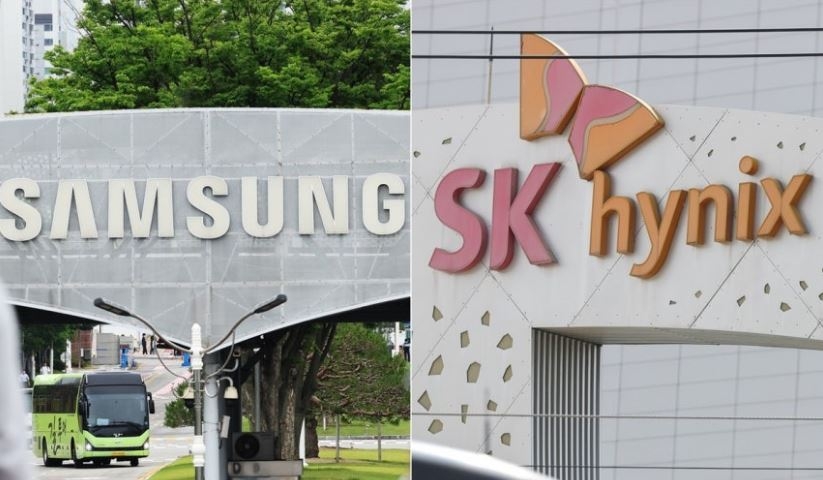
South Korea is expected to hold its position as the world's top memory chip producer through at least 2031, while Nvidia's grip on the high-bandwidth memory market is forecast to loosen as major technology companies accelerate their adoption of custom AI chips.
Joséphine Lau, an analyst at French market research firm Yole Group, said Tuesday at FMS 2026, a memory-focused industry event held in Santa Clara, California, that "South Korea will maintain its leading position in the memory market through 2031."
She cited the South Korean government's plan to double wafer production capacity over the next five years, along with continued large-scale investment by Samsung Electronics and SK Hynix, as the basis for her outlook.
The landscape of memory demand has shifted significantly in the wake of US semiconductor export restrictions on China.
The United States' share of global memory consumption rose 15 percentage points — from 37 percent in 2021 to 52 percent last year — while China's share fell 6 percentage points over the same period, from 35 percent to 29 percent. Combined, the two countries now account for 81 percent of global memory consumption, up from 72 percent.
Lau also said the AI industry is transitioning from "AI 1.0," centered on training, to "AI 2.0," centered on inference.
As a result, she said, memory makers are under pressure to cut new product development cycles from roughly 18 months to around 12 months, with agility in adapting to rapid change emerging as a key competitive advantage.
Nvidia's influence over the HBM market for AI servers is also expected to diminish somewhat.
Avril Wu, senior vice president of research at Taiwan-based market research firm TrendForce, said Nvidia's share of the HBM market is expected to fall from 66 percent last year to around 58 percent this year.
The decline reflects a broader shift among major cloud companies — including Google, with its tensor processing units, as well as Amazon, Microsoft and Meta — away from Nvidia GPUs and toward application-specific integrated circuits, or ASICs.
Chinese memory makers continue to close the technology gap.
Yole Group's analysis of CXMT's DRAM found that the Chinese chipmaker has reached the level of the 1z-nanometer (third-generation 10nm-class) process that global leaders commercialized in 2019.
However, the industry broadly views Chinese chipmakers as still lagging significantly behind Samsung Electronics and SK Hynix in advanced HBM and next-generation DRAM, even as their overall technology capabilities improve rapidly.
sjy@heraldcorp.com