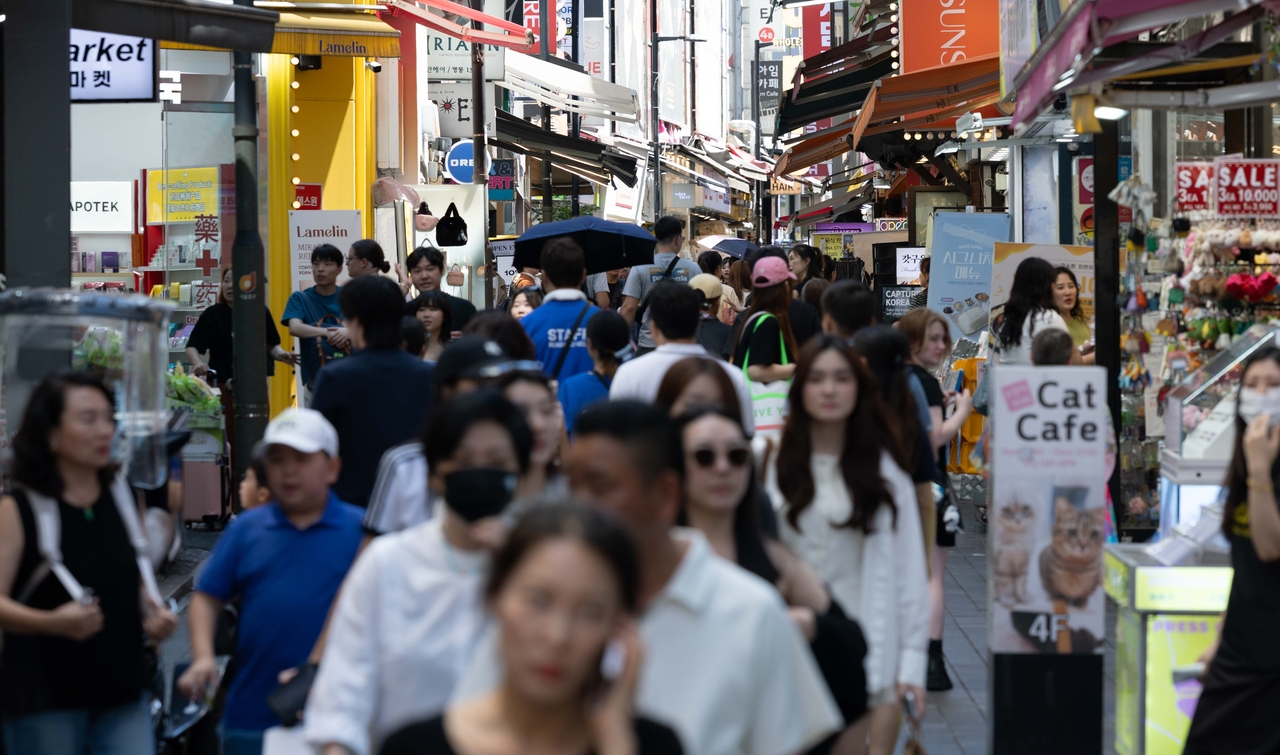
South Korea's tourism exports accounted for 1.17 percent of GDP last year, trailing Japan's 1.45 percent, the Bank of Korea said Wednesday. The country needs to move beyond simply drawing more visitors and focus on extending stays and increasing spending to maximize tourism's domestic economic impact, analysts say.
The findings come from a Bank of Korea report released Wednesday titled "Growth Effects and Policy Directions of the Tourism Industry from a Service Exports Perspective." Japan's ratio was 0.28 percentage points higher than South Korea's. The report attributed the gap to Japan's success in both expanding the scale and improving the quality of its tourism industry since it launched a tourism promotion policy in earnest in 2003.
To bring South Korea's ratio up to Japan's level, the Bank of Korea estimated that tourism exports would need to grow by more than 25 percent. That could be achieved by sharply increasing the number of inbound visitors from about 18.94 million last year to about 23.75 million, raising average daily spending per visitor from $177.80 to $223, or extending the average length of stay from 6.5 days to 8.2 days.
Combining multiple policy levers simultaneously could produce an even greater effect. Even while keeping the average length of stay at 6.5 days, South Korea could reach Japan's GDP tourism export ratio by attracting about 2.26 million additional visitors and raising average daily spending by just $21.30.
The Bank of Korea also said improving the spending mix of inbound visitors and the value-added rate of core tourism industries could further boost domestic value creation.
Raising the share of spending on high-value-added sectors such as medical services and beauty treatments from 17.2 percent to 35 percent, and improving the value-added rates of the accommodation, aviation and restaurant industries by 10, 5 and 8 percentage points respectively, would generate an additional approximately 420.4 billion won in domestic value added.
That would be equivalent to the economic effect of attracting 320,000 additional visitors.
"The true economic gains from tourism can only be fully realized not just by attracting visitors, but when their stays and spending grow and that spending is converted into domestic industrial production and value added," the Bank of Korea said.
Jeong Seon-yeong, head of the Bank of Korea's Asia-Pacific Economy Team, said relying on visitor numbers alone to meet policy targets would require bringing in tourists equivalent to roughly half of South Korea's population, warning that the physical strain could lead to overtourism. "There is a need to evaluate after the fact how much the policies currently being pursued contribute to expanding tourism exports and raising domestic value added," Jeong said, adding that individual policies should be organically linked to improve the consistency and effectiveness of tourism policy.
kimstar@heraldcorp.com