The business world is full of companies — but what do they all actually do? Firms split, merge and rebrand constantly, launching new ventures or winding down old ones. This series uses on-the-ground reporting and data analysis to tell the stories behind the industries that drive them.
![LIG Nexone's Pangyo House. [Provided by LIG Nexone]](https://wimg.heraldcorp.com/news/cms/2026/08/05/news-p.v1.20250103.d7069ae73e3c4a258083013753988ca0_P1.jpg)
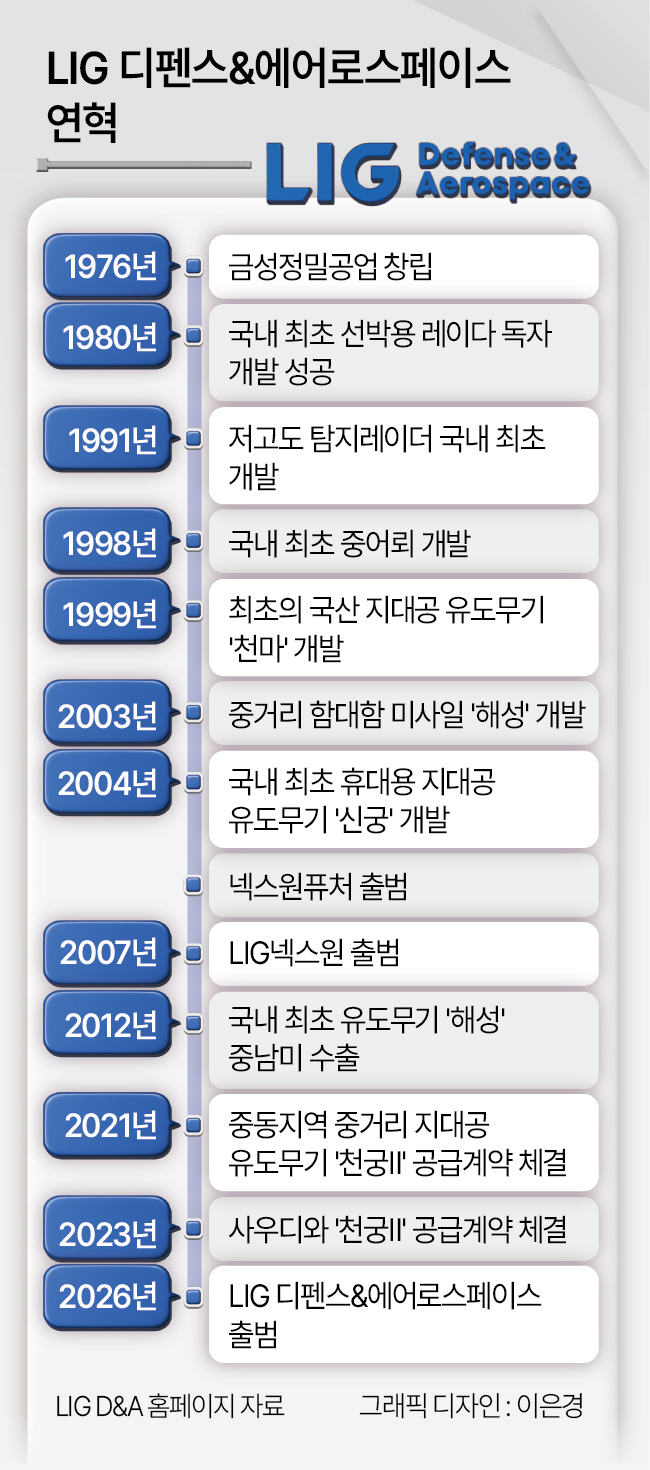
LIG Defense & Aerospace — known as LIG D&A — is marking its 50th anniversary this year by accelerating a transformation from a traditional weapons developer into an AI-driven battlefield intelligence company. Having spent decades at the forefront of South Korea's defense industry developing guided weapons and command-and-control systems, LIG D&A has designated this year as the starting point of its next 50 years, with plans to change its name and expand its business scope.
Central to that push is AI capability, widely regarded as the defining factor in next-generation defense. In January, the company restructured its existing AI research institute into a dedicated "AI Lab" to sharpen its focus on innovation. On July 23, this reporter met Jo Gyu-tae, head of LIG D&A's AI Lab, at a location in Pangyo, Seongnam, Gyeonggi Province, to hear about the company's AI strategy and the direction South Korea's defense industry should take.
The AI Lab operates along two tracks: "battlefield AI," focused on commanding and controlling multiple unmanned systems simultaneously, and "AX" — AI transformation — aimed at improving internal operations. On the AX side, the lab has built an in-house large language model and released an AI-based coding assistant developed entirely within the company.

Agile methods deliver AI command-and-control prototype in four months
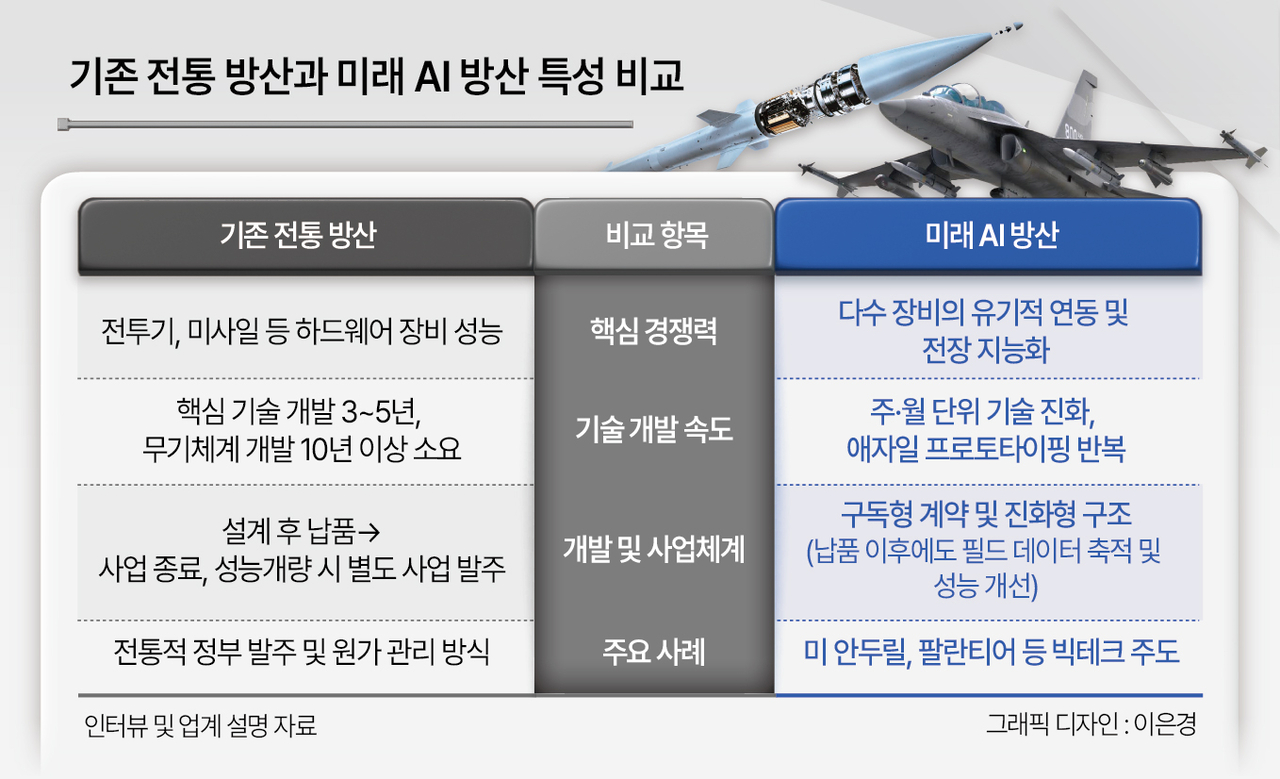
Jo said AI technology is evolving on a weekly and monthly basis, making it impossible for the defense industry to keep pace using traditional development timelines — where core technology typically takes three to five years to develop and full weapons systems can take more than a decade.
A flagship example of the new approach is a partnership with US firm Palantir that produced an AI command-and-control prototype in just four months, combining Palantir's AI platform with LIG D&A's unmanned systems technology through a software-centric development model. "It was the first time we applied agile prototyping," Jo said. "Instead of perfecting something before releasing it, you build it quickly, test it in real environments, and keep improving what falls short."
LIG D&A put that capability on public display in May, hosting a demonstration of AI-based intelligent command-and-control for unmanned surface vessels (USVs). For the first time in South Korea, multiple different unmanned systems were linked through an AI-based command-and-control architecture to carry out a single coordinated operation. Four actual USVs — including the Haegum-S — took part in the exercise, while a range of battlefield assets were simultaneously simulated in a virtual environment.
The event was seen as more than a technology showcase: it signaled that a South Korean defense company had entered the market for AI-based battlefield operating systems in earnest. Competition in export markets is expected to shift from selling individual platforms toward "package exports" that bundle AI software and command-and-control systems together.
![The Haegum-3 USV maneuvers during LIG Defense & Aerospace's AI-based intelligent command-and-control demonstration for unmanned surface vessels, held in May in waters near Korea Maritime & Ocean University off Yeongdo, Busan. [Provided by LIG D&A]](https://wimg.heraldcorp.com/news/cms/2026/08/05/news-p.v1.20260601.d197b76e1079423888c27fa97efb56c4_P1.png)
'The key is effective integration of diverse weapons systems'
Jo identified two areas where LIG D&A holds an edge over rivals: mission-equipment AI and mission-integration AI. "For mission-equipment AI — the AI embedded in individual weapons such as guided missiles, radars and seekers — LIG D&A is recognized as having a broader and more diverse lineup than any competitor," he said.
He added that mission-integration AI, which links multiple weapons systems to carry out a single operation, is equally important. "In recent conflicts, the outcome is not decided by expensive weapons alone — relatively low-cost equipment like drones plays a critical role in overall mission execution," Jo said. "Ultimately, what matters is how effectively you can integrate diverse weapons systems to accomplish one mission."
Building on that integration capability, LIG D&A is also accelerating work on data security and a proprietary platform. The company is collaborating with global firms including Anduril and Shield AI while simultaneously developing a "sovereign AI" architecture designed to prevent any leakage of defense data.
As part of that effort, LIG D&A is partnering with AI platform specialist Ditonic to develop L-NODE, a defense-specific AI platform. L-NODE, which LIG D&A is leading, is designed to make combat management systems and command, control, communications, computers, cyber and intelligence (C5I) systems more intelligent, with a focus on maximizing operational capability for manned-unmanned teaming (MUM-T).
LIG D&A is also working with LG AI Research to develop a command-and-control system based on a large-scale AI model. "LG AI Research has demonstrated overwhelming competitiveness in evaluations of its proprietary foundation model — its sovereign AI — while LIG D&A is unmatched in defense weapons systems and mission-integration experience," Jo said.
![LIG D&A and LG AI Research signed an MOU on July 20 to jointly develop a large-scale AI-based command-and-control system, attended by Kim Hyeon-gi (left), head of LIG D&A's C5ISR business division, and Lee Hwa-young, head of LG AI Research's business division, among others. [Provided by LIG D&A]](https://wimg.heraldcorp.com/news/cms/2026/08/05/news-p.v1.20260721.1ce5473c607242c1b11bc37a1abcd996_P1.jpg)
US defense firms use subscription contracts with military to continuously update software and models
LIG D&A is also broadening the foundation of the future battlefield ecosystem through government R&D contracts and active capital investment. The company was recently selected as the lead research institution for a government defense information and communications technology R&D project, committing about 6.2 billion won ($4.34 million) to develop an AI-based decision-support system. In addition, the company has teamed with IBK Capital and others to establish a defense innovation fund, investing a total of 43.2 billion won across 20 startups as of April to channel private-sector innovation into its operations.
Despite those advances, Jo said the industry must also move faster to shed its hardware-centric culture and overhaul the current defense acquisition system. "Major US defense companies receive ongoing budgets through subscription-style contracts with the military and continuously update their software and models," he said. "In South Korea, the mindset is still stuck at buying a car and taking it in for repairs when something breaks." He went on to say that AI-based weapons systems should evolve the way Tesla vehicles or smartphones do — with software updates that continuously expand their capabilities.
Discussions on reforming agile processes and acquisition regulations are already under way at the National AI Strategy Committee and the National Assembly. A separate initiative is also in progress to establish five national defense AI transformation hubs — in Yongsan, Pangyo, Daejeon, Yangjae and one other location — that would supply military data to support development.
"People say K-defense is in a golden age right now, but in fact this is a golden window to transform," Jo said. "We have to compete with global tech giants like Anduril and Palantir. If we don't shift to a software-centric model that can integrate flexibly and quickly within the next two to three years, we will be in trouble. This is an era where we have to ask whether the weapons systems we are building today will still be competitive 20 years from now."
'The era of expensive fighter jets is over' — battlefield intelligence is the keyword for the next 50 years
As LIG D&A marks its 50th anniversary, "battlefield intelligence" stands as one of the defining keywords for the company's next half-century. Modern warfare has expanded beyond land, sea and air to encompass space and cyberspace in multi-domain operations, and is increasingly a contest of ideas.
"In recent conflicts, we are seeing technologies like fiber-optic drones that operate without GPS — the controller and the drone are connected by a fiber-optic cable, allowing control without any GPS signal," Jo said. "Ultimately, AI competition also comes down to how quickly you can turn a fresh idea into reality." He added that as new technologies emerge, the ability to integrate them with existing weapons systems in a more flexible architecture will only grow in importance.
"The era of winning wars by owning a few expensive fighter jets or tanks is over," Jo said. "When a commander sets an objective, all manned and unmanned mission assets on the battlefield must be organically linked through AI, making autonomous judgments and acting on them — that is battlefield intelligence." He added: "From an AI perspective, LIG D&A's ultimate goal is to become the world's best company at battlefield intelligence."

keg@heraldcorp.com