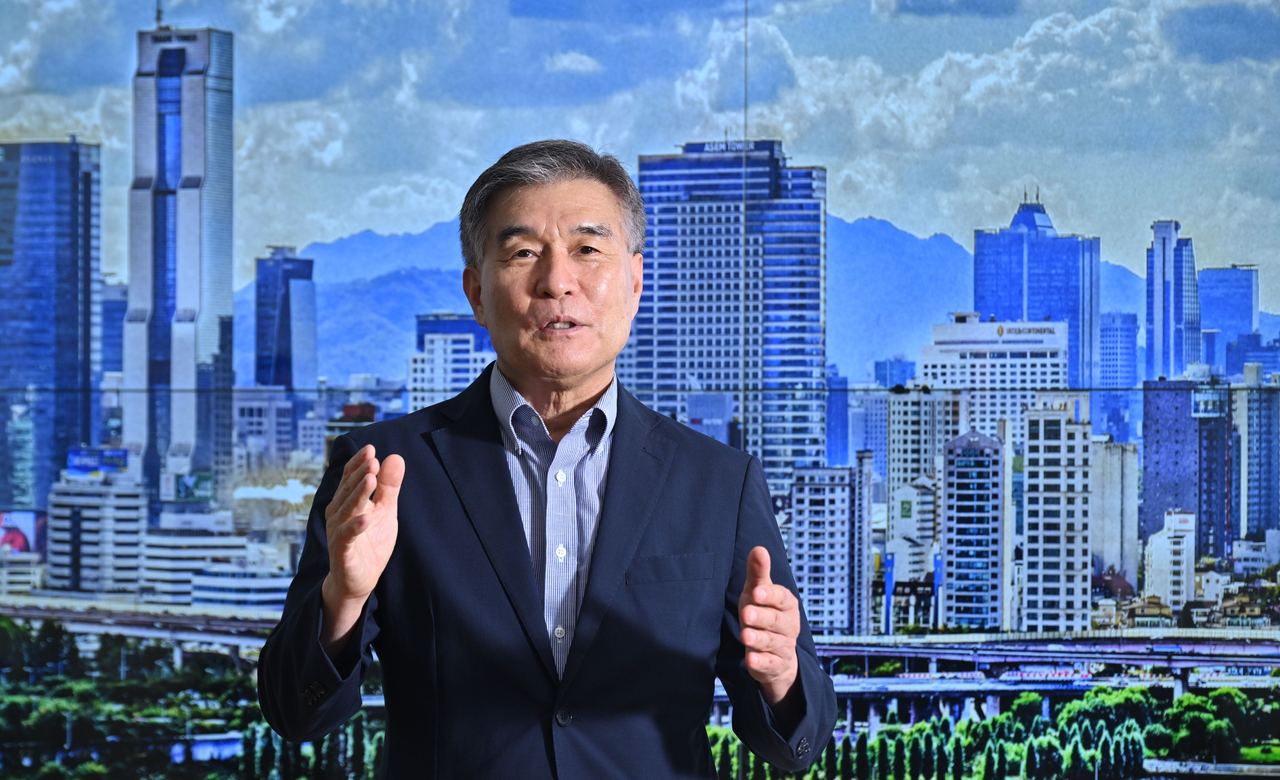
"First and foremost — reconstruction revitalization." On his first day in office, July 1, Gangnam-gu District Mayor Kim Hyun-gi signed his inaugural official order to launch the "Gangnam Reconstruction Acceleration Task Force," known by its Korean acronym Sinhwa TF. The following day he visited Eunma Apartments, one of the district's most prominent aging complexes, and personally handed residents their project implementation plan approval — the task force's first field visit and a clear signal that he intended to push the process forward without delay. On July 22, the district issued approval for the reconstruction association preparatory committee of Ilwon Hansol Apartments, just 10 days after the application was submitted, cutting the statutory processing period by 20 days. Kim sat down for an interview on Friday and said "Gangnam is aging," adding that he would lead a "great transformation of Gangnam" through reconstruction and by cultivating new growth engines. The following is an edited transcript.
— What message did residents send through this election?
Every resident I met during the campaign said the same two things. First, they asked why there is so much administrative regulation and interference when they simply want to rebuild their own homes. Second, they asked why every government, regardless of party, pursues policies that amount to a tax assault on Gangnam. Tax policy is not something a district mayor can control, but I believe those words carry the genuine wishes of residents. Not everyone in Gangnam is wealthy. Gangnam has the second-largest stock of rental apartments among Seoul's 25 districts. It also has the most informal settlements of any district in the city. Half of all North Korean defectors in Seoul live here in Gangnam.
— What is the governing direction for Gangnam-gu under the ninth term of local government?
The slogan for the ninth term is "Gangnam, Energized! Residents, Inspired! The Great Transformation of Gangnam!!" This is a golden time — we must lay the foundation for Gangnam's next 100 years of growth. I will channel every resource and capability the district has into this great transformation, grounded in change and innovation. I intend to complete the projects we have planned: reconstruction that ends the long wait and raises property values, relief from the tax burden to protect residents' property rights and right to housing, and the creation of a K-Tech Valley that will become the economic heart of South Korea.

— You have said Gangnam is aging. What do you mean by that?
Gangnam is approaching 50 years since it was developed. A significant number of apartment buildings date to the late 1960s and early 1970s. The housing stock is deteriorating and the urban infrastructure is worn out — that is what I mean when I say Gangnam is aging. The district itself has not invested heavily in its own renewal. Seoul and the central government provided support in the past, but that is no longer the case. If anything, oversight and regulation have only grown. The growth engines have been spent. Discrimination against Gangnam has intensified. Under the assumption that people would always flock here regardless, we never prepared for the future or pursued reform. Teheran Valley is widely seen as a shadow of its former self, and vacancy rates along major commercial strips such as Garosugil and Nonhyeon have risen. Some companies have relocated their headquarters to other parts of the country. We need to build new growth engines alongside reconstruction. I will develop the strengths Gangnam already has — K-medicine, K-culture, K-beauty — while creating jobs. In this context, the K stands for Gangnam's K.
— Your first official act was establishing the Sinhwa TF for reconstruction.
On July 29, we appointed 41 private-sector experts as advisory members of the task force. Conflict specialists will objectively mediate disputes and issues of distrust, while accounting experts will advise to ensure projects proceed transparently. I, as district mayor and head of the task force, will oversee everything. What matters most is the speed of administrative processing. By handling permit procedures that are currently spread across multiple departments simultaneously, we can cut processing times by more than 30 percent.
— Some district mayors have said they will ask Seoul City Hall to transfer permit authority over projects with fewer than 500 units to the district level.
Transferring that authority to district offices might speed things up, but the districts could fall short of Seoul City Hall's level of expertise. Delegating authority without ensuring that expertise is in place would be like transferring investigative powers to the police before they have sufficient capacity. Investigative independence only works when the police have the capability to handle it.
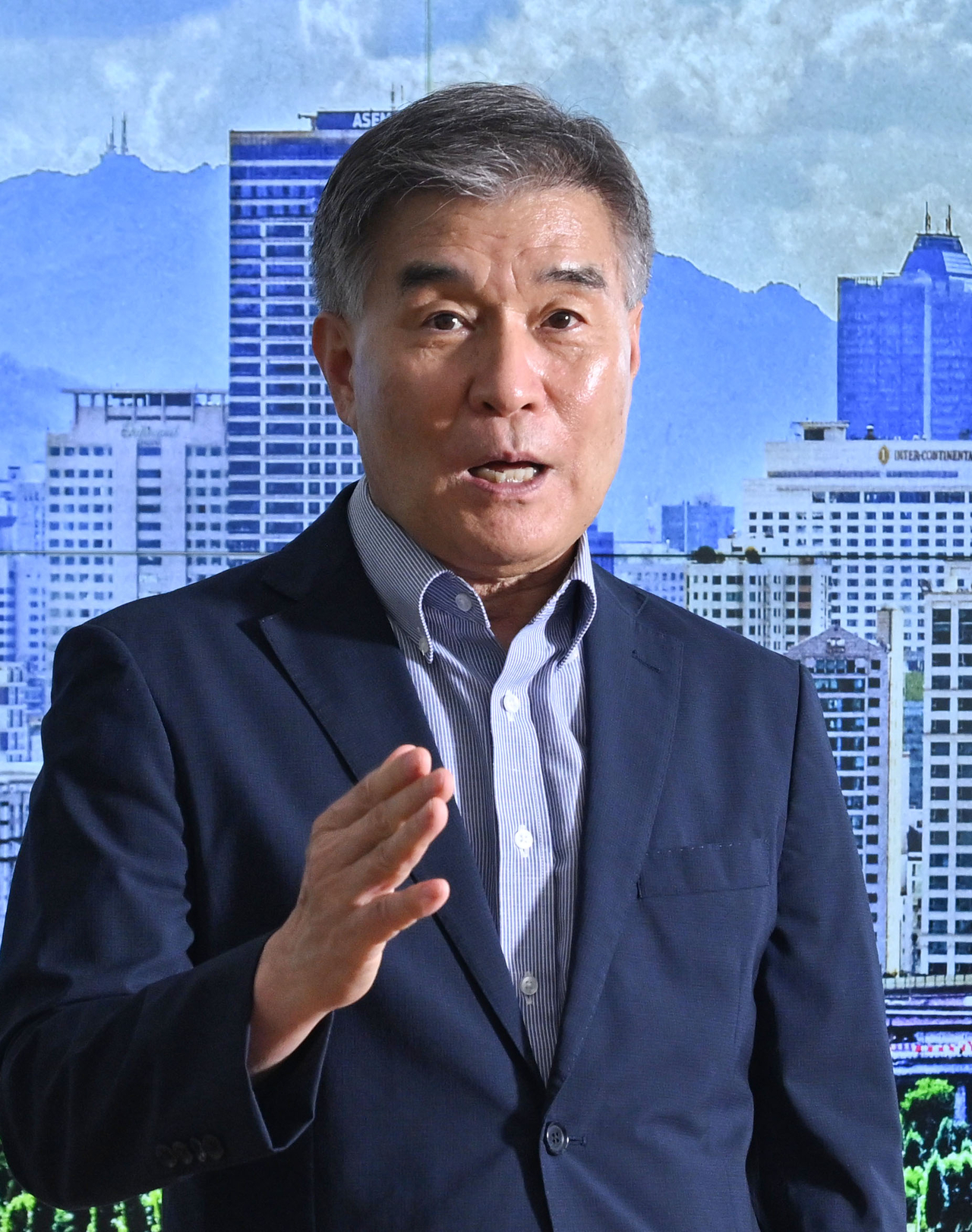
— You pledged to make Gangnam the top district for public education. What is the specific plan?
Gangnam is synonymous with education. Gangnam's schools lead Seoul's education system and in turn play a pioneering role in education across South Korea. This year, Gangnam-gu's education subsidy budget stands at 35.7 billion won ($25 million). Until now, that money has gone mainly toward facility improvements requested by schools. I want to change that. Facility and environment upgrades should be funded through the Seoul Metropolitan Office of Education's own budget; I will focus our resources on programs that raise the quality of education itself. Too many students are falling below basic academic standards — that is, in effect, a violation of their fundamental rights as students. Schools that conduct basic academic skills assessments will receive additional budget support as an incentive. Student literacy is declining and children are not reading. I will promote reading education and support schools that run strong reading programs.
— How will your administration differ from the previous term?
Good policies from the previous term will be continued; those that have not worked will be boldly reorganized or discontinued. I will uphold what I call the "three-no budget principle": projects that are unnecessary and non-urgent, projects whose purpose is unclear, and projects whose impact is opaque will be cut without hesitation.
— What will you focus on most at the start of your term?
First and foremost — reconstruction revitalization. When reconstruction projects stall, housing supply is delayed and related costs rise. Ultimately, it is the association members and residents who bear the burden. For residents living in deteriorating conditions, improving their housing welfare is the top priority — nothing matters more than that. After that, creating jobs for young and middle-aged residents is the most pressing task. Throughout my term, I will make sure I never neglect what is happening on the ground.
cook@heraldcorp.com