Seoul mayor criticizes president's 'biased' remarks on public redevelopment; urges action against Democratic Party-led delays
Seoul Mayor Oh Se-hoon has called on President Lee Jae Myung to visit Changsin-dong in Jongno-gu, saying that if the president is sincere about urban renewal, he cannot simply stand by while Democratic Party-affiliated district chiefs "trample twice over the years of blood and tears shed by residents."
Oh made the remarks Thursday in a Facebook post titled "If you are serious about redevelopment, come to Changsin-dong too."
Oh said residents of Changsin-dong had their redevelopment hopes shattered when the area's New Town designation was lifted under then-Seoul Mayor Park Won-soon. All 14 zones of the Changsin-Sungin redevelopment promotion district lost their New Town status without sufficient resident consent, he said, and roughly 87 billion won ($64.9 million) was subsequently poured into urban regeneration programs over the years with little to show for it. Oh added that over the past five years, the Seoul Metropolitan Government had worked to revive stalled redevelopment projects, and that Changsin-dong had finally been put back on track through the city's fast-track integrated planning process — only for those hopes to be shaken again after Democratic Party member Yoo Chan-jong took office as Jongno-gu district chief.
Oh said residents of Changsin Districts 9 and 10 had painstakingly gathered consent from more than 75 percent of households — above the legal threshold — but that the Jongno-gu office had delayed the project operator designation process for months before demanding that the consent forms be collected all over again from the outset. "If there are legal problems with the consent process, they must be thoroughly reviewed and corrected," Oh wrote. "But is it truly proper administration to wipe out entirely the hard-won efforts and hopes of so many residents?"
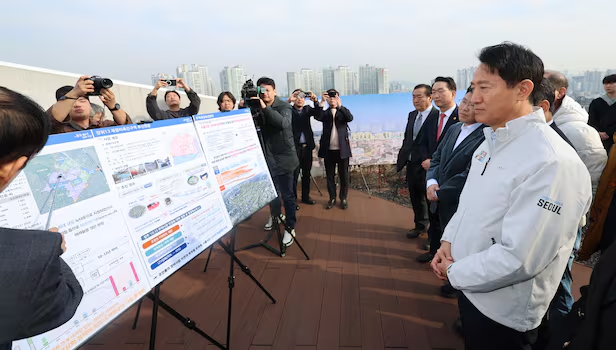
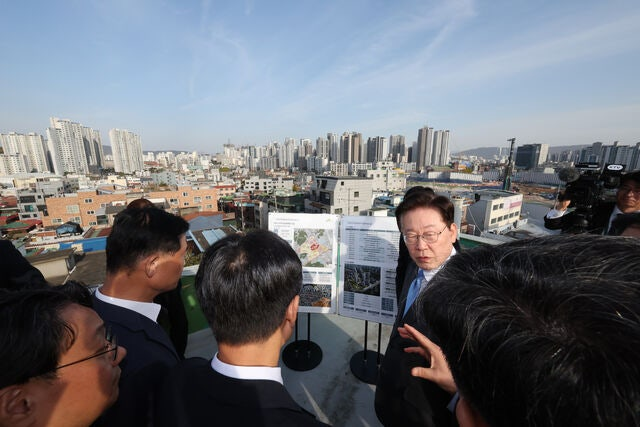
Oh also took aim at the president's site visit Thursday, saying there was something Lee should have made sure to see at Jangwi-dong: the stark contrast between areas where redevelopment has taken place and those where it has not. The Jangwi New Town, Oh said, makes that reality plain at a glance — newly built residential complexes stand on redeveloped land, while worn-down houses and narrow alleyways remain unchanged just across the street in zones where redevelopment was cancelled. "The quality of life and living conditions of residents are starkly divided by nothing more than a single road," he said. Oh also asked whether the president was aware that the Jangwi New Town he visited Thursday was the very site where, under Mayor Park, redevelopment zones had been forcibly dissolved based on the consent of fewer than half of residents, and where residents had even filed lawsuits to nullify the administrative procedures.
Oh said what the president should have said at the scene Thursday was a commitment that the mistakes of the past — the dismantling of redevelopment projects — would never be repeated. He added that Lee should also have instructed the Ministry of Land, Infrastructure and Transport to abandon the outdated binary thinking that "private development means speculation, public development means supply" and to accelerate all redevelopment projects. Instead, Oh said, the president revealed a biased view by suggesting that private development carries a greater risk of corruption while public development can be pushed forward more quickly. "Over the past three years, roughly 90 percent of Seoul's housing supply has been delivered by the private sector," Oh said. "Ignoring the role and importance of private development is the same as ignoring the very core of housing supply." Oh said the president should "break free from the notion that public development is a cure-all" and first listen to the voices of residents desperately waiting for redevelopment. President Lee had visited the Jangwi-dong public redevelopment site Thursday to review the project's progress, saying at the scene that public-led redevelopment is faster and less prone to corruption, but that there remains strong momentum to keep development in private hands — which he attributed to what he called "so-called corruption."
cook@heraldcorp.com