A rebuttal paper says the geometric component of the code is vacuously true; a counter-rebuttal argues only 30 of 1.47 million entries are affected; neither paper has been peer-reviewed; the Clay Mathematics Institute still lists the problem as unsolved

A rebuttal paper has emerged challenging a mathematician's claim to have proved the Riemann hypothesis — one of the greatest unsolved problems in mathematics — with the help of AI model Claude. A counter-rebuttal followed almost immediately, and the debate remains unresolved.
On Friday (local time), Levent Alpoge, a mathematician at US AI company Anthropic, published a proof code claiming to have solved the Riemann hypothesis together with Claude.
The 167-year-old secret of prime numbers
The Riemann hypothesis is a conjecture put forward by German mathematician Bernhard Riemann in an 1859 paper on prime numbers. Prime numbers — integers such as 2, 3, 5, 7 and 11 that are divisible only by 1 and themselves — become increasingly sparse as numbers grow larger, and their distribution appears irregular, making it difficult to predict precisely when the next one will appear.
Riemann proposed that a function known as the "zeta function" could reveal the underlying pattern governing the distribution of primes. The zeta function has infinitely many points at which its value equals zero, and Riemann conjectured that all such zeros lie on a single straight line.
If the hypothesis is correct, the distribution of prime numbers could be described with precise error bounds.
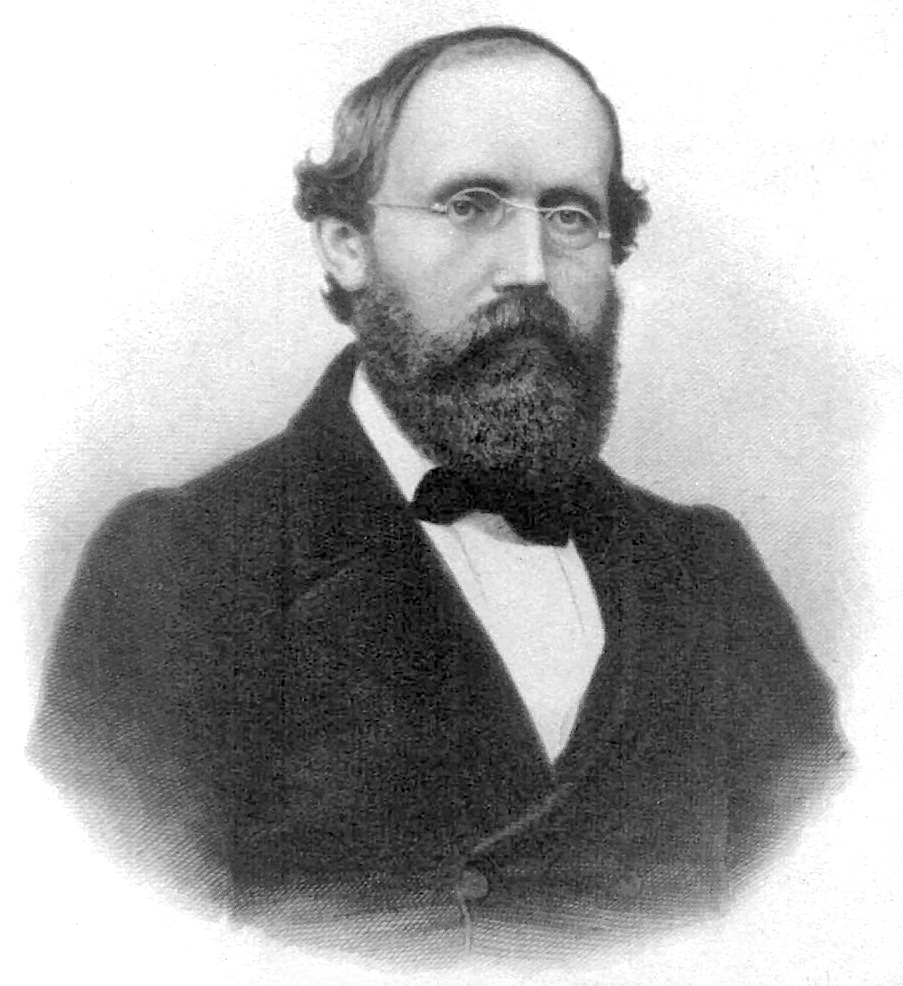
Riemann died in 1866 at the age of 39 without proving his own conjecture. In the 167 years since, mathematicians around the world have attempted a proof, and none has succeeded.
German mathematician David Hilbert included the Riemann hypothesis in his list of 23 problems to be solved in the 20th century, presented in 1900, and thousands of mathematical papers have since been written on the premise that the hypothesis is true.
A verified proof would simultaneously confirm the conclusions of those thousands of papers that assumed the hypothesis as a given.
The Riemann hypothesis is one of the seven Millennium Prize Problems designated by the Clay Mathematics Institute in the United States. In 2000, the institute selected seven of the most important unsolved problems in mathematics and offered a $1 million prize for each. To date, only one — the Poincaré conjecture — has been solved.

17 million lines of code, and the computer checker passed it
Alpoge's proof was released not as a human-readable paper but as code written for a program called Lean. The submission spans 175,187 files and more than 17 million lines. Lean is a proof assistant that checks every step of a proof against formal logical rules, and is widely used in mathematics because it can catch errors that human reviewers might miss.
Lean FRO, the nonprofit organization behind Lean's development, and the Mathlib Initiative, which runs the Mathlib library, issued a joint statement the following day saying they were "confident the proof is correct."
Mathlib is a kind of digital mathematical encyclopedia, built by mathematicians who have painstakingly translated already-proven theorems into a form that Lean can verify.
Since 2017, 772 mathematicians and developers worldwide have contributed to it, compiling more than 296,000 theorems and 140,000 definitions. This year, the project received the De May Award for its contribution to open science by making research freely available to all.
Alpoge's proof was built on theorems already in Mathlib. The two organizations said dozens of researchers had independently reproduced the result, and that multiple verification programs developed separately from one another had all accepted Alpoge's proof of the Riemann hypothesis.
'Always returns true' — a rebuttal emerges
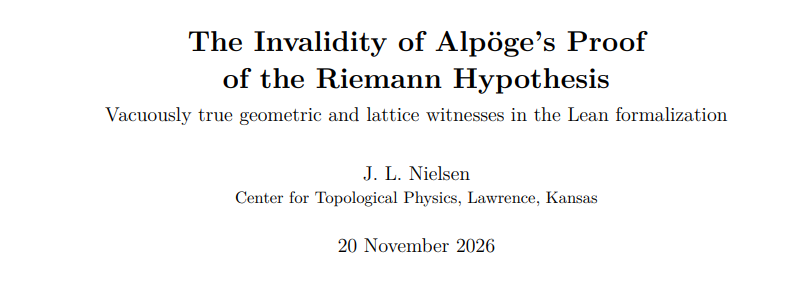
A rebuttal paper appeared the same day. J. L. Nielsen, identified as affiliated with the Center for Topological Physics in Lawrence, Kansas, posted a 16-page paper titled "Invalidity of the Alpoge Proposed Proof of the Riemann Hypothesis" to PhilArchive, a philosophy preprint repository.
A related problem had previously been solved. In the 1940s, French mathematician André Weil proved a simplified version of the Riemann hypothesis using algebraic geometry — the branch of mathematics dealing with geometric objects such as curves and surfaces.
Weil connected the locations of the zeros of the zeta function to the size of a geometric object through a single formula. Under that formula, if even one zero were to stray off the critical line, the size of the geometric object would come out negative. Just as a line cannot have a length of negative 3 centimeters or a shape a negative area, a geometric object cannot have a negative size — and so no zero can lie off the line, the argument concludes.

In 1969, Soviet mathematician Sergei Stepanov offered an alternative approach, solving the same problem using polynomials rather than geometry. Alpoge said in his announcement that his proof extends Stepanov's method to the original Riemann hypothesis.
Applying that method to ordinary numbers hits a blocking step partway through, and Alpoge said he overcame it by chaining together multiple applications of a tool called the "theta lift," which transfers information between different mathematical objects.
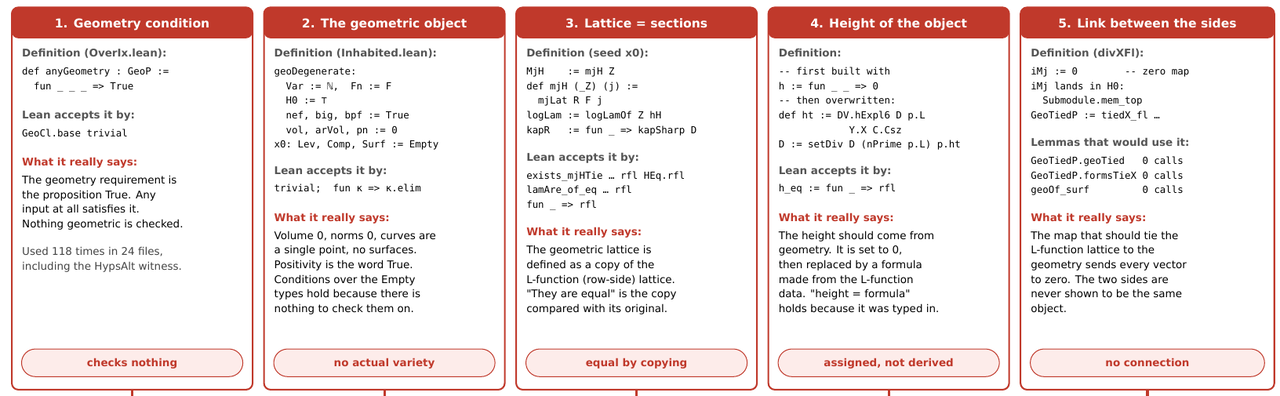
Nielsen, after analyzing the code, concluded that Alpoge had borrowed geometric properties to get past that blocking step. For the approach to work, the geometric object used in the proof must be well-formed. If the size of that object is fixed in advance using values from the Riemann hypothesis side of the calculation, checking whether the size comes out negative becomes meaningless.
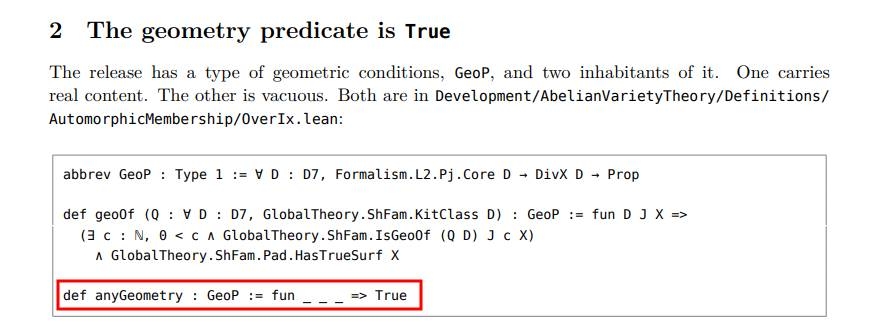
Nielsen said the geometric component of Alpoge's published code does not function properly. In the code, the geometric condition is defined so that it returns "true" regardless of what value is entered.
Nielsen argued that because the values that should have come from an actual geometric object were pre-filled using calculations from the Riemann hypothesis side, it was inevitable that the numbers would match up.
The paper went on to say that "the kernel" — Lean's verification engine — "verified how the proof was assembled, not whether the argument holds," and "this code does not contain a proof of the Riemann hypothesis."
'Redundant but the conclusion still holds' — the counter-rebuttal
A counter-rebuttal came quickly. Zeng Zhijian of UCSI University in Malaysia, in a 26-page response posted to GitHub, acknowledged that the code Nielsen had identified does exist.
Zeng rebuffed the claim, however, that the problem Nielsen identified plays any meaningful role in the proof of the Riemann hypothesis. Of the 1,468,418 entries used in the proof, only 30 rely on the "always true" condition, while the core calculation is separately proved through 38 other assumptions.
If Zeng is correct, Nielsen had flagged only a non-essential part of the proof, and the Riemann hypothesis stands proved by the remaining calculations. The logic is similar to how a math solution with a few redundant steps can still be accepted as correct if the rest of the working leads to the right answer.
Even within Nielsen's own paper, there is a passage that supports Zeng's counter-argument. The paper concedes that the code did in fact carry out the calculations comparing values on the Riemann hypothesis side.
Nielsen's paper has not undergone peer review, and major international news outlets have yet to give it significant coverage. Nielsen's previous writings are also all posted on PhilArchive. The work has focused primarily on a self-developed "topological unified field theory," and this year Nielsen has published a series of challenges to mathematical results put out by OpenAI.

The remaining task: human understanding
According to a verification page maintained by Andrew Sutherland, a professor at the Massachusetts Institute of Technology, as of Sunday multiple independent verification programs had all accepted Alpoge's proof of the Riemann hypothesis, with only a few remaining tasks — including a final comparative check — still to be completed.
Fields Medal winner Terence Tao, a professor at the University of California, Los Angeles, wrote on his blog that Alpoge's proof is a massive piece of work that arrived only as Lean code, with no human-readable explanation, and that at first glance it appears to draw broadly on decades of accumulated research in number theory and the study of primes.
Tao stopped short of declaring the proof correct, saying it would take time to understand the key ideas.
The Clay Mathematics Institute still lists the Riemann hypothesis as unsolved on its website.
dbsdn1110@heraldcorp.com