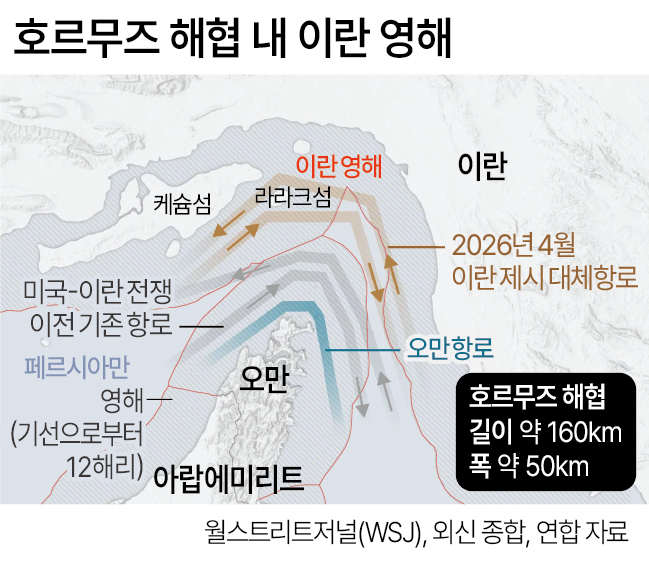
Iran and Oman are in the final stages of drafting a 60-day interim agreement to reopen the Strait of Hormuz, the Wall Street Journal reported Wednesday.
Citing multiple sources, the Journal said the two countries have agreed on the core elements of the plan — establishing an inbound shipping lane through Iranian waters and an outbound lane through Omani waters — and have shared the framework with the United States, Iran and regional nations.
Iranian Foreign Ministry spokesperson Esmail Baghaei confirmed the progress Wednesday, saying "agreement has been reached on the geographical coordinates of the proposed routes" and that "the joint statement by Iran and Oman is currently in the final review and completion stage."
Under the draft agreement obtained by the Journal, vessels entering the Persian Gulf through the strait would coordinate with Iranian authorities and use the Iranian-side lane, while ships exiting would coordinate with Omani authorities and use a lane in Omani territorial waters.
If implemented, the arrangement would give Iran control over vessels entering the Persian Gulf through the strait. The draft stipulates that no transit fees or service charges would be imposed.
However, sources cautioned that even if tolls and fees are prohibited, it may prove difficult to bar voluntary contributions made in the name of security and search-and-rescue costs.
Reuters, citing a senior Iranian official, reported a different picture: Iran is demanding a fee equivalent to 5 to 7 percent of the cargo value of ships using the strait. Oman has been discussing a fee of around 3 percent, while the United States maintains that no tolls or fees should be imposed at all.
The official said the agreement currently on the table includes a provision giving Iran control over vessels entering the Persian Gulf, but that Iran's role regarding ships traveling in the opposite direction remains a key unresolved issue.
Reuters also noted that some observers are cautious about predictions of an imminent deal, pointing to significant issues that remain unsettled.
![Ships in the Strait of Hormuz [Reuters]](https://wimg.heraldcorp.com/news/cms/2026/08/06/rcv.YNA.20260805.PRU20260805032401009_P1.jpg)
The Journal also noted that the deal could still fall apart or fail to reopen the strait.
Iranian Deputy Foreign Minister Kazem Gharibabadi drew a line, saying the agreement with Oman "does not mean a full opening of the Strait of Hormuz."
He said reopening the strait requires specific conditions to be met and that any agreement must be reached solely between Iran and Oman. "We will not tolerate any foreign interference," he added.
If the agreement is finalized and officially announced, the United States and Iran are expected to return to the negotiating table to discuss Iran's nuclear program and the easing of economic sanctions.
President Donald Trump said Wednesday that "the Strait of Hormuz will open soon," claiming an announcement of a deal was imminent.
However, a Middle Eastern source told CNN that the odds of Iran and Oman actually reaching an agreement by Friday stand at "50-50."
The source said hardline voices from Iran's Islamic Revolutionary Guard Corps were not represented in the Iranian delegation, and that the IRGC's final approval of the deal's details would likely be required.
mokiya@heraldcorp.com