![[Generated with ChatGPT]](https://wimg.heraldcorp.com/news/cms/2026/08/06/news-p.v1.20260806.ff0089fa2e574cc38a5fc750c8122714_P1.png)
South Korea's ETF market was virtually all red in July. Nearly eight out of every 10 exchange-traded funds fell during the month, and total net assets across the market shrank by roughly 80 trillion won ($56.1 billion).
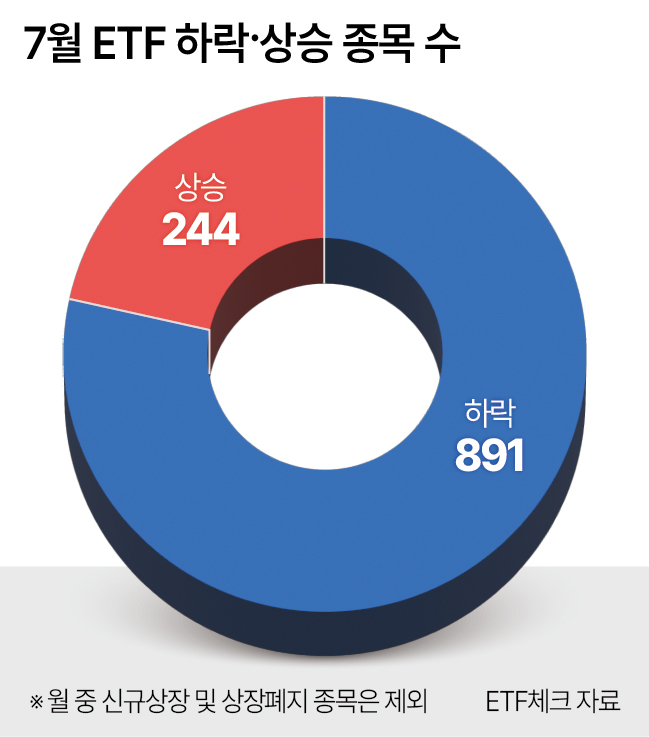
According to Korea Exchange and ETF Check, 891 listed ETFs — 78.3 percent of all products — declined in July. Only 244 posted gains. Of the declining funds, 531 fell more than 10 percent over the month, meaning more than half of all losers suffered crash-level losses.
The breadth of the selloff rivaled the market rout in March, when the Middle East war broke out. At that time, 838 ETFs — 78.5 percent of the total — had declined.
The market freeze also took a heavy toll on total net assets. ETF net assets stood at 434.4 trillion won at the end of July, down 77.9 trillion won from 512.4 trillion won at the end of the previous month. On July 30, net assets briefly fell as low as 398 trillion won, breaching the 400 trillion won threshold.
The turmoil in the ETF market was driven by a sharp plunge in the Kospi and Kosdaq indexes themselves. The Kospi closed at 8,476.48 on June 30 and finished July at 6,595.45, a drop of 22.19 percent over the month. The Kosdaq fell 21.44 percent over the same period, from 916.18 to 719.76.
Semiconductors were at the epicenter of the selloff. News of a strong market debut by Chinese chipmaker CXMT heightened concerns about China's push to dominate the chip industry, sending shares of Nvidia, AMD and Micron sharply lower on Wall Street first.
The fallout then hit South Korea's two largest stocks by market capitalization. Samsung Electronics fell 21.41 percent in July and SK Hynix dropped 35.17 percent, dragging the broader indexes lower.
On the supply side, heavy foreign net selling dealt the decisive blow. Foreign investors sold a net 17.9 trillion won worth of shares on the Kospi and Kosdaq markets last month. On July 28 alone, they offloaded 4.97 trillion won worth of Kospi-listed shares in a single session, sending the Kospi plunging 10.84 percent.
The selling pressure triggered a series of trading halts. Circuit breakers on the Kospi were activated four times during July. On July 28 and 29, circuit breakers were triggered on both the Kospi and Kosdaq on two consecutive days — an unprecedented occurrence.
More recently, overall ETF trading activity has also visibly slowed. Total ETF turnover on Wednesday came to about 15.9 trillion won, roughly half the daily average of about 33 trillion won recorded in July.
Tighter regulations on leveraged products have also weighed on activity. Combined turnover for the 16 single-stock leveraged ETFs — including inverse products — fell to 919.8 billion won on Wednesday, dropping below 1 trillion won for the first time since their listing. That came just four trading days after financial regulators on July 31 raised the minimum deposit requirement from 10 million won to 30 million won and tightened other investment conditions.
Turnover for those products had reached 12.45 trillion won on July 30, the day before the rules took effect, before plunging to 3.15 trillion won on the first day of implementation and subsequently falling to around 1 trillion won. Their share of total ETF turnover has also dropped sharply, from 30 to 40 percent before the regulation to around 5 percent in recent sessions.
"The unwinding of excessive leveraged positions and the authorities' aggressive regulatory intervention caused single-stock leveraged ETF turnover to plunge sharply in August," said Park Woo-yeol, an analyst at Shinhan Investment. "In July, daily average turnover for single-stock leveraged ETFs was about 12.3 trillion won, but over the past three trading days it has fallen to around 1 trillion won — one-tenth of that level."
Some analysts see a silver lining: the drop in leveraged ETF trading could actually benefit the Kosdaq. "The 16 single-stock leveraged ETFs had been absorbing Kosdaq liquidity, deepening the decline in turnover and overall weakness," Park said. "Now that single-stock leveraged ETF trading has fallen off, the Kosdaq may be entering a phase where an oversold reversal is worth watching for."
th5@heraldcorp.com