![The headquarters of the Seoul Housing & Communities Corporation. [SH]](https://wimg.heraldcorp.com/news/cms/2026/08/11/news-p.v1.20260427.d9378438c41c415d8ec90db8bc1c84a1_P1.png)
The Seoul Housing & Communities Corporation, known as SH, will see its comprehensive real estate tax bill more than double by 2028 under the government's proposed tax reform, the corporation said Tuesday. The new tax regime, which tightens the burden on property ownership, is expected to significantly increase the financial strain on SH as a supplier of public rental housing.
The reform would add at least 2.66 billion won to SH's annual comprehensive real estate tax liability — including the special agricultural and rural development tax — starting in 2028, compared with this year's estimated bill of about 2.2 billion won ($1.55 million), which will be finalized at year-end. That represents an increase of 123 percent. Next year alone, the tax is projected to rise by 1.18 billion won, or more than 50 percent, over this year's level.
The estimates assume that assessed property values and the taxable base remain unchanged from current levels, and are based on two key changes proposed in the reform package: a reduction in the basic deduction amount from 900 million won to 400 million won, and an increase in the fair market value ratio from 60 percent to 70 percent. The legislation has not yet been finalized. Because assessed land values tend to rise over time, the actual increase in the comprehensive real estate tax is expected to be even larger.
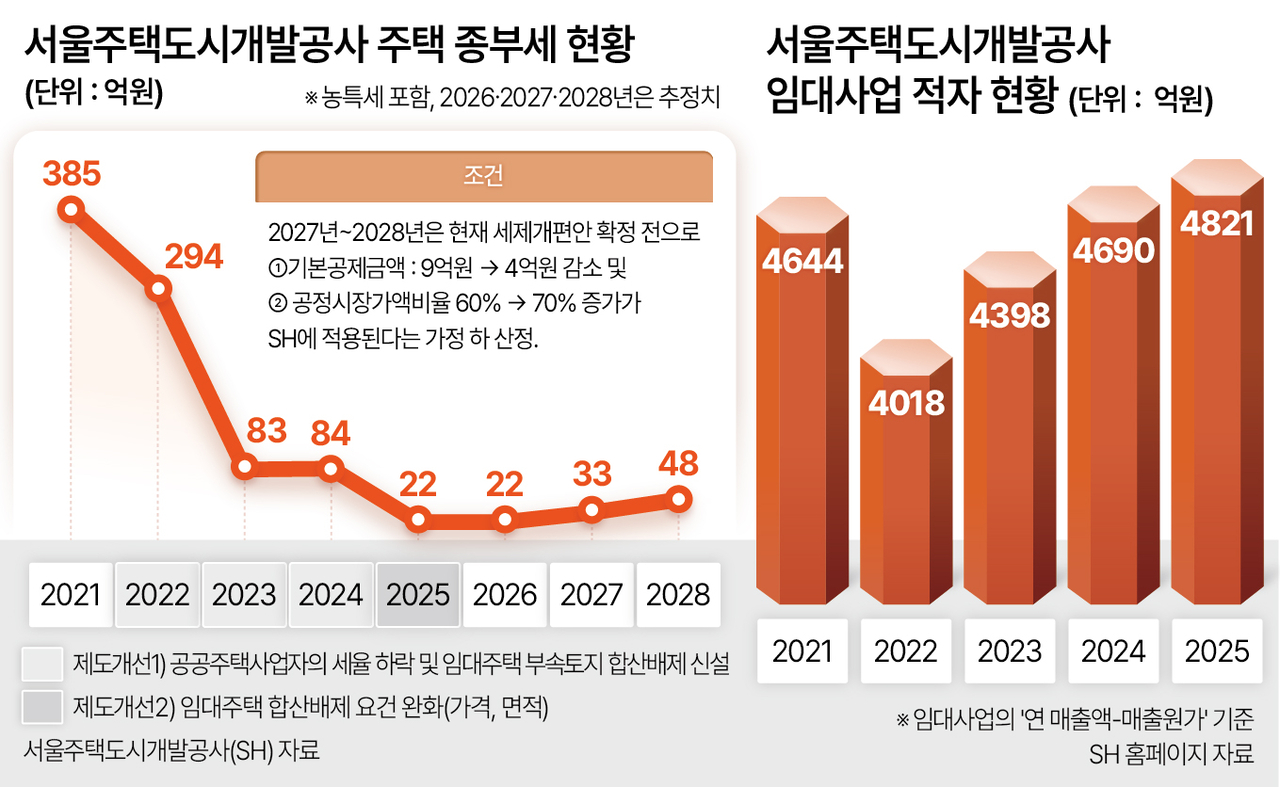
SH had previously shouldered comprehensive real estate tax bills running into the tens of billions of won, which deepened losses in its rental business and prompted a series of legislative fixes to ease the burden. In 2021, at the height of the housing price surge, SH's comprehensive real estate tax hit a record 38.5 billion won, pushing the ratio of property holding taxes — including the comprehensive real estate tax and property tax — to rental income to 44 percent in 2022. Citing the threat to the long-term viability of the public rental housing program, authorities introduced successive reforms: in 2023, tax rates for public housing operators were lowered and land attached to rental properties was excluded from the combined tax base; in 2025, the eligibility criteria for exclusion were relaxed on price and floor area. As a result, SH's comprehensive real estate tax plunged to about 2.2 billion won last year.
SH paid the comprehensive real estate tax on a total of 1,166 housing units last year. The vast majority of public rental units it holds are now excluded from the taxable base under revised regulations — specifically Articles 3 and 4 of the Enforcement Decree of the Comprehensive Real Estate Tax Act. However, even public rental units that have sat vacant for more than two years remain taxable. Last year's taxable inventory included 883 multi-family homes and villa-type units classified as long-term vacant rental properties, among them one unit at 36-3 Ogeum-dong, Songpa-gu, and one at 443-2 Jangan-dong, Dongdaemun-gu. Beyond rental housing, SH's taxable holdings also include properties acquired through its below-ground floor housing purchase project, its vacant-home redevelopment project, and housing taken over through development projects.
For SH, which had steadily reduced its tax burden through successive policy reforms, the latest overhaul means fixed costs will rise again. The corporation's rental business deficit already widened from 401.8 billion won in 2022 to 482.1 billion won last year, driven by a growing stock of public housing and below-market rents. The tax increase is expected to add to the long-term financial pressure on SH, which has been running a chronic annual deficit of more than 400 billion won in its rental housing operations.
"The comprehensive real estate tax on public rental housing is not expected to be large, given the exclusion rules," an SH official said. "However, it is true that SH's total comprehensive real estate tax liability will increase, because long-vacant units and some properties held for purposes other than rental are subject to taxation."
hope@heraldcorp.com