![The Wirye business-use site in Songpa-gu, Seoul, which was included in the Sept. 7 housing supply measures. A land-use conversion would be required before any housing can be built there. [The Herald Business DB]](https://wimg.heraldcorp.com/news/cms/2026/08/12/news-p.v1.20250911.ecdb32b0b1a64de6817f9cd956356ad2_P1.jpg)
Development of about 165,000 square meters within Incheon's Songdo International Business District (IBD) has stalled over unresolved disputes about securing school sites and sharing the associated costs — a problem that surfaced after officetel residents, whose school needs were not adequately reflected in the original development plan, began moving in.
As the government prepares to announce a housing supply package expected to include converting long-idle commercial and business-use land into residential land, infrastructure issues stemming from such rezoning are emerging as a key variable that could determine how quickly new housing actually reaches the market.
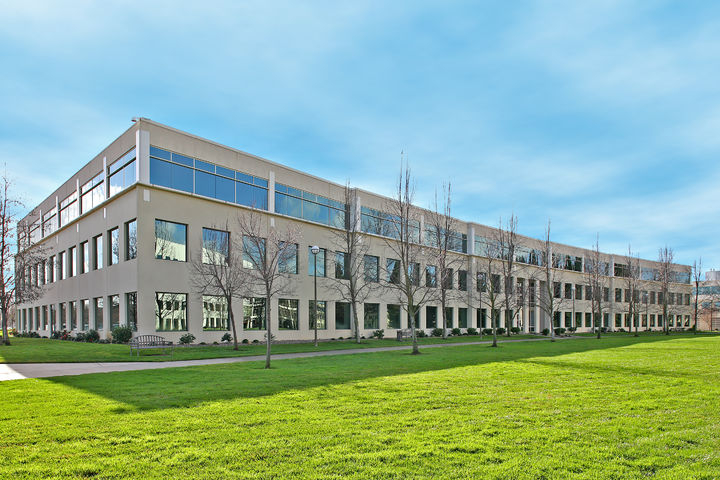
Sites already included in existing supply plans — such as the Wirye business-use land in Songpa-gu that was part of last year's Sept. 7 supply measures — will also require land-use conversions. Negotiations with local governments and education authorities over school sites and related regulations could become a complicating factor during project implementation.
Under the Sept. 7 supply measures, the government announced plans to convert long-idle commercial and business-use land within Greater Seoul public housing sites into residential land, adding more than 15,000 units to the supply pipeline. Korea Land and Housing Corporation (LH) is prioritizing land-use adjustments covering about 4,100 units across sites in Namyangju Wangsuk, Paju Unjeong 3 and Suwon Dangsu.
The core problem is that placing large-scale residential facilities on non-residential land brings in new residents and school-age children who were never factored into the original development plan. Even after a parcel is rezoned for residential use, additional negotiations over building new schools or expanding existing ones, assigning students, and providing infrastructure such as roads and parks can follow — making it difficult for a land-use change to translate directly into housing supply.
Officetels have been classified as "school-age population-generating facilities" since 2021, requiring education authority approval before construction can begin.
The slow pace of development at Songdo IBD stems from the Incheon Metropolitan Office of Education demanding additional school sites during subsequent development phases, which sparked a dispute. The Incheon Free Economic Zone Authority has drawn up a plan to rezone business-use parcels I9 and I10 in Zone 1 and part of a neighborhood park in Zone 3 as school sites, but a dispute over who will bear the estimated 55.5 billion won cost of securing the additional school land remains unresolved.
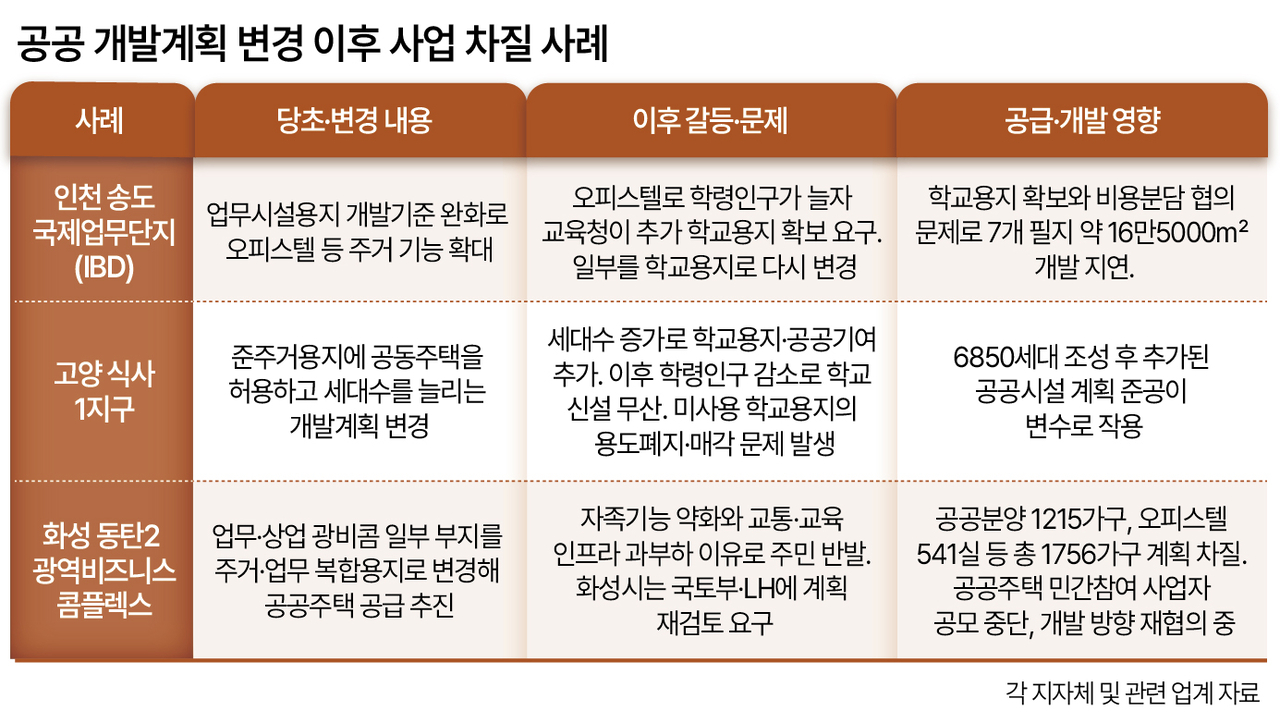
A school-site dispute also erupted during a plan revision in the Siksa District 1 development in Goyang, Gyeonggi Province. When the number of units was increased, additional school sites and public contribution requirements were added — but a subsequent decline in the school-age population effectively killed the plan to build new schools. The procedure for repurposing the already-secured school land for other uses was also delayed, leaving the parcels unused for years.
The complications then cascaded into financing. The Siksa District 1 association failed to raise about 4.5 billion won in construction costs, and work on a mixed-use sports and lifestyle facility that broke ground in 2020 was halted at 98 percent completion. The association subsequently went bankrupt, and the facility has yet to reopen.
If the conversion of non-residential land to residential use expands, similar problems are likely to recur at other project sites. The "Wirye Business 34" parcel in Geo-yeo-dong, Songpa-gu, Seoul — included in the Sept. 7 measures — was originally designated for business facilities, but the government is now pursuing a plan to rezone it for residential use to boost housing supply. The site has sat vacant for years since a military unit relocated away from it.
If housing is built there, the influx of new residents could drive up demand for schools, transportation and other infrastructure. Wirye new town in particular has long faced recurring complaints about school assignment and overcrowding, meaning that regulations governing new school construction, expansion of existing ones and student placement negotiations could act as a drag on housing supply.
Experts say that to accelerate housing supply through non-residential-to-residential conversions, flexible administration of the relevant regime is essential — a blanket, one-size-fits-all approach will not work. They argue that the system must be designed with enough flexibility to reflect infrastructure demand in each area and the capacity of existing facilities to absorb new residents.
The Korea Construction Industry Institute noted in a 2024 policy report on housing supply and real estate finance market stability that while school facility regulations had contributed to expanding educational infrastructure, they had failed to keep pace with recent changes in the school-age population and could instead become an obstacle to housing supply. The institute recommended adjusting the uniform school-site standards applied across development projects, and allowing projects below a certain scale to determine whether school sites are needed based on local school capacity and demand — in short, a more flexible approach.
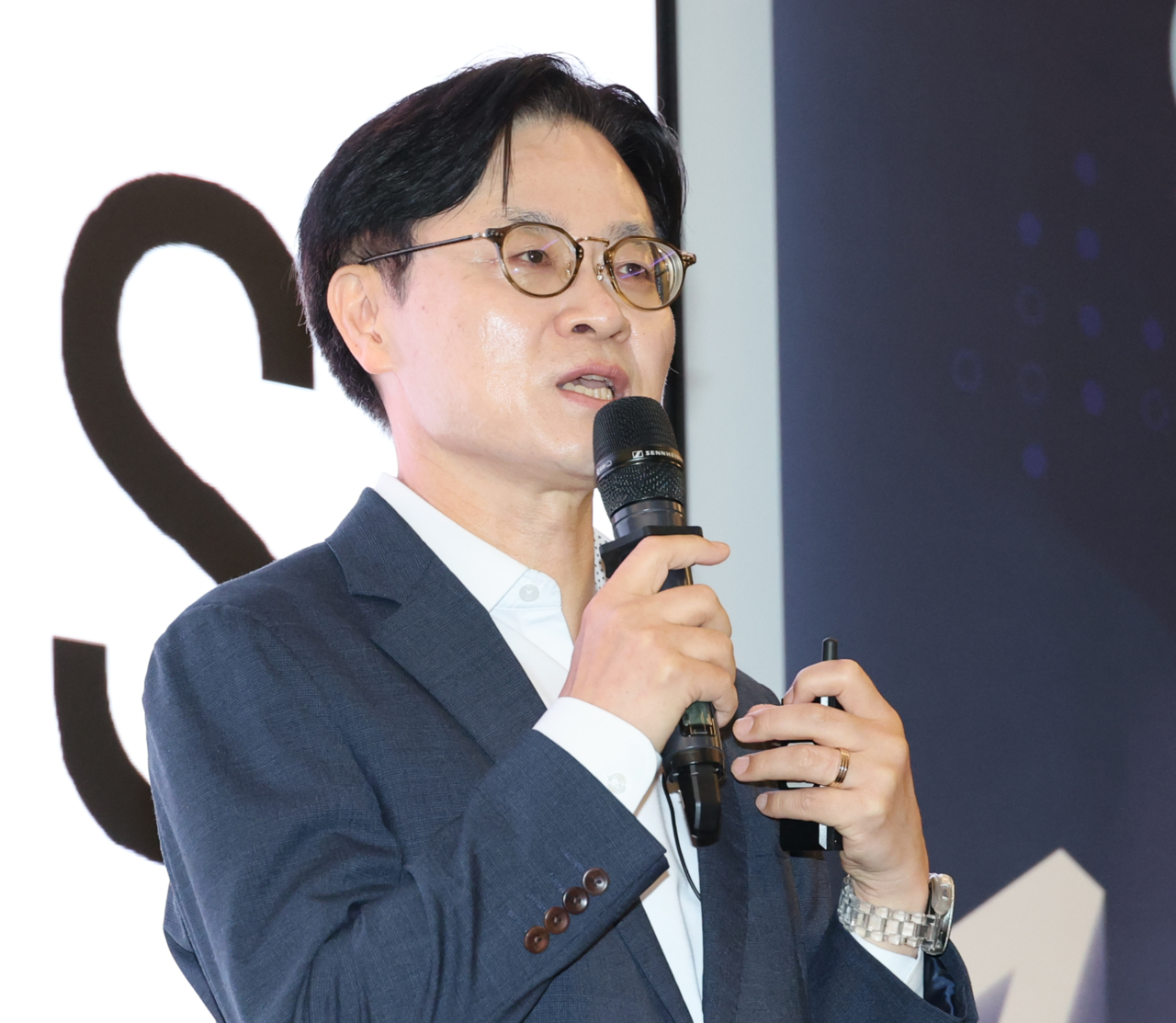
Park Hap-su, an adjunct professor at Konkuk University's Graduate School of Real Estate, said converting vacant or long-idle land through rezoning is "the single most viable option to consider first" for boosting housing supply. He added that creative deregulation should be applied to school-site requirements as the decline in the school-age population becomes more pronounced.
He also said that many existing business-use zones exclude officetels from permitted uses, and that flexibly adjusting existing land-use regulations — for instance by adding officetels to the list of permitted uses in such zones — is another approach worth exploring.
quq@heraldcorp.com
lucky@heraldcorp.com