Companies that have adopted a four-and-a-half-day workweek and other shorter-hours arrangements are seeing tangible results — new hires, improved operational efficiency and higher employee satisfaction, according to the government.
Participation in the government's "Work-Life Balance Plus 4.5 Project" has already surpassed its original target for this year, and authorities plan to expand funding and extend the push for shorter actual working hours to small and medium-sized enterprises.
The Ministry of Employment and Labor said Wednesday it held the eighth meeting of the "Actual Working Hours Reduction Roadmap Implementation Review Panel" to discuss best practices in reducing working hours — including adoption of a four-and-a-half-day week — and ways to embed those changes in the workplace.
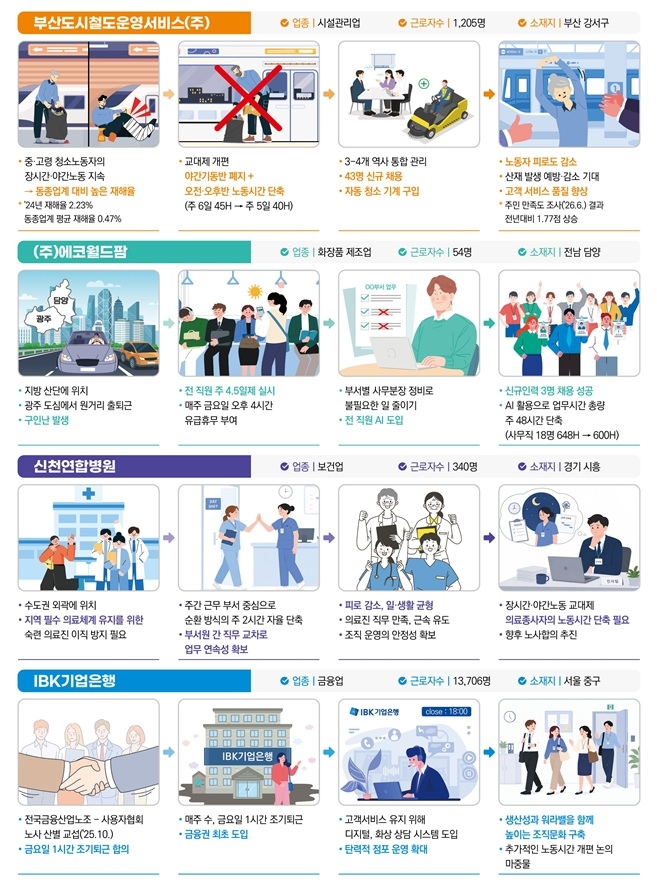
The panel was established to monitor the on-the-ground rollout and timely implementation of the "Actual Working Hours Reduction Roadmap," announced in December last year. It comprises representatives from labor, management and government, as well as outside experts. Wednesday's meeting was attended by labor and management representatives from companies that have reduced working hours, including Busan Metro Operations Service, Eco World Farm, Sincheon General Hospital and Industrial Bank of Korea.
Among the cases presented, those in which shorter hours led directly to new hiring drew particular attention.
Busan Metro Operations Service overhauled its shift system to reduce long hours and late-night work for older cleaning workers. Scheduled working days and hours for morning and afternoon shifts were cut from six days and 45 hours a week to five days and 40 hours, and the overnight mobile team was eliminated.
To minimize gaps in service coverage, the company reorganized operations so that three or four subway stations are managed together as a single unit, introduced automated cleaning equipment and hired 43 new workers.
As a result, 85 percent of employees surveyed said they were "very satisfied" with the five-day week, and 72 percent said they were able to perform their duties "in good physical health." Customer service satisfaction scores rose 1.77 points from the previous year, and no workplace accidents have occurred since the shift system was reformed.
Eco World Farm, a small and medium-sized enterprise based in Gwangju, introduced a four-and-a-half-day week for all staff as a way to attract and retain workers. Under the arrangement, employees work from 8 a.m. to noon every Wednesday, with the remaining four hours treated as paid leave.
The company offset the reduction in working hours by deploying AI across its operations. It covers the full cost of AI subscriptions for staff and uses the technology for tasks ranging from contract management, social insurance administration and cash-flow tracking to cost calculations, profit-and-loss reporting, sales document preparation and customer service.
As a result, total actual working hours for 18 office staff fell from 648 hours to 600 hours per week — a reduction of 48 hours. The company also hired three new employees after introducing the four-and-a-half-day week.
Sincheon General Hospital moved to cut working hours at the suggestion of its labor union, which sought to reduce the frequent turnover of skilled medical staff. Starting this month, 63 daytime workers in departments including the health screening center and outpatient nursing unit are participating in a voluntary two-hour weekly reduction scheme.
Individual employees choose either to leave early or arrive late, rotating the arrangement to keep patient care uninterrupted. The hospital plans to explore extending the shorter-hours policy to shift workers in the emergency room and wards, where long hours and overnight shifts are common.
Industrial Bank of Korea reduced working hours through a labor-management agreement without government support. Employees cut one hour each on Wednesdays and Fridays, using the freed-up time for non-face-to-face job training. To maintain customer service levels, the bank also expanded its digital and video consultation systems and introduced more flexible branch operating hours.
The government plans to build on these cases by expanding support to spread shorter working hours to small and medium-sized enterprises and other businesses.
As of the end of last month, 293 companies had reduced actual working hours — including through a four-and-a-half-day week — under the Work-Life Balance Plus 4.5 Project, already exceeding the government's original target of 220 companies for this year. As of July 22, the target achievement rate stood at 133.2 percent.
The panel said companies should be encouraged to view shorter working hours not as a simple cost but as a management strategy, and that sustainability requires parallel efforts to streamline workforce operations and drive technological innovation. Members also discussed ways to actively identify and share best practices across different regions and industries.
Bae Gyu-sik, co-chair of the panel, said shorter working hours can only be sustained when accompanied by changes that eliminate unnecessary tasks, improve work processes and raise productivity. "We hope that, based on the many best practices available, shorter working hours will spread to more and more companies," he said.
Lee Hyeon-ok, director general for labor policy at the Ministry of Employment and Labor, said the ministry would secure more funding for the Work-Life Balance Plus 4.5 Project given confirmed demand from the field. "We will take the lead in supporting more companies to reduce working hours so that good jobs can increase at small and medium-sized enterprises," she said.
fact0514@heraldcorp.com