
![Samsung Electro-Mechanics MLCC products [Yonhap]](https://wimg.heraldcorp.com/news/cms/2026/08/12/news-p.v1.20260728.cdfb3aa10b4e40fbbdd649fb533b8d0e_P1.jpg)
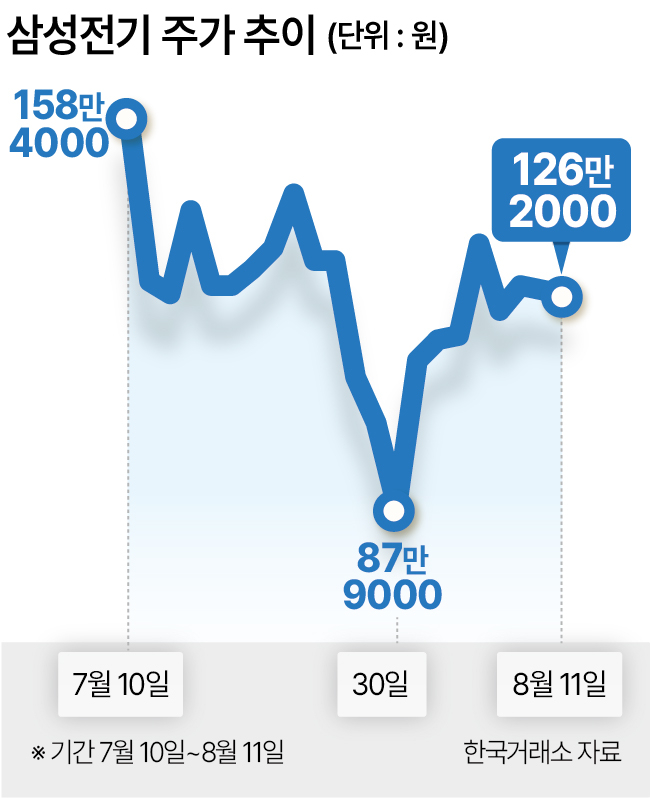
Morgan Stanley has swapped Samsung Electronics for Samsung Electro-Mechanics as its top pick among South Korean technology stocks, arguing that the recent selloff has created a buying opportunity. Samsung Electro-Mechanics shares, which had soared to around 2.4 million won ($1,700) on expectations of AI investment-driven demand, have since been cut roughly in half to around 1.2 million won.
The Wall Street bank also raised its price target to 2.62 million won, implying more than double the current share price. The call has drawn market attention given that it comes as a sharp recent decline has chilled investor sentiment — and that Morgan Stanley has effectively passed the top-pick mantle from Samsung Electronics to Samsung Electro-Mechanics.
Morgan Stanley recently designated Samsung Electro-Mechanics as its top pick and revised its price target upward, according to the financial investment industry. The bank had already maintained an "Overweight" rating on the stock; the top-pick designation signals it is now the firm's single most preferred name within its coverage universe.
Notably, Samsung Electronics had previously held the top-pick position in Morgan Stanley's South Korean technology sector coverage. The latest report marks a transfer of that distinction to Samsung Electro-Mechanics.
The price target was nudged higher. Morgan Stanley raised its base-case target from 2.56 million won to 2.62 million won. The bull-case scenario was left unchanged at 3 million won, while the bear-case scenario was trimmed to 1.35 million won.
The bank explained that raising the base target while keeping the bull-case ceiling and lowering only the bear-case floor reflects an adjustment for the wider share-price volatility seen recently.
Morgan Stanley said that even under the most conservative bear-case scenario, the stock still has upside from current levels, and that the base-case scenario implies roughly a doubling of the share price.
Morgan Stanley's optimistic outlook rests on what it sees as a structural rise in demand for multilayer ceramic capacitors (MLCCs) and Ajinomoto build-up film (ABF) substrates, driven by expanding AI data center investment. Both products require significant lead times to scale up supply, while demand is already growing rapidly — making it structurally difficult for supply to keep pace, the bank said.
In the MLCC market, a series of price increases rolled out during the first half of this year. Murata moved first, raising prices on products for AI servers and premium automotive applications, followed by Taiyo Yuden, which extended increases across its entire product lineup including consumer-grade items. Taiwan's Yageo and Walsin then followed suit. Samsung Electro-Mechanics, meanwhile, has temporarily suspended distributor quotations ahead of its own price adjustment.
The premium AI-grade MLCC segment operates as a duopoly effectively split between Japanese and South Korean players. Murata and Samsung Electro-Mechanics together hold roughly 85 percent of that market. Across the broader MLCC market, Murata leads with about 41 percent share, with Samsung Electro-Mechanics holding a clear second place.
Morgan Stanley added that Samsung Electro-Mechanics has already signed long-term contracts with about 10 customers, moving toward institutionalizing its pricing structure.
On the supply side, the bank sees little prospect of the bottleneck easing for now. Murata's additional premium capacity, Samsung Electro-Mechanics' expansion in the Philippines, and Taiyo Yuden's South Korea server-grade capacity are all not expected to come fully online until 2027 or later. Until then, the only meaningful near-term supply addition is the conversion of Samsung Electro-Mechanics' Tianjin factory to higher-capacity products.
Compounding the supply constraint, manufacturers themselves are limiting annual output growth to around 10 to 15 percent and are inclined to wait for confirmation that price increases are holding before committing to further investment — a cautious posture that Morgan Stanley said will itself prolong the supply shortage.
The outlook for ABF substrates is equally positive. Drawing on its own supply-demand model updated in July, Morgan Stanley projected that the ABF substrate supply deficit will reach 25 percent by 2030, up from its previous estimate of about 22 percent.
The bank particularly emphasized that the composition of the market is fundamentally shifting: PC-related demand accounted for roughly 70 percent of the total ABF market in 2015, fell to 23 percent in 2025, and is projected to drop below 10 percent by 2030.
"MLCCs could become a new AI 'picks and shovels' investment with high leverage to data center investment expansion," Morgan Stanley wrote in the report, adding that "ABF demand is also continuing to strengthen."

th5@heraldcorp.com





