![MG vehicles manufactured by China's SAIC Motor wait to be loaded for export at Lianyungang port in Jiangsu Province, China, in June. [AFP]](https://wimg.heraldcorp.com/news/cms/2026/08/13/rcv.YNA.20260617.PAF20260617218501009_P1.jpg)
Chinese-made electric vehicles held a 35% share of South Korea's EV market in the first half of this year, while their share in the United States stood at virtually zero — a stark divergence that analysts say reflects the height of the defensive barriers each country has erected against Chinese automakers.
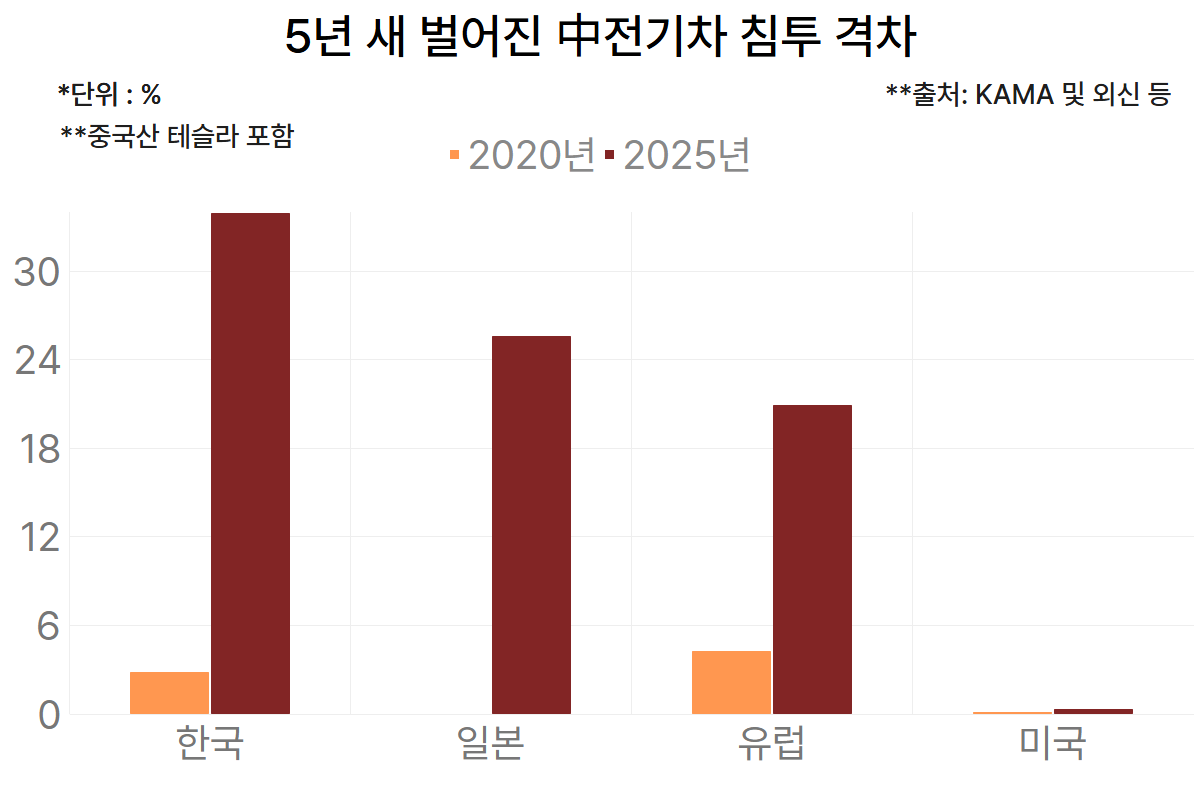
According to the Korea Automobile Mobility Industry Association and other sources, South Korea's battery electric vehicle market totaled 220,177 units last year, of which 74,728 — or 33.9% — were Chinese-made, including Teslas produced in China.
As recently as 2020, Chinese-made EVs accounted for just 1,314 units and a 2.8% share of the domestic market. In five years, that share surged by 31.1 percentage points — roughly 12 times the earlier level. The trend continued into this year, with the share reaching 35% in the first half.
The US market tells a sharply different story. In 2020, Chinese-made vehicles accounted for just 231 units out of 259,210 total BEV sales — a 0.1% share. Last year, even as the US BEV market expanded nearly fivefold to about 1.24 million units, Chinese-made sales reached only 4,154 vehicles. The share edged up to just 0.3%, a gain of only 0.2 percentage points over five years.
Over the same period, Chinese EVs' share climbed from zero to 25.6% in Japan and from 4.2% to 20.9% in Europe. Among major markets, the United States alone has in effect blocked Chinese EV penetration.
Even with Chinese cars effectively banned, US dealers push for permanent exclusion
Calls to shut Chinese automakers out of the US market are growing louder even though Chinese-made EVs hold a mere 0.3% share there.
The American International Automobile Dealers Association, which represents foreign-brand auto dealers across the United States, launched a "No China Autos" campaign on Aug. 4 and publicly backed legislation that would permanently bar Chinese automakers from the US market. The AIADA has about 9,400 member dealerships. It is unusual for a trade group whose business depends on selling imported vehicles to call for blocking an entire country's automotive brands from the market entirely.
![Visitors browse the BYD exhibition booth at the Beijing Motor Show in Beijing, China, in April. [AFP]](https://wimg.heraldcorp.com/news/cms/2026/08/13/rcv.YNA.20260426.PAF20260426003601009_P1.jpg)
Mike Darrow, president of the AIADA, said the threat posed by Chinese brands "is getting closer." He warned that if Chinese automakers continue to flood markets with low-cost vehicles backed by massive government subsidies and excess production capacity while engaging in predatory export practices, the result would be falling market share for established brands, deteriorating dealer profitability and ultimately job losses in the United States.
The National Automobile Dealers Association, which represents the entire US auto dealer industry, has echoed those concerns. NADA CEO Mike Stanton said 95% of the association's board members this year support administration policies aimed at keeping Chinese automakers out of the US market, arguing that Chinese vehicles pose risks not only to the American auto industry but to the country and consumers as well.
Underlying these calls is a fear that failure to stop unfair competition from Chinese manufacturers could make the United States "the next in line." Chinese brands' sales in Europe jumped 118% year-on-year in June, with their market share hitting a record high of 10.9%. In Mexico, one in every five new vehicles sold last year was made in China.
China's passenger car exports have grown nearly tenfold, from about 600,000 units in 2020 to about 5.74 million last year. In the first half of this year alone, China exported about 5.09 million vehicles, up 65% from the same period a year earlier.

127.5% tariffs and connected-car rules: America's layered defense
The United States has already built the world's highest tariff wall against Chinese-made EVs. The maximum tariff rate on Chinese BEVs reaches 127.5% — a combination of a 2.5% base tariff, a 100% additional tariff under Section 301 of the Trade Act and a 25% tariff under Section 232.
Even so, some argue that tariffs alone are not enough, as Chinese companies are seeking ways to circumvent high duties by building factories in third countries. Zhang Guibing, president of Chery Automobile, recently left the door open to entering the US market, saying the company hopes to do so "when the right time comes."
As tariff barriers have risen, some Chinese automakers have pivoted from exports to local production. BYD, Geely, Chery and Xpeng are expanding their manufacturing footprints into Hungary, Spain, Brazil, Thailand, Indonesia and other countries. Since October last year, Chinese automakers and parts suppliers have announced more than 15 overseas projects, with planned investment reaching about 70 billion yuan ($10.4 billion).
In response, the United States is moving to extend regulations to connected vehicles made by companies with significant Chinese ownership. Polestar, in which China's Geely holds a controlling stake, has already been caught by connected-car rules that restricted US sales of its 2027 model. The rationale is to prevent location data, driving records, photos, video and other information from leaking through vehicles connected to communications networks.
![Zeekr 7X (top left, clockwise), Tesla Model Y, Polestar 4 and BYD Dolphin. [Zeekr, Tesla website, Herald DB]](https://wimg.heraldcorp.com/news/cms/2026/08/13/news-p.v1.20260804.9064c8d543be462191d1feadc7640632_P1.jpg)
Europe's slow response a cautionary tale as Korea warned its window is closing
Alarm within South Korea's auto industry is reaching a tipping point. Industry insiders warn that the "golden window" for responding to the Chinese EV challenge is closing. With Chinese-made EVs already deeply embedded in the domestic market, further delay could make it impossible to reclaim market leadership. The cautionary example the industry watches most closely is Europe.
The EU currently imposes tariffs of up to 45.3% on Chinese-made EVs, combining a 10% base tariff with company-specific countervailing duties. However, the top rate does not apply uniformly to all Chinese EVs — Tesla vehicles made in Shanghai face a 17.8% rate, while BYD faces 27%, with rates varying by manufacturer. Crucially, the final countervailing duties only took effect in October 2024, by which point Chinese EVs had already made rapid inroads into the European market.
Chinese-made vehicles accounted for 20.9% of Europe's BEV market last year. The momentum has continued into this year, with BYD sales up 145.5% year-on-year in the first half and Chery Group up 305.8%.
"Chinese vehicles are rapidly gaining share in major markets outside the United States, including Europe and Latin America," said an official from South Korea's auto industry. "If Korea's national-level response is delayed any further, the very competitive foundation of our domestic auto industry could be shaken."
kwater@heraldcorp.com