
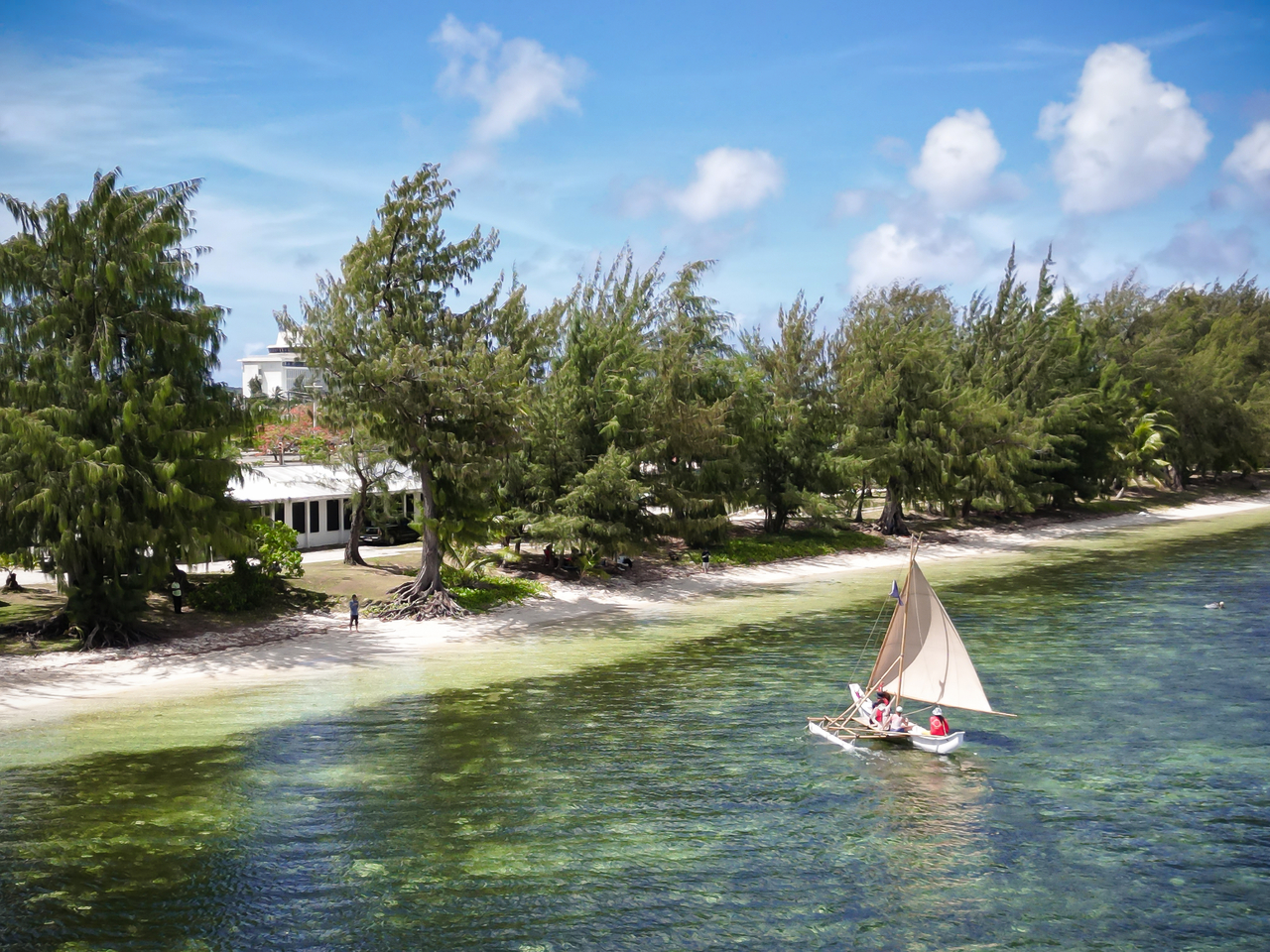
A typhoon left Saipan with serious damage, but paradoxically handed the island's tourism ecosystem a chance to reinvent itself. With Managaha — long the symbol of island tourism — temporarily closed to visitors while it recovers, the untouched landscapes of the eastern coast and mountain interior have rapidly emerged as compelling alternatives.
Beaches and forests emptied of crowds have put Saipan's raw natural beauty on full display. For travelers seeking quiet solitude away from the bustle, Saipan has become a clear sanctuary — a place to visit right now.
Managaha closed, East Bay steps up as the alternative
![A panoramic view of East Bay, a new attraction on Saipan's eastern coast [Kim Myung-sang]](https://wimg.heraldcorp.com/news/cms/2026/08/14/news-p.v1.20260814.53b1e3ed2c8e4f3f84d034fc5274cf70_P1.jpg)
Managaha Island — known as "the jewel of Saipan" and a paradise for water activities — remains closed to tourists as of early August. The typhoon's powerful winds snapped large trees across the island en masse, severely damaging the nesting habitat of seabirds that breed there, on top of destroying the island's facilities and infrastructure.
With Managaha out of the picture, East Bay — near Lao Lao Bay on the island's eastern side — has emerged as the new base for snorkeling and water activities. Unlike the calm, shallow waters of Saipan's western beaches, East Bay features rugged terrain where near-vertical rock cliffs meet the sea head-on. The absence of sandy beaches has kept hotels and resorts away, and that very condition has, paradoxically, shielded the area from development and preserved its pristine natural beauty.
![The jump zone at East Bay where visitors can leap into the sea [Kim Myung-sang]](https://wimg.heraldcorp.com/news/cms/2026/08/14/news-p.v1.20260814.8f76bb0e1262469897b4ba81db6999e1_P1.jpg)
A local guide described East Bay as "the ideal spot where you can experience both the colorful underwater world you'd find at Managaha and the rugged terrain of the Grotto sea cave along the coastal cliffs."
Entering the water, visitors encounter schools of butterflyfish, parrotfish and boxfish weaving through shallow coral reefs along the shore. A few steps further out, the seafloor drops away sharply into a dramatic underwater cliff.
The defining feature of East Bay's marine ecosystem is its role as a communal habitat for wild sea turtles. "At peak times I've spotted up to 17 turtles," the local guide said. "Their shells are the same color as the rocks, so you often don't notice one right beside you — when that happens, we sometimes dive down and give it a gentle nudge to wake it up." The area is also where hawksbill rays occasionally break from the group and make an appearance.
![A tourist diving into the sea at East Bay [Kim Myung-sang]](https://wimg.heraldcorp.com/news/cms/2026/08/14/news-p.v1.20260814.0d87f86985b7413db20261ec9c50b911_P1.jpg)
The highlight of East Bay is a jump platform standing 4 to 5 meters above the water. The spot gained attention after actor Lee Si-young was reported to have leaped from it while heavily pregnant. The height triggers a primal fear response, making it hard to take the plunge — but those who do are rewarded with a spectacular underwater world below.
The road from town to East Bay is unpaved, and the entrance sits on private land secured with a padlock, making it impossible to visit without a guide. Tours can currently be booked through the local operator Saipan Adventure's website or through PIC Saipan.
A jungle tour reveals a different side of Saipan
![Forbidden Island as seen from the observation deck [Kim Myung-sang]](https://wimg.heraldcorp.com/news/cms/2026/08/14/news-p.v1.20260814.05fc3f5ad16b4dc08ca00b0aa4506ebc_P1.jpg)
Saipan's main tour offerings fall into two broad categories: the northern tour and the jungle tour. The jungle tour has been restructured in the typhoon's aftermath and is operating on a revised route for now — combining what were previously separate mountain and eastern coastal courses into a single itinerary. The merged route lets visitors take in both the island's central highlands and the rugged cliff terrain of the southeast in one trip. "I've visited Saipan many times, but this is the first time I realized how vast and varied the island really is," one tourist said.
Forbidden Island, the centerpiece of the eastern course, has a distinctive topography that calls to mind Jeju's Seongsan Ilchulbong. From the observation deck, deep navy Pacific waters crash against sheer vertical cliffs, sending up walls of white surf. The Chamorro people, Saipan's indigenous inhabitants, have long regarded it as a sacred resting place of the gods. The island's perimeter is ringed by steep coastal cliffs battered by powerful Pacific currents, while its summit has been worn flat into a vast plateau — a striking contrast in a single landscape.
![A Japanese military bunker at Tank Beach [Kim Myung-sang]](https://wimg.heraldcorp.com/news/cms/2026/08/14/news-p.v1.20260814.ea401ccb476b467995007c6d5b401341_P1.jpg)
Not far from Forbidden Island, Tank Beach bears witness to the tragic history of World War II. Traces of the fighting from the 1944 American amphibious landing still mark the shoreline. Visitors who look carefully along the beach's edges and between the rocks can find remnants of Japanese bunkers and rusted shell casings left behind from the war.
![The town of Garapan and the sea as seen from the summit of Mount Tapochau [Kim Myung-sang]](https://wimg.heraldcorp.com/news/cms/2026/08/14/news-p.v1.20260814.951991b82f4d4d438332afe92660a65d_P1.jpg)
The highest point on the mountain course — and on all of Saipan — is the summit of Mount Tapochau at 474 meters above sea level. Visitors reach the observation deck at the top via a four-wheel-drive vehicle along an unpaved gravel track, where the entire island unfolds in a full 360 degrees. Positioned at the island's center, the mountain offers clear-day views stretching from the emerald lagoon and Managaha Island to the west all the way to the deep Pacific to the east.
![The view from the summit of Mount Tapochau [Kim Myung-sang]](https://wimg.heraldcorp.com/news/cms/2026/08/14/news-p.v1.20260814.38005f83c028400bb6937fbcc1c3cd1b_P1.jpg)
At the center of the summit stands a statue of Jesus Christ rising about 5 meters tall including its base, facing out toward the Pacific. Cast in plain concrete rather than ornate materials, it is known locally as "Concrete Jesus." On an island where Spanish colonial rule planted deep Catholic roots, the statue was erected as a prayer for peace after the war.
![The Santa Lourdes outdoor shrine [Kim Myung-sang]](https://wimg.heraldcorp.com/news/cms/2026/08/14/news-p.v1.20260814.6ba50f3088f94903b6475db34d5a0b0d_P1.jpg)
At the foot of Mount Tapochau, the Santa Lourdes outdoor shrine is regarded by local Catholics as "land divinely protected by God and the Virgin Mary." Even as the island endured fierce bombardment during World War II, the open-air shrine and its cave altar emerged unscathed.
A well on one side of the shrine flows year-round. Its water has long been considered sacred and healing by residents. Local lore holds that applying the water to one's head brings wisdom, and students facing important exams have been known to make the pilgrimage. The recent typhoon damaged branches of the banyan trees surrounding the shrine, but the shrine building and the well itself came through intact — sustaining the site's long-standing reputation as hallowed ground.
Jeju Air currently operates four flights a week between Incheon and Saipan. The outbound flight departs Incheon at 8:20 p.m. and arrives in Saipan at 2 a.m. the following day (local time), while the return flight departs Saipan at 3:05 a.m. (local time) and lands at Incheon International Airport at 6:50 a.m. the same day. Departure and arrival times and flight frequency are subject to change without notice.
terry@heraldcorp.com





