Banks' digital asset operations are expected to expand beyond deposit tokens and stablecoins into tokenized bonds, funds and real-world assets, an industry official said. As payment instruments and investment products diversify, the ability to connect them with existing financial systems will become a core competitive advantage for financial firms.
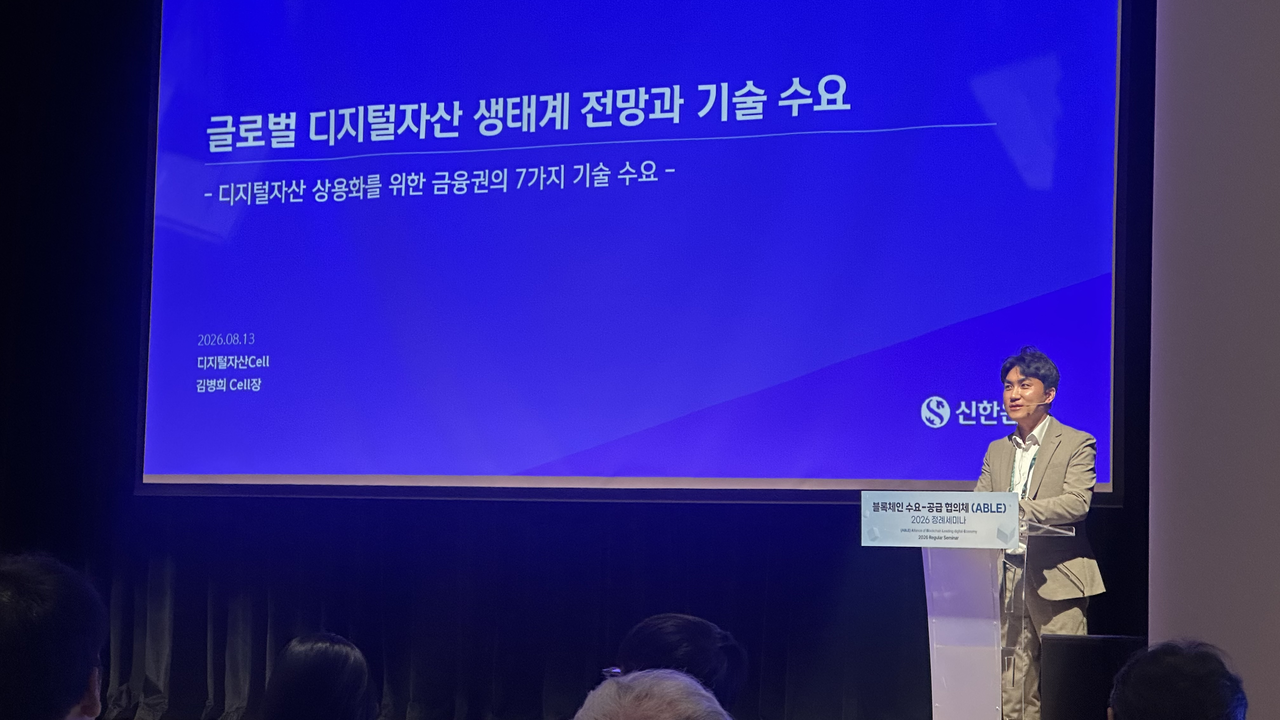
Kim Byung-hee, head of Shinhan Bank's digital asset cell, said Thursday at the regular seminar of ABLE (Alliance of Blockchain Leading digital-Economy) — a blockchain supply-and-demand consultative body organized by the Ministry of Science and ICT and the Korea Internet & Security Agency, held at the Textile Center in Samseong-dong, Seoul — that "deposit tokens, stablecoins and cash will each likely retain distinct roles and develop in a mutually dependent way."
"From a financial firm's perspective, the key question is how to connect different forms of money and allow customers to use them seamlessly," Kim said. He added that banks would expand from managing payment and settlement assets — such as CBDCs, deposit tokens and stablecoins — into investment assets including tokenized bond funds and real-world assets.
Kim drew on his experience meeting with major Japanese banks and brokerages last month, saying the institutions commonly told him that issuing tokens itself was not a major challenge. "What they were wrestling with was how to connect token systems with their existing legacy infrastructure," he said.
In Japan, 3 trillion won ($2.12 billion) in STOs have already been issued and private stablecoins have emerged, shifting market attention toward liquidity management and back-office automation. Kim also highlighted delivery-versus-payment — the simultaneous exchange of assets and settlement funds — as another area drawing close attention from Japanese financial firms.
As digital assets move into the mainstream financial sector, Kim outlined three broad challenges domestic financial firms must address: customer and asset control, regulatory system integration, and accommodating new types of financial transaction participants. He said firms need frameworks not only to safeguard customer assets but also to manage transaction permissions, connect blockchain activity with existing anti-money-laundering, accounting and tax operations, and ultimately recognize AI agents as legitimate financial transaction participants.
He said these shifts are generating technology demand across four areas: institutional custody, integration with financial and tax legacy systems, CBDC lifecycle management, and AI agent wallets.
Kim said institutional custody must be approached as an operational framework encompassing the full range of financial functions, not merely a storage solution. "A cold wallet is a storage technology; custody is financial operations that include storage," he said. Pointing to the Ministry of Economy and Finance's announcement that digital assets would be managed as national assets, he said institutional custody would grow in importance and that preparation was needed.
Connecting blockchain payments with existing financial and tax systems is also essential before they can reach full commercial use. When a foreign visitor pays at a domestic merchant using USDC via QR code, the transaction may be seamless for the consumer, but it triggers a chain of back-office work for the financial firm and merchant — settlement, transaction verification, value-added tax processing, tax refunds and foreign exchange operations.
"Many technology companies emphasize that they have succeeded at the payment itself, but that alone is not enough to reach full commercialization," Kim said. "It can only become a real commercial service when it covers the back-office work that financial firms and the government consider essential."
Kim said lifecycle management after issuance is equally critical for digital currencies, particularly in handling abnormal transactions and exceptional situations. "If 10 billion won in stablecoins are issued and redemption requests suddenly flood in, or a specific address needs to be frozen, there has to be an answer for what to do," he said. "How to recover and process erroneously issued or misdirected transactions also matters."
He also said the financial sector needs to prepare for AI agents emerging as a new class of financial transaction participants. While financial firms have traditionally categorized customers as individuals or corporations, he said that if laws and regulations come to define the legal status of AI agents, they could establish themselves as an entirely new customer type.
In that scenario, digital wallets could evolve beyond simple asset storage into infrastructure for setting the permissions and responsibilities of AI agents. Kim said a "KYA" (Know Your Agent) framework may also be needed — one that configures transaction limits, accessible products, operating hours and payment scope for each agent and verifies the relevant permissions.
"Looking at recent industry trends, banks, brokerages and asset managers have all been setting up a lot of digital asset teams," Kim said. "I think that reflects how digital assets are in the process of seeping into the financial sector."
He went on to say that "the last mile of blockchain technology depends on how it connects with and takes root in the operational systems of existing industries."
kyoung@heraldcorp.com