Dollar stablecoins spread, raising questions for won and domestic finance
Cross-border payments shift on-chain as exchanges eye expanded role
Robinhood Chain, Polymarket cited as market races ahead of rules

"Dollar stablecoins are nothing short of a shock. They could effectively strip a country of one of the most important tools it has for running its economy — discretion over monetary policy."
Oh Tae-min, chief executive of Dugby Co., said Saturday at Herald Money Festa 2026, held at the art hall of Dongdaemun Design Plaza (DDP) in Seoul, that the spread of dollar stablecoins could reshape the existing monetary and financial order.
Oh said US fiscal problems are the main driver behind Washington's push to bring dollar stablecoins into the regulatory mainstream. "One of the biggest reasons the US finds itself cornered right now is the government bond issue," he said. "Ultimately, the goal is to convert the savings sitting in the pockets of Indians, Chinese, Koreans and Japanese into US government bonds."
He also raised the possibility that wider dollar stablecoin adoption could erode the standing of the won and other non-dollar currencies. "When you hold won, it means your bank is using those funds to hold Korean government bonds and similar assets," Oh said. "If that money goes into Tether instead, fewer Korean bonds get sold and more US bonds do."
"The more US bonds are sold, the fewer local government bonds around the world get sold — it could become a zero-sum game," he added.
He said this dynamic could also constrain central bank monetary policy. "Currency and finance are inseparable," Oh said. "If countries are forced to align their interest rates with the US just to maintain their exchange rates, their discretion over monetary policy will inevitably shrink."
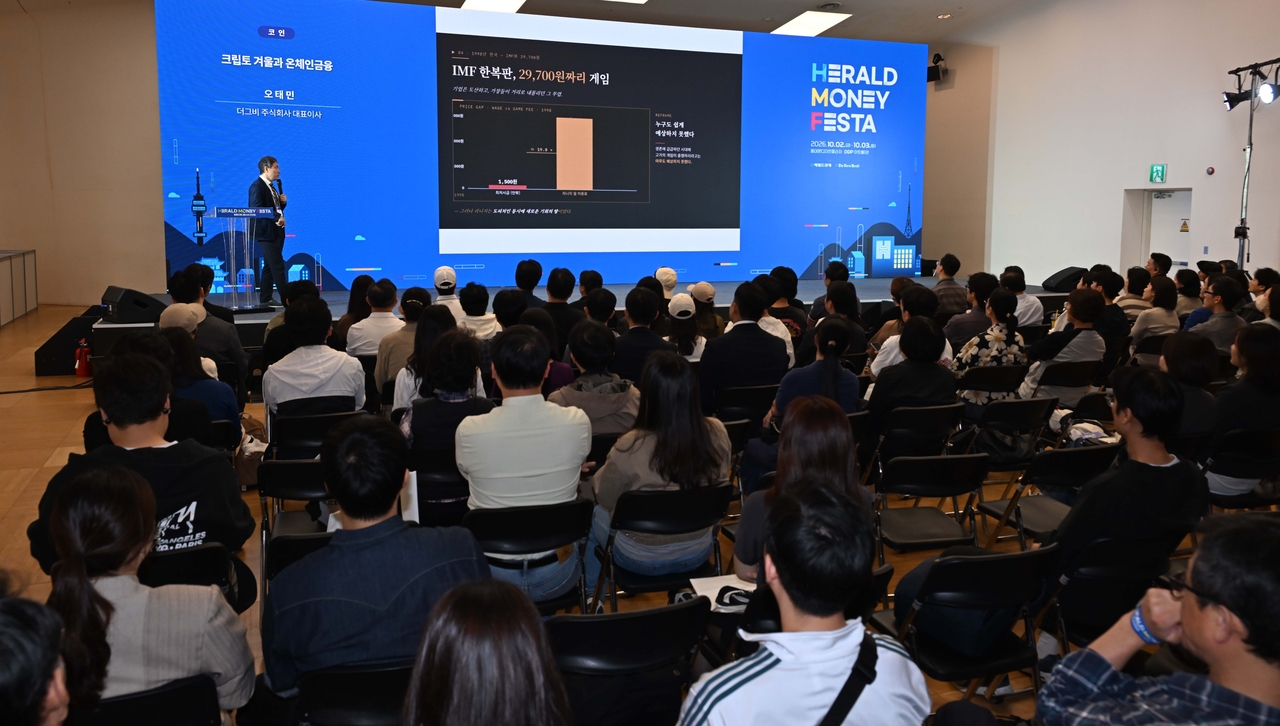
Oh also highlighted how payment and remittance functions long handled by traditional financial institutions are migrating to on-chain markets. He described a scenario in which a Korean importer buys Tether (USDT) on a domestic exchange, sends it to a Japanese exporter, who then converts it to yen on a Japanese exchange. "At the very quickest, it's done in three to four minutes — even at a generous estimate, 30 minutes," he said. "Money moves without banks."
He went on to say that exchanges are becoming hubs in business-to-business transactions. "That is why I say banks need to own exchanges if they want to survive," Oh said. If regulations allow, exchanges could expand beyond simple trading brokerage into credit, payments and other areas traditionally dominated by financial institutions.
Oh also drew attention to the on-chain market growing faster than regulators can keep up.
On the layer-2 blockchain Robinhood Chain, new trading pairs have emerged that bundle meme coins with tokenized stocks such as Nvidia and SpaceX. According to DeFiLlama, Robinhood Chain recorded $25.09 million in sales over the past month. "Real-world assets are subject to quite a lot of regulation, yet the back doors are wide open," Oh said. "That's not Robinhood's imagination — it's the users' imagination."
He attributed the phenomenon to user demand. Citing the Korea Communications Standards Commission's recent move to block access to Polymarket, Oh said regulators should ask why users are drawn to prediction markets in the first place. "If you keep regulating centralized exchanges, the demand doesn't disappear — it just moves somewhere else, like decentralized exchanges," he said.

kyoung@heraldcorp.com