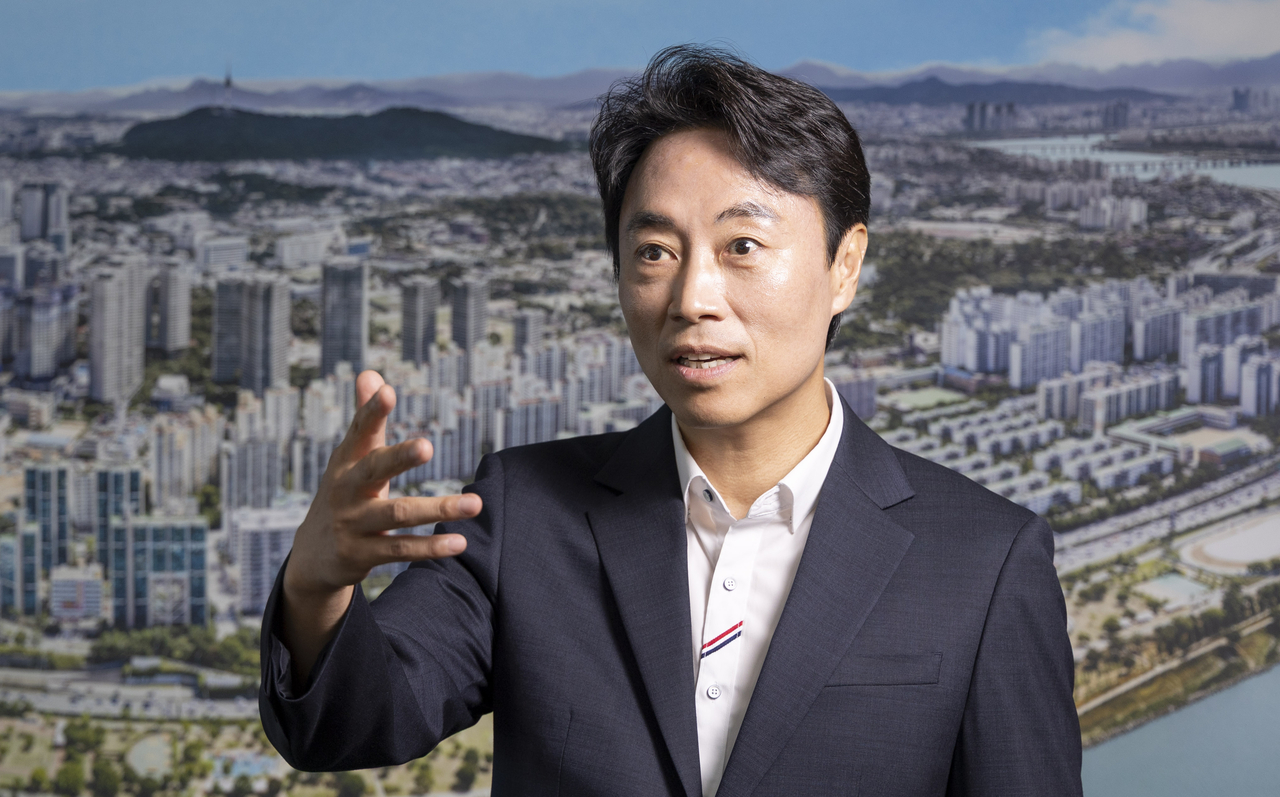
Kim Gyeong-dae entered politics in his early thirties and served three consecutive terms as a Yongsan-gu district council member before winning the district mayorship on his third attempt in the ninth round of local elections. Having watched Yongsan's transformation more closely than almost anyone, Kim said he is committed to doing his utmost during his term to shape the district's future. He was particularly emphatic about the government's plan to consider Yongsan Park as a housing supply site, calling the park "a legacy that must be preserved for future generations" and vowing to "stop it without fail, even if I have to lie down in the street." The following is an edited transcript of the interview conducted Wednesday afternoon at his office in the Yongsan district office.
— What does it feel like to become district mayor after three terms as a district council member?
Both roles share the same goal — working for residents' happiness and local development. The difference is that a council member listens to residents and proposes policy, while a district mayor must plan and execute that policy and be accountable for the results. The weight of responsibility is different. Every decision — from the upcoming supplementary budget to various projects to disaster response — affects residents' daily lives, so I try to exercise careful judgment every single day. When I compare the complaints I heard from residents during my time on the council with what I have encountered in the field since taking office, they are not very different. The biggest demands are for faster development and for solutions to everyday inconveniences — traffic, parking, education and safety. Now it is my job to turn those voices into policy and deliver results.
— You have publicly opposed the government's plan to consider Yongsan Park as a housing supply site under its real estate measures. Why is Yongsan Park off limits?
I think of this not as a question of "why" but as an axiom. Historically, this land was occupied by Qing dynasty troops, then by Japanese forces after the First Sino-Japanese War, and then by US forces after liberation. It returned to us after 120 years. The Special Act on the Creation of Yongsan Park established a full social consensus that this land would be developed solely as a park — a position the Democratic Party of Korea also agreed to. Now, suddenly, there is talk of building apartments inside the park. Raising the development density or expanding the residential function of a space that should be handed down to future generations risks destroying the park's intrinsic value and public character. The value of Yongsan Park lies not in how many housing units it can supply, but in how we complete a national park where history, culture and ecology coexist — one worthy of representing the Republic of Korea. If the government pushes ahead with developing Yongsan Park, I will stop it even if I have to lie down in the street. This is not just a Yongsan issue — it could be an issue for all Seoul residents, and indeed for the entire nation. It is our obligation to our descendants.
— You have also opposed the government's plan for the Yongsan International Business District.
The Yongsan International Business District is the same story. I am not opposed to housing supply as such — what matters is where and how it is provided. The district was planned from the outset as a national strategic space aimed at becoming a global business hub representing South Korea. It needs a proper balance of office, commercial, cultural and residential functions. If the residential share becomes too high, the international business function will be weakened and the burden on infrastructure — transportation, schools and the like — will increase considerably. Once an urban planning decision is made, it is very hard to reverse, so we must prioritize the long-term competitiveness of Yongsan and Seoul over short-term housing supply targets. Yongsan-gu has consistently maintained that the original plan of 6,000 units must be kept. Going forward, I will monitor the consultation process among the relevant agencies — including the Seoul Metropolitan Government and the Ministry of Land, Infrastructure and Transport — and make sure that residents' wishes and voices from the field are fully reflected in the decision-making process.
— Is there one signature policy you are determined to deliver results on during your term?
If I had to name one, it would be "unimpeded Yongsan development." That phrase captures both speed and direction. There are currently 91 development projects under way in Yongsan, but many have stalled. That is why I used the word "unimpeded." Yongsan is on the verge of the biggest transformation in all of South Korea — not just Seoul — with large-scale national projects and residential environment improvements. If we miss this opportunity, it will be decades before we get another foothold for a leap forward. The district office must be proactive, not passive, across all development projects. Rather than standing by while residents clash, I want to make the effort to resolve those conflicts — that is how projects move faster. Excessive intervention is not appropriate, but where we can act, we should mediate actively and keep projects moving. To that end, I have established a Yongsan Development Fast-Track Task Force and appointed a conflict management coordinator. That said, when I talk about unimpeded development, I do not mean speed alone. Development is truly successful only when its benefits spread beyond specific areas to neighborhoods that have lagged behind, and when improvements to everyday infrastructure and safety are achieved alongside it.
— What changes can residents expect to feel during the ninth term of local government?
Hardware changes like development projects do not happen quickly — they take years at minimum. What I want residents to feel is a software change. Until now, resident participation has been limited to a handful of opinion leaders such as neighborhood heads and professional associations. I want to break down the "us versus them" divide and create an environment where all residents come together and take part in district activities. I intend to apply the same thinking to the administration itself. I want to change the rigid organizational culture among staff. A structure where everything flows downward from the district mayor at the top is not right. An organization that is tough on the weak and weak on the tough can never be a healthy one. There must be a hierarchy in how work gets done, but I want to build an organizational culture where principles and common sense are respected — not rank or title. Good administration comes from an organization built on mutual respect and trust, and the results will ultimately translate into public services that residents can feel. Alongside this, I have set "Yongsan — a city of charm that opens the future" as the slogan for the ninth term. If we raise Yongsan's appeal and draw more people to the district, its residents will feel a greater sense of pride.
ikson@heraldcorp.com