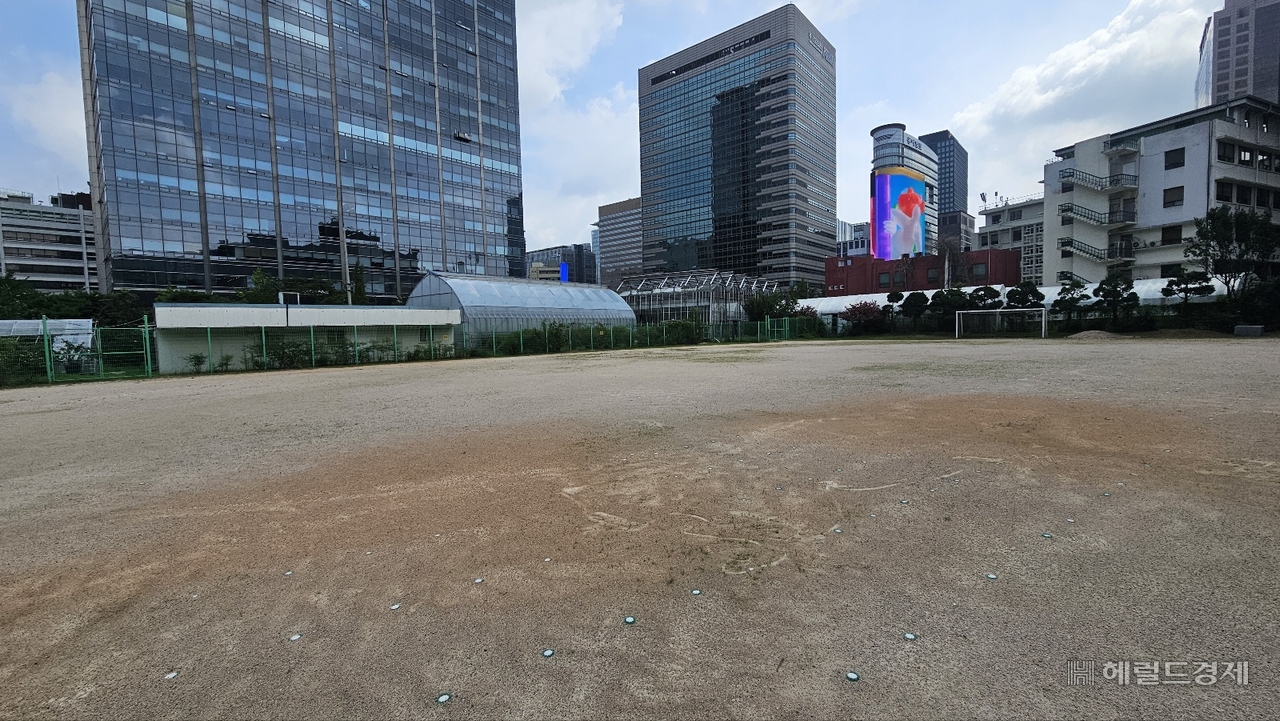
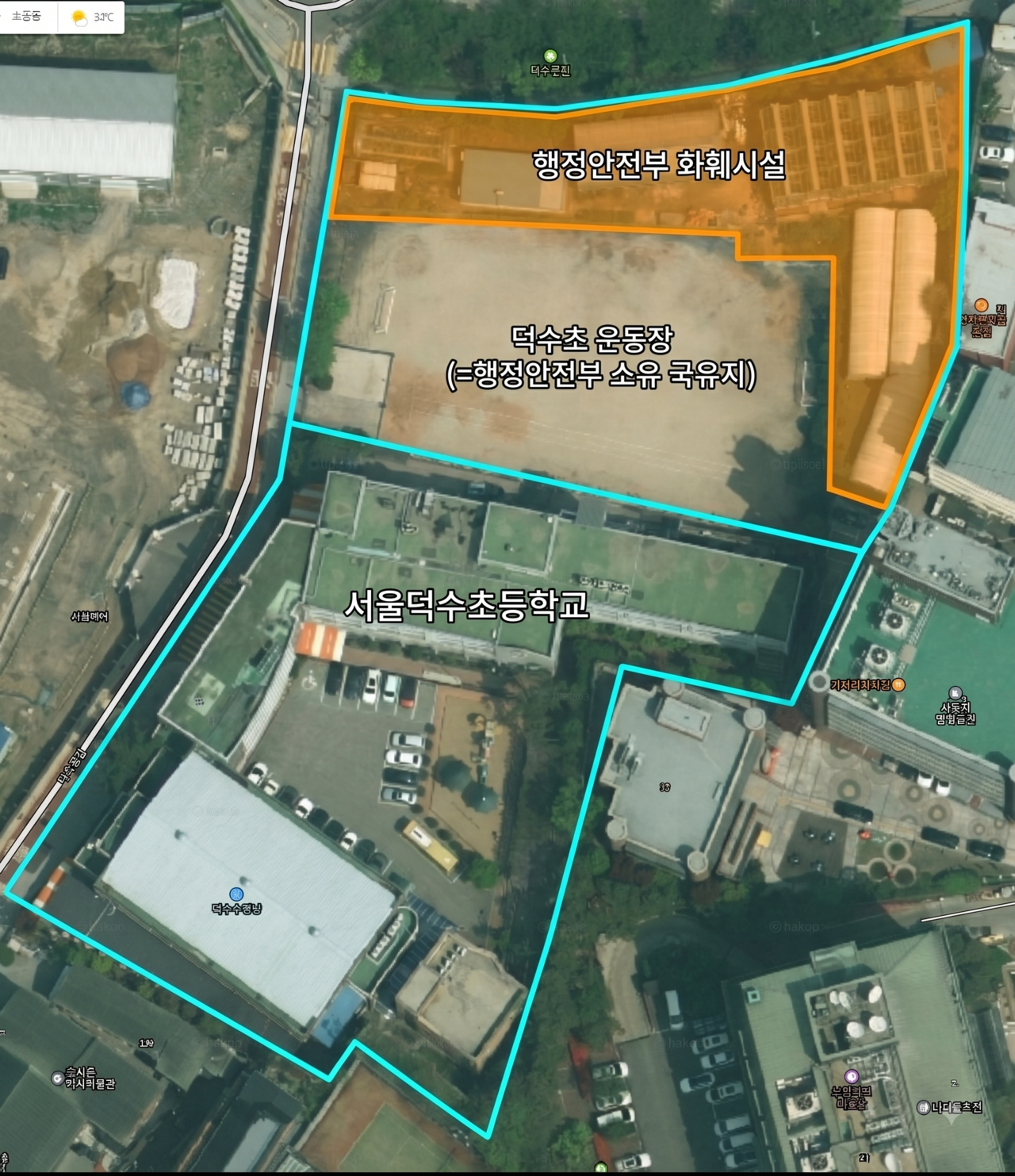
Deoksu Elementary School sits tucked between the high-rise office towers lining Sejong-daero in central Seoul. Founded in 1912, the school occupies the heart of the capital — yet the playground where its students run and play belongs not to the school or the Seoul Metropolitan Office of Education, but to the Ministry of Interior and Safety.
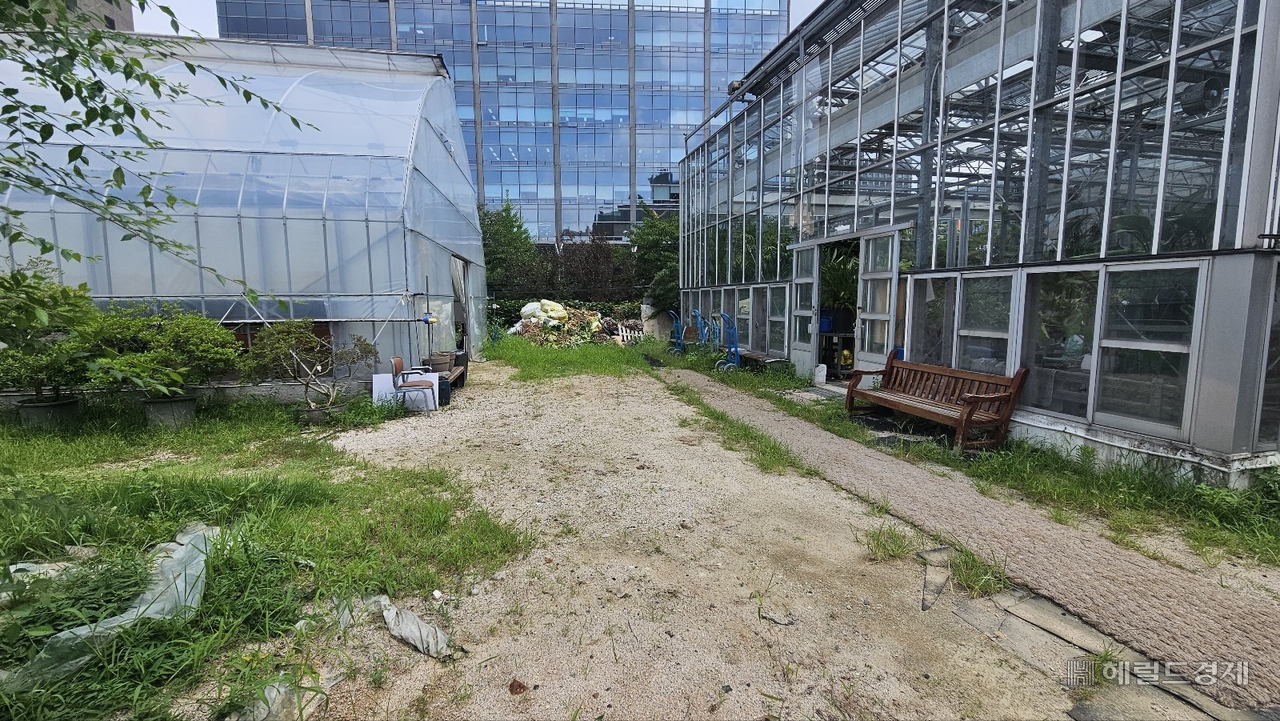
On one side of the playground stands a flower-cultivation facility managed by Government Complex Seoul; maintenance vehicles and workers pass through the school grounds to reach it. Parents have been staging picket protests since last month, calling for a complete ban on vehicle access, the installation of a separate entrance and the relocation of the flower facility.
The land came under the ownership of the General Affairs Office — the predecessor of the Ministry of Interior and Safety — in the 1990s through a series of inter-agency land swaps and transfers of state property management. At the time, the Seoul Metropolitan Office of Education sought to acquire the site of Hwigyeong Technical High School in Hwigyeong-dong, Dongdaemun-gu, then managed by the Ministry of Justice, and pursued an exchange involving the Deoksu Elementary playground. Management of the national land subsequently transferred to the General Affairs Office. When the Ministry of Home Affairs and the General Affairs Office merged in 1998 to form the Ministry of Government Administration and Home Affairs, the land remained under what is now the Ministry of Interior and Safety. The ministry described the arrangement as "an extension of inter-agency land exchanges carried out during the reorganization of the state property management system."
The government had used the land for purposes such as receiving applications for national examinations before granting the school free use of it as a playground from 2006 at the school's request. Even after that, the site — still formally owned by the ministry — was at one point considered as a candidate location for a democracy movement memorial hall. That proposal was later dropped after concerns were raised about students' right to education and the quality of the school environment.
Schools using state-owned land is not unusual in Seoul. According to the Seoul Metropolitan Office of Education, 109 of the city's 569 public elementary schools occupy national land. Of the 1,361 lots — totaling about 7.08 million square meters — that make up school sites across the city, 223 lots covering about 340,000 square meters are state-owned, accounting for 4.9 percent of the total area.
In most cases, however, only some lots within a school site are state-owned, as at Deoksu Elementary. Just four public elementary schools in Seoul have their entire site on national land: Yeoncheok Elementary in the northern district, Sincheon Elementary and Pungseong Elementary in Gangdong, and Haengdang Elementary in Seongdong. An official at the Seoul Metropolitan Office of Education said that as educational autonomy was being established, ownership transfers were not clearly sorted out, leaving a mix of national and public land used by education offices alongside education-office-owned land used by state agencies.
Parents ask why school can't control its own grounds; ministry says safety measures are in place
Parents have emphasized the nature of the space as a school playground. Because outside workers and vehicles enter an area where students live and learn, they argue, stricter safety standards should apply than at a general administrative facility. The school and parents had planned to increase the number of security guards from two to three and to build a rest shelter for them, but the Ministry of Interior and Safety rejected the proposal.
A representative of the Deoksu Elementary Emergency Response Committee said the school wanted to station an additional security guard to protect children but was told it could not install even a small, movable shelter. "Whether something is related to educational activities should be for the school to decide," the representative said, "but we are constrained simply because the land belongs to the ministry."
The committee has also called for background checks on workers entering the ministry-owned flower facility to screen for sex crimes and child abuse, on the grounds that elementary school students spend time in the space.
The Ministry of Interior and Safety said it has already separated the movement routes of students and workers, and that because civil servants also use the facility, it sees no need for additional security guards. The ministry added that it has directly verified the identities of the workers and considers the matter unproblematic.
An official at the Government Complex Seoul Management Office said workers do not enter freely but notify the school in advance, receive approval and carry out work only during hours when students are not present. "Given that work takes place only during set hours each week, I question whether a separate security guard is really necessary," the official said.
Land swap revisited after 30 years — four sites proposed, no agreement reached
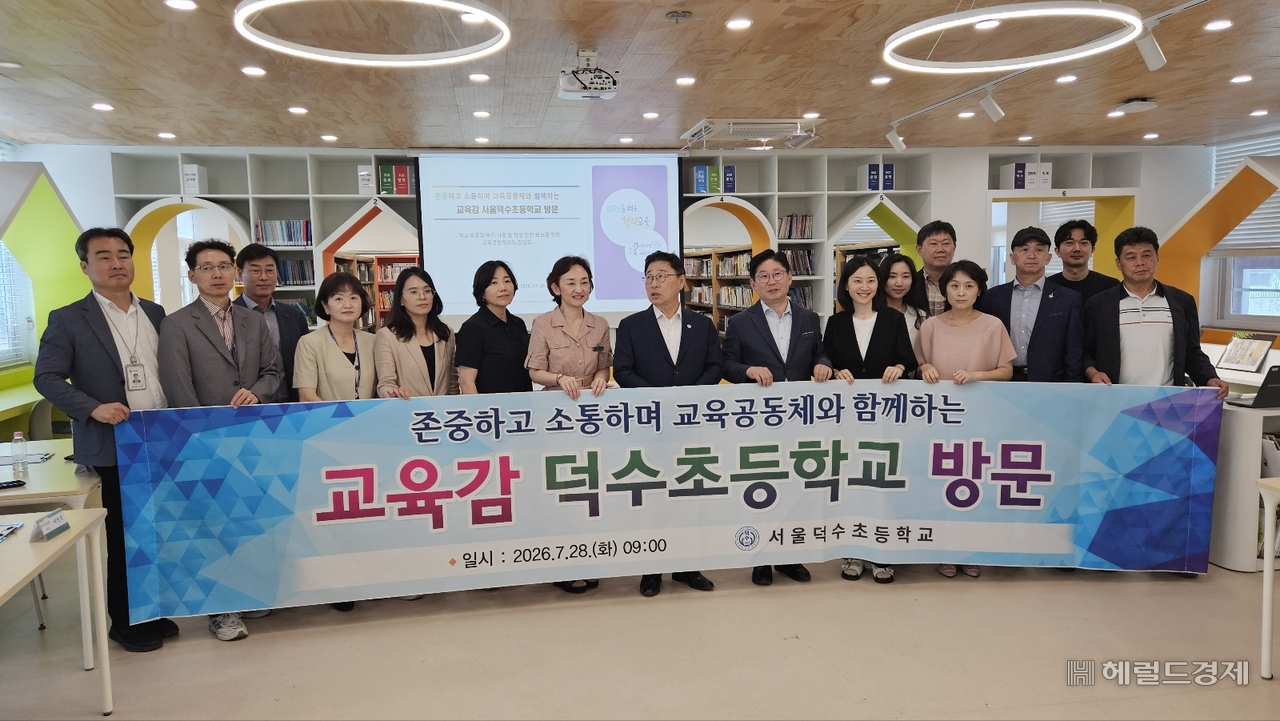
The Seoul Metropolitan Office of Education has also indicated it favors resolving the ownership question rather than maintaining the current shared arrangement indefinitely. Seoul Superintendent of Education Jeong Geun-sik visited Deoksu Elementary on July 28 and proposed a land swap — exchanging the ministry-owned playground for other land held by the education office — as the way forward.
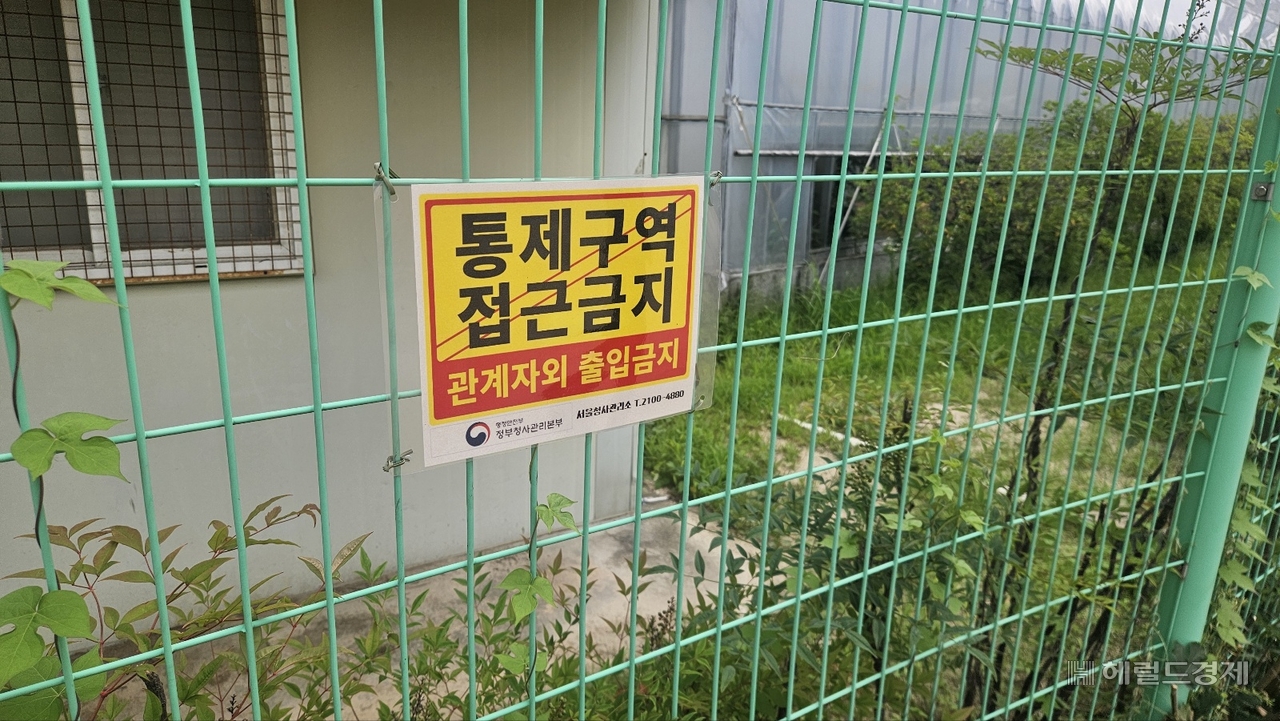
In response, the Ministry of Interior and Safety, the Seoul Metropolitan Office of Education and the Jungbu District Office of Education held their first working-level meeting on land-swap candidates on Thursday. The education office put forward four candidate sites. The ministry, which would need to relocate the flower facility currently on the Deoksu Elementary grounds, set out several conditions: adequate sunlight access, sufficient distance from surrounding facilities and a location reachable by vehicle from Government Complex Seoul. None of the four sites fully met all of those conditions, according to officials familiar with the talks. The flower facility covers about 1,200 square meters, though the ministry said it could consider a somewhat smaller site if it met an acceptable standard.
An education office official said the office would need to identify additional candidate sites, adding that the existing four would not be ruled out and would be included in upcoming field inspections. Both sides plan to conduct on-site checks of the candidate locations in early September.
jookapooka@heraldcorp.com
raining@heraldcorp.com