Concerns are mounting that the accumulated fiscal burden of the Gwangju area will be shouldered by the entire Jeonnam-Gwangju Special City once the merged entity is launched.
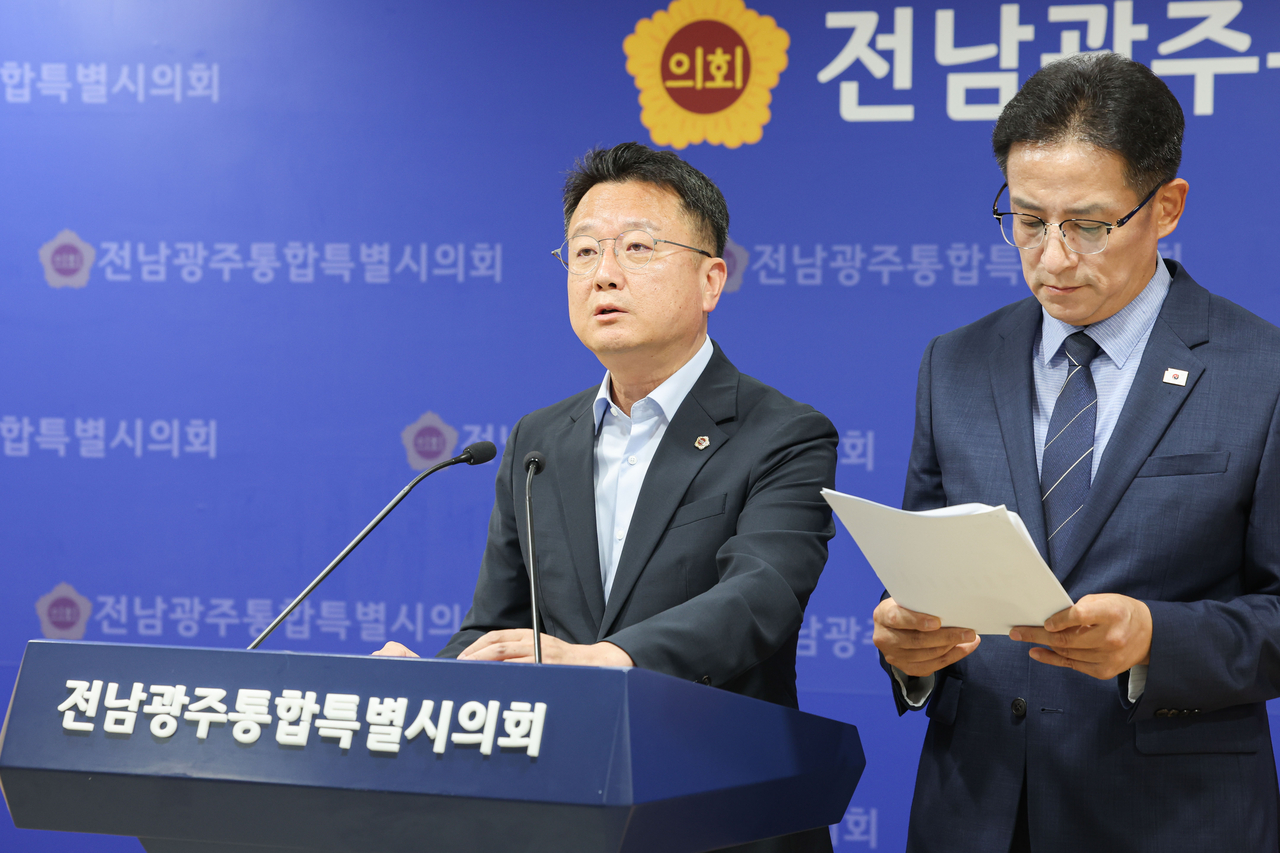
Choi Seon-guk, a lawmaker on the Planning and Finance Committee of the Jeonnam-Gwangju Special City Assembly, and Park Mun-ok, a lawmaker on the Administration and Fire Department Committee, held a press conference Tuesday morning at the assembly's South Jeolla Province office, raising serious concerns about the merged city's deteriorating fiscal position and the potential reduction of budgets and subsidies for the South Jeolla region as a result of the merger.
The two lawmakers said particularly that "South Jeolla Province, which had sound finances, must not be placed in a structure where it also bears Gwangju's fiscal burden," and called for transparent disclosure to residents of Gwangju's post-merger debt and the growing fiscal burden on the South Jeolla region, along with a concrete response plan.
Before the merger, Gwangju Metropolitan City's debt ratio stood at 25.61 percent, exceeding the "Caution" threshold under the Ministry of Interior and Safety's local fiscal crisis management system.
After the merger with South Jeolla Province, the combined debt ratio of the special city appears to fall to 16.25 percent — but critics say this is merely a statistical effect of folding in South Jeolla's relatively healthy finances, and that the underlying debt Gwangju carried has not disappeared.
More alarming, the two lawmakers said, is the sheer scale of the debt. They said liabilities stemming from cost overruns on Gwangju Subway Line 2 and other projects amount to about 2.2 trillion won ($1.56 billion), while Gwangju Urban Corporation alone carries roughly 1.4 trillion won in debt — meaning just those two items together represent a fiscal burden of around 4 trillion won. On top of that, they said 380.8 billion won of the budget immediately needed to maintain Gwangju's urban functions in the second half of this year is currently unfunded.
The budget shortfall for the Gwangju area in the second half of this year breaks down as follows: 24.5 billion won for free school meals at elementary, middle and high schools; 50.3 billion won for the semi-public bus operating system; 100 billion won in education fiscal grants; 22.8 billion won in private investment support for the Second Ring Road; 23.2 billion won in medical aid fund transfers; 9.1 billion won for the disaster management fund; and 139.8 billion won for other national government matching project costs.
The problem, the lawmakers said, is that most of these items are essential expenditures directly tied to urban functions and residents' daily lives, making spending restructuring impossible. They said the severity of the situation is compounded by the fact that this is not a one-time shortfall but a structural deficit that recurs every year.
Ultimately, the two lawmakers argued, covering Gwangju's shortfall from the special city's limited fiscal resources would inevitably reduce the funds available to the South Jeolla region.
They said that adding the annual interest burden on the 4 trillion won in debt to the projected recurring annual shortfall of 380.8 billion won, the fiscal deterioration in the Gwangju area is expected to generate more than 1 trillion won in additional debt every two years.
The special city integration law includes a principle prohibiting residents from suffering disadvantages as a result of the merger, and Mayor Min Hyeong-bae has repeatedly said welfare and other areas closely tied to residents' daily lives would be brought up to the higher standard.
However, Baek Seung-ju, vice chairman of the Jeonnam-Gwangju Great Transformation Planning Committee, indicated at a press conference on June 18 that spending restructuring was unavoidable.
On this, the two lawmakers said: "They told us there would be no disadvantages from the merger, yet now, after the merger, they say spending restructuring is unavoidable — so who exactly is supposed to bear that burden?"
The two lawmakers said that while the information already made public is cause for serious concern, additional factors exist that could further worsen the special city's fiscal burden.
They cited the Gwangju Arts Center and the National Asian Culture Center (ACC) as prime examples.
The Gwangju Arts Center recorded a deficit of 32.3 billion won in 2025 alone, with accumulated losses reaching around 70 billion won, the two lawmakers said. As for the ACC — whose operating rights Mayor Min recently asked President Lee Jae-myung to transfer to the city — the lawmakers said accumulated losses stand at around 200 billion won, with annual deficits running between 50 billion and 70 billion won, and expressed concern that taking on the ACC could further worsen the special city's fiscal position.
They said accepting the transfer of the ACC's operating rights without a firm government guarantee of continued national funding would risk saddling the special city with additional fiscal burdens, and called for a thorough financial feasibility review before any transfer of operating rights proceeds.
sij@heraldcorp.com