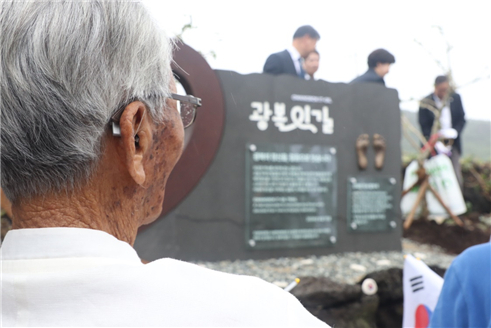
"The Gwangbokit-gil will become a historical and cultural space where the sacrifices and dedication of independence fighters are remembered in everyday life and passed on together with future generations."
Jaseng Hospital of Korean Medicine and the Jaseng Medical Foundation marked the 81st anniversary of Liberation Day by establishing a commemorative trail on Jeju Island dedicated to preserving the history of Korea's independence movement. The hospital unveiled the trail — called the "Gwangbokit-gil" (a path connecting the spirit of liberation) — and announced a long-term project to expand it nationwide.
The hospital said it held an unveiling ceremony for the Gwangbokit-gil memorial stone on Saturday along the opening stretch of Jeju Olle Trail Route 1 in Siheung-ri, Seongsan-eup, Seogwipo, Jeju Special Self-Governing Province.
The Gwangbokit-gil is a walking trail that honors independence fighters through memorial stones, rocks bearing the Taegukgi (Korean national flag), and plantings of hwanggeun — a native species in the hibiscus family. The Jeju trail is the first course in the hospital's nationwide expansion project.
The hospital said it chose Siheung-ri as the inaugural site to create a symbolic starting point in the hometown of Kang Tae-seon, one of only three surviving independence activists recognized by the government. The other two are Oh Seong-gyu and Kim Yeong-gwan. Lee Seok-gyu, the sole surviving independence activist from the Honam region, died on Thursday — two days before the 81st Liberation Day anniversary.
Born in Siheung-ri, Jeju, in 1924, Kang traveled to Osaka, Japan, in 1942 to study and joined the independence movement while there. He and his fellow activists pledged to resist Japanese conscription and forced labor and worked to foster national consciousness through organized anti-Japanese activities. He was arrested by Japanese colonial police in 1944 and imprisoned for violating the Peace Preservation Law. After liberation, he returned to his hometown and received a presidential commendation in 1982 and the Order of Merit for National Foundation (Aejokjang) in 1990.

The unveiling ceremony at the Siheung-ri Cultural Experience Center drew about 100 attendees, including Kang and his family, National Assembly member Kim Seong-beom, Jeju Special Self-Governing Provincial Council Speaker Song Yeong-hun, Jeju Special Self-Governing Province Superintendent of Education Ko Eui-suk, local students and Siheung-ri residents. Participants took part in the memorial stone unveiling and a commemorative planting of hwanggeun.
The event also brought together art and community. The chairperson of the Jeju Language Preservation Society recited an original dedicatory poem reflecting on the meaning of liberation, and master lacquer artist Jeon Yong-bok personally presented a dedicated work to Kang. Local students performed a special tribute honoring independence fighters.
The hospital selected hwanggeun as a symbolic element of the Jeju trail for its ties to both the region's history and its ecology. The only naturally occurring species of the hibiscus genus native to Korea, hwanggeun grows wild around Seongsan and Ojo-ri on Jeju Island. Its yellow flowers bloom in full from June through August — overlapping with Liberation Day — and its resilience in harsh coastal conditions mirrors the endurance of independence fighters during the Japanese colonial period.
The hospital's consistent support for independence activists and their families is rooted in the spirit of the late Shin Gwang-ryeol, an independence activist and the father of Jaseng Hospital founder Dr. Shin Jun-sik. Shin Gwang-ryeol led anti-Japanese resistance activities and was imprisoned at Seodaemun Prison. Even after his release, he continued to secretly treat independence fighters and worked to advance both Korean independence and the development of traditional Korean medicine. His philosophy of "geunghyuljisim" — caring for a patient's pain as if it were one's own family's — became the founding ethos of the Jaseng Medical Foundation.
Building on the Jeju trail as a starting point, the hospital plans to develop QR-code-based story content on independence fighters next year and run school-linked field learning programs. It also aims to hold a Liberation Day walking festival along the Gwangbokit-gil in 2028 and build a nationwide Gwangbokit-gil network.

"It is deeply meaningful and moving that a trail honoring the spirit of myself and my fellow activists has been created in the hometown I left as a young man to fight for our country's independence," Kang said. "I hope that all who walk this path will long remember the sacrifices and dedication of the independence fighters and hold the value of our nation close to their hearts."
Shin Min-sik, chair of the Jaseng Medical Foundation's social contribution committee, said the Gwangbokit-gil is "a historical and cultural space where the sacrifices and dedication of independence fighters are remembered in everyday life and passed on together with future generations." He expressed deep gratitude to Kang Dae-seong, the son of Kang Tae-seon, as well as to Jeju Special Self-Governing Province and its residents for their support. "Starting from Jeju, we will create Gwangbokit-gil trails across the country so that anyone can naturally encounter and experience the meaning of the independence movement," he added.
Meanwhile, Jaseng Hospital of Korean Medicine continues to provide medical, lifestyle and residential support for national merit recipients and their families, in keeping with its identity as a hospital rooted in the spirit of the independence movement. In recognition of these efforts, the hospital recently received the grand prize at the 25th Patriots and Veterans Culture Award, hosted by the Ministry of Patriots and Veterans.
kty@heraldcorp.com