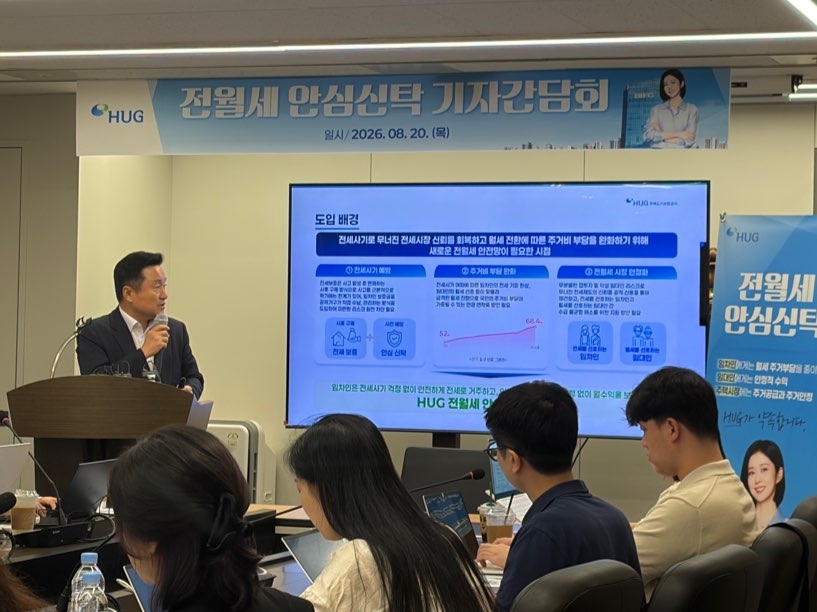
The government's new "jeonse and monthly rent safety trust" program — designed to prevent jeonse fraud and stabilize the rental market — will begin recruiting landlords and tenants in September. Under the scheme, the Korea Housing and Urban Guarantee Corporation (HUG), which will operate the trust as the designated jeonse and monthly rent stabilization body, invests jeonse deposits and pays landlords a monthly return of around 4 percent annually. To encourage voluntary participation, the government plans to offer tax incentives including rental income tax cuts and higher deduction limits for landlords.
HUG President Choi In-ho outlined the plan Thursday morning at a press briefing at the corporation's Seoul West branch in Yeouido.
The safety trust program works by converting market-rate monthly-rent properties into jeonse units that HUG then supplies to tenants. HUG, landlords and tenants enter into a three-way contract, and the jeonse deposits along with private investment capital are pooled into a housing supply activation fund. The fund is invested in project financing (PF) loans to support housing supply and contribute to market stabilization.
Choi described the program as a "3S system" — tenant Safety, landlord Stability through steady monthly income, and expanded housing Supply to the market. "Our short-term goal is to take in 15 trillion won ($10.7 billion) in jeonse deposits annually," he said, "and over the long term we aim to scale that up to 100 trillion won."
Because voluntary participation by landlords and tenants is essential to the program's success, the plan calls for meaningful incentives — including rental income tax reductions and exemptions from mandatory guarantee insurance enrollment — to drive uptake.
On the tenant side, HUG plans to launch a dedicated low-interest loan product and expand financial support, while helping tenants build savings by switching from monthly rent to jeonse. According to HUG's estimates, a tenant in a Seoul row house or multi-unit dwelling with a sale price of 300 million won and a jeonse value of 200 million won currently pays 740,000 won per month in rent — assuming a 10 million won deposit and a jeonse-to-monthly-rent conversion rate of 4.7 percent. Under the safety trust, that cost falls to 530,000 won per month, based on borrowing 80 percent of the jeonse value — the maximum — at a jeonse loan rate of 3.97 percent.
"On a two-year contract, tenants can save a total of 5.04 million won, and 10.08 million won over four years if they renew," Choi said.
For landlords, the program offers rental income tax cuts, exemption from mandatory rental deposit guarantee enrollment, and a guarantee of up to two months of monthly income in the event of a vacancy. Under current law, landlords with annual rental income of 20 million won or less may choose between comprehensive taxation and separate taxation, with the latter carrying a flat rate of 14 percent. Those earning above 20 million won have their rental income combined with other income and taxed at the comprehensive income tax rate of 6 to 45 percent.
"The rental income tax reduction is a confirmed tax support measure," Choi said, adding that while it requires an amendment to enforcement ordinances, "some lawmakers in the National Assembly have been showing favorable reactions and interest."
HUG noted that the difference in landlord returns is minimal: a landlord currently receiving 740,000 won per month in rent would receive 730,000 won under the safety trust — a gap of 10,000 won. The estimate assumes a trust return rate of 4.35 percent.
Choi also outlined additional benefits by landlord type. Individual registered rental business operators stand to save an average of 0.2 percentage points on guarantee premiums; the Korea Land and Housing Corporation (LH), which handles new-build purchase projects, could reduce its annual debt by about 3.7 trillion won; holders of housing pension plans could earn a combined annual return of 5 to 7 percent from pension income and trust proceeds; and corporate registered rental business operators would benefit from lower guarantee premiums and reduced financing costs.
He also said that because the housing supply activation fund invests directly in PF projects, the program could help ease liquidity constraints in the construction industry and support broader housing supply expansion.
Under the current timeline, HUG will open applications for landlords and tenants in September, and from November will begin verifying jeonse prices and executing three-party agreements. Move-ins and deposit transfers are targeted to begin in December. For the housing supply activation fund, HUG plans to sign contracts with asset management firms between this month and October, with investor recruitment and agreement signing set to begin in November.
"We plan to initially target homes with a market price of 2 billion won or less," Choi said, adding that there is considerable demand among landlords who do not need a large lump sum and prefer a steady monthly income. "We will exclude, as much as possible at the early stage, any investments that could cause anxiety for tenants," he said, "and focus on contributing to housing market stabilization."

hwshin@heraldcorp.com