Average Seoul villa price hits 430 million won
Districts under 400 million won cap fall from 14 to 9 in a year
Experts say policy must first gauge what young buyers actually need
![A property listing board at a real estate agency in Eunpyeong-gu, Seoul. [Yonhap]](https://wimg.heraldcorp.com/news/cms/2026/08/21/news-p.v1.20260816.bc19a0629a194891844a0a329289a73b_P1.jpg)
Only 36 percent of Seoul's administrative districts have average sale prices for row houses and multi-family homes — commonly called villas — below 400 million won ($285,000), an analysis shows. The government announced plans to launch the "Youth Mirae Bogeumjari Loan" to help young people buy non-apartment homes priced at 400 million won or less, but properties that actually fall within that threshold are largely confined to outer districts such as the Nodo-gang area (Nowon-gu, Dobong-gu and Gangbuk-gu) and the Geumgwan-gu cluster (Geumcheon-gu, Guro-gu and Gwanak-gu). While the program is intended to support housing stability and asset building for young people, critics say the price cap fails to reflect the sharp rise in non-apartment market prices over the past one to two years, undermining the policy's effectiveness.
According to data commissioned from real estate platform Zigbang, the average sale price of row houses and multi-family homes across Seoul stood at 432.33 million won in July this year, up about 11.6 percent from 387.39 million won in the same month last year.
By district, nine of Seoul's 25 districts — 36 percent — had average villa prices at or below 400 million won in July. In ascending order: Dobong-gu at 226.4 million won, Gangseo-gu at 252.34 million won, Gangbuk-gu at 254.9 million won, Guro-gu at 259.83 million won, Geumcheon-gu at 293.51 million won, Eunpyeong-gu at 303.29 million won, Nowon-gu at 321.58 million won, Gwanak-gu at 329.84 million won and Jungnang-gu at 366.54 million won.
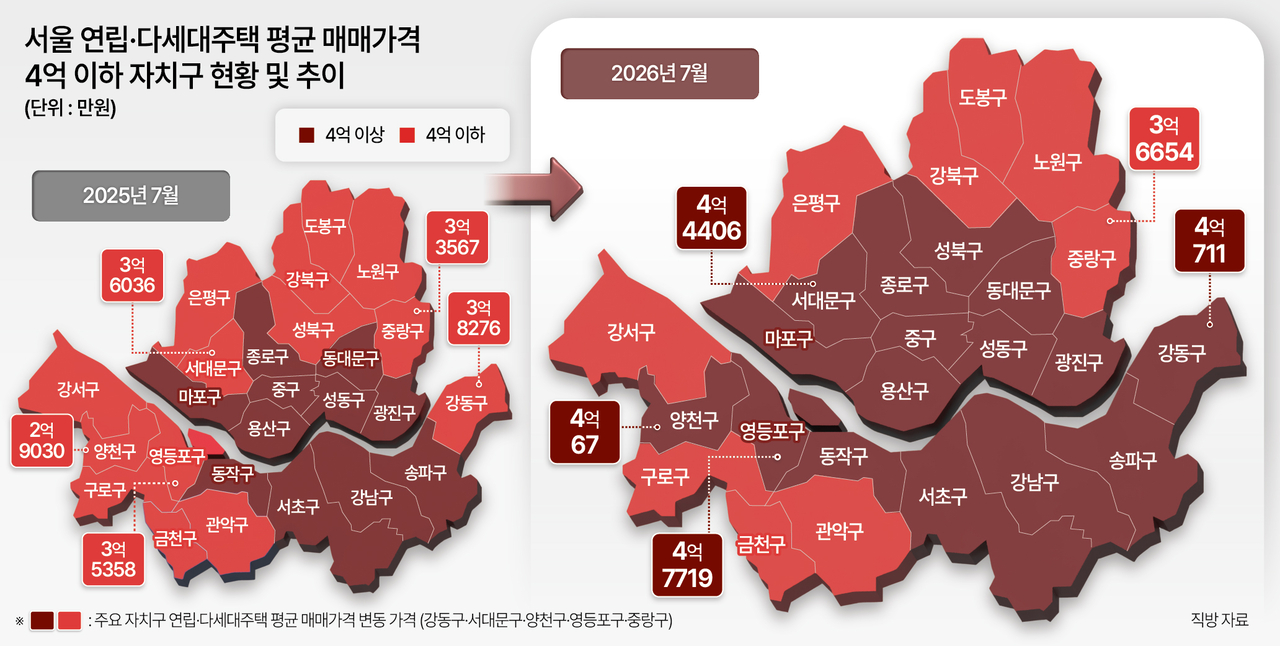
That is five fewer than the 14 districts that fell below the 400 million won mark in July last year. Gangdong-gu, Seodaemun-gu, Seongbuk-gu, Yangcheon-gu and Yeongdeungpo-gu all crossed the threshold over the past year. Yangcheon-gu saw the sharpest rise, climbing about 38 percent from 290.3 million won to 400.67 million won, while Yeongdeungpo-gu surged about 35 percent from 353.58 million won to 477.19 million won. The other three districts also posted significant gains: Gangdong-gu rose from 382.76 million won to 407.11 million won, Seodaemun-gu from 360.36 million won to 444.06 million won and Seongbuk-gu from 351.18 million won to 448.14 million won.
Of Seoul's 25 districts, 20 recorded higher average sale prices than a year earlier, with only Gangseo-gu, Gwanak-gu, Dongdaemun-gu, Seocho-gu and Jongno-gu bucking the trend. Yongsan-gu, which has the highest average sale price in the city, rose by nearly 250 million won — from 818.26 million won in July last year to 1.07 billion won in July this year.
The surge in Seoul villa prices reflects a combination of factors: a supply cliff and a shift in demand from jeonse rentals to purchases have driven apartment prices sharply higher, pushing spillover demand into the villa market. That balloon effect has been compounded by a years-long decline in non-apartment construction starts, leaving the segment chronically undersupplied. Demand from young buyers targeting villas slated for redevelopment has also been cited as a driver of rising sale prices.
As average villa prices continue to climb, the pool of properties eligible under the government's Youth Mirae Bogeumjari Loan is increasingly limited to outer-district listings. Announced as part of the government's Aug. 13 rapid housing supply plan for a January launch next year, the loan product allows buyers aged 39 or under with annual incomes of 70 million won or less to purchase a non-apartment home — a villa or officetel with an exclusive use area of up to 85 square meters — priced at 400 million won or less as their first home, with a loan-to-value ratio of up to 80 percent. Critics note that because most villas in well-connected central areas already exceed the price cap, young buyers are unlikely to feel any meaningful benefit.
Kwon Dae-jung, a distinguished professor of economics and real estate at Hansung University, said the market is caught in a self-reinforcing cycle. "Because there are no apartments available, jeonse and monthly rents for villas go up, and because there are no jeonse listings for villas, sale prices get pushed up along with them," he said, adding that non-apartment sale prices could rise another 3 to 4 percent by around January next year. He went on to say that "rather than performative administration, the government should first find out what young people actually want and then roll out effective policies — such as jeonse support and a quality housing supply."
Meanwhile, the monthly rate of price increases for row houses and multi-family homes has been accelerating. According to the Korea Real Estate Board's July national housing price trend survey, the sale price index for Seoul row houses, including multi-family homes, rose 0.96 percent last month. The monthly gain has climbed steadily from 0.53 percent in March to 0.62 percent in April, 0.76 percent in May and 0.86 percent in June. The cumulative price increase through July this year stands at 5.27 percent, more than 4 percentage points above the 1.19 percent recorded in the same period last year.
shy@heraldcorp.com
hwshin@heraldcorp.com