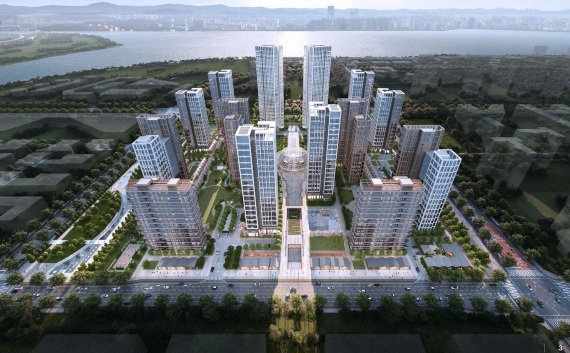
The Songdo Global Town Phase 3 project in Incheon, which had been stalled by a legal dispute with Hoban Construction, appeared to be back on track after the lawsuit was dropped — only to run into a new obstacle from within.
Incheon Global City Development (IGCD), the entity driving the project, has been ordered to halt its contractor selection process by the Incheon Free Economic Zone Authority (IFEZA) — the agency that holds a 100 percent stake in IGCD. IFEZA issued the order again on Tuesday, following a similar directive the previous month.
The stated reason offers little substance. IFEZA cited unexpected issues that arose during the Hoban Construction dispute, a failed re-bid, and the subscription-of-intent process, saying contractor selection must be suspended "until separate approval is granted, to prevent further confusion." No specific wrongdoing by IGCD was identified — the directive amounts to little more than a call to pause.
No concrete criteria or timeline has been provided for what needs to be addressed before contractor selection can resume, or what conditions would need to be met for work to restart.
IGCD, the entity that is supposed to be advancing the project, finds itself once again with its hands tied.
The lawsuit is over — so why is contractor selection blocked again?
The Songdo Global Town Phase 3 project aims to build a residential complex of about 1,700 units in Songdo International City.
Unlike a standard private housing development, the project is designed to help overseas Koreans settle stably, expand the residential capacity of Songdo International City, and channel development profits into local education and residential infrastructure.
But the project began to unravel during the contractor selection process.
Negotiations with Hoban Construction, which had been named the preferred bidder, broke down. IGCD revoked Hoban's preferred-bidder status in May, and Hoban responded with legal action, pulling the project back into dispute.
A subsequent new bid failed to attract any takers, compounding the setback.
A path forward appeared to open when Hoban withdrew its injunction application — filed with the Incheon District Court to preserve its preferred-bidder status — on Aug. 11, clearing the main legal hurdle.
From IGCD's perspective, with the key obstacle removed, the time had come to launch a new contractor selection process and get the project moving again.
Instead, IFEZA — IGCD's own investor — stepped in and demanded that contractor selection be suspended.
'Preventing further confusion' — but what did IGCD do wrong?
A fundamental question arises: what exactly has IGCD done wrong? The situation risks casting IGCD as the problem entity, when the evidence does not clearly support that characterization.
The dispute with Hoban Construction has already been resolved through the withdrawal of the lawsuit. The failed re-bid was not the result of IGCD arbitrarily selecting a particular firm — it was an outcome of the bidding process itself.
The question, then, is whether IGCD resuming contractor selection in order to normalize the project is itself somehow improper.
IFEZA's position is that contractor selection must be suspended until separate approval is granted, to prevent further confusion. But without a clear explanation of what that "further confusion" refers to, or what steps IGCD must take to address it, the project operator is effectively placed in an indefinite holding pattern.
A larger concern is that this situation risks making IGCD appear to be an organization that mismanaged the project and caused the problems in the first place.
Yet whether the various disputes and the failed bid are all attributable to IGCD's fault is a separate question that has not been established.
IGCD is, in fact, the project operator obligated to run a new bidding process to keep the project alive after negotiations with the preferred bidder collapsed.
The paradox is that IGCD — the entity trying to advance the project — is being cornered into looking like the problem, precisely because its own investor is blocking it from doing so.
The cost of delay ultimately falls on IGCD
What makes IFEZA's work-stoppage order particularly consequential is that much of the financial burden from the resulting delay will ultimately fall on IGCD.
IGCD is a wholly owned subsidiary of IFEZA. If IGCD cannot proceed with contractor selection, the project schedule will inevitably slip.
A delayed ground-breaking means a delayed completion, and a delayed completion could push back the move-in schedule for future residents.
On top of that, the economic costs of delay — land balance payments, financing costs, project management expenses and various fixed costs — will continue to mount.
Most pressingly, IGCD is required to pay IFEZA approximately 306 billion won ($220 million) in land balance payments by mid-December. If that deadline is missed, late-payment interest of 7 to 10 percent per annum will accrue depending on the length of the delay.
This raises an uncomfortable structural question: the authority to halt the project sits with one entity, while the financial consequences of that halt fall on another.
IFEZA has a direct financial stake in the land balance payment, while the operational risks and costs that accumulate from the delay are borne primarily by IGCD, the project operator.
The argument gaining traction is that if IFEZA is halting contractor selection in the name of normalizing the project, it must also explain who will bear the costs and responsibility for the resulting delay.
Is the investor-investee relationship itself holding the project back?
A key aspect of this situation is the nature of the relationship between IFEZA and IGCD.
IGCD is not an independent private developer unrelated to IFEZA — it is a wholly owned subsidiary.
That relationship, observers argue, means that when problems arise, the first response should be for the investor and its subsidiary to work through the issues together, not for the investor to simply shut the project down.
IFEZA may well have legitimate grounds to call for additional review of the project process.
But if a work stoppage is deemed necessary, there should at minimum be clear answers to five questions: what the problem is, what corrective action is needed, who is responsible for addressing it, by when the review will be completed, and under what conditions work can resume.
Without those answers, a directive to suspend work "until separate approval is granted" leaves IGCD effectively unable to act.
IGCD faces a situation where moving forward draws a halt order from its investor, while standing still means absorbing the costs of delay — leaving it with no viable path in either direction.
The conflict is also a burden for the Park Chan-dae administration
The standoff is not a trivial matter for the newly launched Park Chan-dae administration, which took office as Incheon's ninth directly elected city government.
The immediate cause of the dispute cannot be laid at Park's door.
But from the public's perspective, the picture looks different. A major residential project of 1,700 units — involving agencies under the city's own umbrella — has been drifting for an extended period. That will inevitably prompt the question of whether Incheon City is properly coordinating its own agencies.
Park has made urban renewal, economic revitalization, and the expansion of residential, transportation and education infrastructure central priorities of his administration since taking office.
If a prolonged conflict between IFEZA and IGCD — both entities under the city's authority — becomes a fixture of the early days of the new administration, it risks undermining the pace and credibility of the mayor's policy agenda.
The situation grows more complicated still if IFEZA continues to demand work stoppages without any official directive from Incheon City itself.
For overseas Koreans and ordinary residents, it is difficult to tell whether a city agency is acting on its own initiative or under instructions from above — and that ambiguity itself is a problem.
Ultimately, this episode may be less about IGCD's project management and more about whether the Park administration can demonstrate that it is capable of coordinating and overseeing its own agencies.
What Park needs to do is not pick a side, but establish clear administrative standards — verifying the facts and ensuring that citizens do not end up bearing the cost of a project delayed by institutional infighting.
Linked projects — including a new elementary school and an international school — are also at risk
The consequences of delay may not stop at IGCD.
The Songdo Global Town Phase 3 project is not solely about building a residential complex. It is also tied to a set of linked initiatives designed to support local education and residential infrastructure.
If the project schedule slips, concerns are mounting that linked commitments could also be affected — including support for the planned opening of a new elementary school (tentatively named Ara Elementary School No. 1) in March 2030, and a construction cost contribution of approximately 150 billion won toward an international school in Yeongjong.
A delay of several months in contractor selection, in other words, is not simply a matter of pushing a construction timeline back by a few months.
The ripple effects could include delayed housing supply, a disrupted timeline for education facility support, rising project costs and reputational damage to the project operator.
That is why voices are growing louder that Incheon City can no longer treat this as a purely internal matter between IFEZA and IGCD.
External dispute resolved, internal conflict begins — a self-defeating cycle
The Songdo Global Town Phase 3 project has already consumed far too much time on the contractor selection problem alone.
A dispute erupted after the preferred bidder was named, legal action threw the project into turmoil, and a new bid failed to attract any participants.
Hoban Construction's withdrawal of its lawsuit finally created an opening to get the project back on track — only for the project's own investor to step in and block contractor selection once again.
The external dispute has ended, and now an internal conflict has brought the project to a halt.
The more pressing question is who suffers most in this process.
While IFEZA and IGCD remain at an impasse, the costs and risks of delay accumulate, the project's reputation erodes, and the anxiety of residents and overseas Koreans waiting for the housing complex deepens.
The longer the institutional conflict drags on, the more it becomes a case of self-inflicted damage.
Incheon City must now provide answers
What the Songdo Global Town Phase 3 project needs now is not more controversy.
Clear answers are needed: why IFEZA and IGCD are at odds, why contractor selection must be suspended, what procedures are required to normalize the project, and who will be responsible for the costs and harm to citizens caused by the delay.
If IFEZA continues to demand work stoppages without any official directive from Incheon City, the city itself cannot claim to be uninvolved.
If the city simply watches from the sidelines, it will effectively be allowing a conflict between its own agencies to fester.
For Mayor Park, this is not a matter of choosing sides — it is a test of administrative competence.
If IGCD has genuinely made mistakes in advancing the project, those mistakes should be clearly identified and corrected.
If, on the other hand, IGCD is following the necessary procedures to normalize the project, it should not be cornered by unfounded suspicion and unnecessary interference.
The point is not to shield a flawed agency. It is to ensure that an agency that has done nothing wrong is not made to look as though it has.
A project to build 1,700 units of housing should not be held hostage to an institutional blame game.
The lawsuit with the contractor is over. It is time to normalize the project.
If the investor and its subsidiary defer resolution by issuing a suspension order rather than sitting down together to work through the problem, it is ultimately the citizens who will pay the price.
"Should the project go ahead or not?" — Incheon City now owes the public an answer.
If a single residential complex triggers not only an external legal battle but a prolonged internal conflict as well, citizens are entitled to ask: does building one housing development really have to be this hard?
gilbert@heraldcorp.com