![Samsung Electronics [Korea Herald DB]](https://wimg.heraldcorp.com/news/cms/2026/08/21/news-p.v1.20260811.e558a2388db6416e985587e7a16204fd_P1.jpg)
The government envisions the Future Response Fund not as a simple savings account but as a fiscal stabilization mechanism to absorb revenue volatility and a strategic platform for investing in the AI transformation. The plan is to accumulate surplus tax revenue during semiconductor boom years and deploy those reserves during downturns, while channeling funds into future growth areas such as AI and youth support.
With 580 trillion won in national tax revenue next year, additional receipts estimated at around 150 trillion won
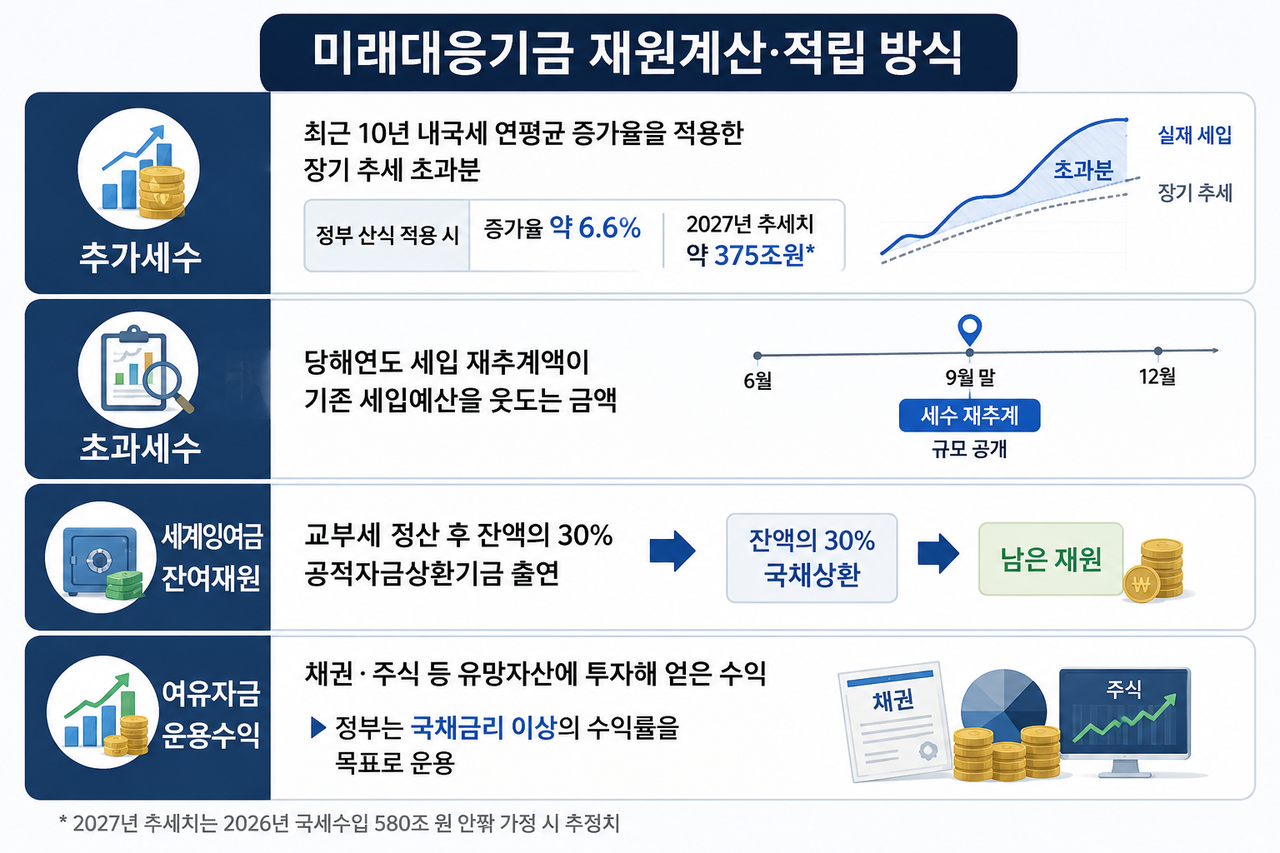
According to the government, the Future Response Fund would draw from several sources: tax revenue exceeding the long-term trend, in-year surplus receipts, residual funds from the fiscal year-end balance, and returns on idle-cash management. Of these, the primary source is the additional tax revenue component.
The government has decided to treat the gap between actual domestic tax receipts and the long-term trend as "additional tax revenue" and deposit it into the fund whenever structural economic changes or large-scale cyclical swings push collections above that baseline. Surplus receipts, by contrast, arise within a given fiscal year when actual collections exceed the original budget estimate — driven by forecasting errors or unexpected short-term economic shifts.
The "long-term trend" that defines additional tax revenue is calculated by applying the average annual growth rate of domestic tax settlements over the past decade, producing a baseline path for revenue growth. Using the government's formula, that average annual growth rate works out to roughly 6.6 percent over the past 10 years.
On that basis, the 2027 long-term trend figure can be derived by multiplying the 2025 domestic tax settlement by (1 + 6.6 percent) twice — assuming two consecutive years of 6.6 percent growth from the 2025 actual figure. That calculation puts the 2027 long-term trend at around 375 trillion won ($269 billion). The government has not officially confirmed the 6.6 percent rate or the 375 trillion won figure.
If next year's total national tax revenue reaches around 580 trillion won and domestic taxes — the portion eligible for the fund calculation — account for roughly 90 percent of that, additional tax revenue would come to around 150 trillion won: approximately 522 trillion won in domestic taxes minus the 375 trillion won long-term trend, leaving about 147 trillion won. Both the 580 trillion won projection and the 90 percent share are assumptions, however, and the actual additional revenue figure will not be confirmed until the government releases its revenue forecast later this month.
Buffering the semiconductor 3-to-5-year cycle — and loading up for the AI era
South Korea's tax revenue is heavily influenced by the semiconductor industry. Core industries such as semiconductors typically alternate between boom and bust on a three-to-five-year cycle, and corporate tax receipts swing sharply with company earnings, causing overall revenue to fluctuate in tandem.
After suffering large revenue shortfalls in 2023 and 2024, the country now finds itself in the opposite situation. An improvement in semiconductor conditions has pushed corporate tax collections well above expectations, and the government has been wrestling with whether to spend the windfall immediately or set it aside for the future.
That dilemma is the backdrop for the government's announcement Friday of a plan to establish the Future Response Fund. The idea is to hold back a portion of boom-era revenue rather than spending it all, then draw on those reserves when a downturn or revenue shortfall hits.
Expanding government spending in lockstep with rising boom-era revenue risks overheating the economy and stoking inflation. Conversely, cutting spending when revenue falls during a downturn can deepen a recession. The Future Response Fund is designed as a buffer against this kind of procyclical fiscal management.
When tax revenue exceeds the long-term trend during a boom, funds accumulate in the reserve. When revenue falls below the trend or a shortfall occurs, money flows from the fund into the general account to shore up spending capacity. "South Korea's tax structure is one where the semiconductor industry's ups and downs repeat on a three-to-five-year cycle," a Ministry of Planning and Budget official said. "It's a reservoir that fills up during good times and performs a fiscal stabilization function when revenue falls short of the trend."
A second rationale for the fund is the intensifying global race for AI investment.
Combined capital expenditure by the five largest global technology companies — Amazon, Google, Microsoft, Meta and Oracle — rose from $80 billion in 2018 to $380 billion last year, a roughly 4.8-fold increase in seven years, as companies worldwide accelerate spending to secure leadership in AI.
South Korea's growth potential, meanwhile, is declining. According to the OECD, the country's potential growth rate is forecast to fall from an average of 2.5 percent in 2020–2024 to 1.9 percent last year, 1.7 percent this year and 1.5 percent next year.
The government views the next two to three years as a "golden window" to redesign national systems around the spread of AI and lift the country's growth potential. Rather than consuming the fiscal space created by the semiconductor boom on routine expenditure, it intends to concentrate that firepower on building the foundations for future growth.
Investment will be directed at four areas: youth, growth engines, regional development, and education and talent. In the growth-engine category, the fund will back frontier AI, physical AI and AI data centers to help propel South Korea into the top three AI nations. It will also expand the power and water infrastructure needed for three major megaprojects and channel resources into seven strategic technology domains — small modular reactors, nuclear fusion, renewable energy, quantum technology, space and aviation, advanced biotech, and advanced supply chains.
In the youth category, the fund will support vocational training in high-demand fields, work experience programs and startups, as well as efforts to build a housing ladder and ease the financial burden of marriage, childbirth and child-rearing. For regional development, it will fund living infrastructure, a basic income for rural communities, administrative integration and local future-growth initiatives. In education and talent, it will go toward training science and engineering professionals, attracting top overseas talent and strengthening university competitiveness.
Faster than a supplementary budget — but critics warn of 'permanent supplementary budget' risk
Another distinguishing feature of the Future Response Fund is that it can be deployed more flexibly than the regular budget. Project-type funds are permitted to revise their management plans within certain limits without separate National Assembly approval.
The government plans to apply that same structure to the Future Response Fund, allowing it to respond more quickly to urgent policy needs that arise mid-fiscal-year than would be possible by drafting a supplementary budget. "If a policy need emerges during the year, we can respond faster by drawing on the accumulated fund balance than by going through a supplementary budget process," a Ministry of Planning and Budget official said.
That flexibility, however, has raised concern that the fund could in effect become a tool for permanent supplementary budgeting. Yang Jun-seok, a professor of economics at Catholic University of Korea, said that unlike the main budget or supplementary budgets, funds face relatively less National Assembly oversight, making it difficult to rule out the possibility that the government could use the resources for political purposes.
The windfall is also likely to reignite debate over whether the government should pay down national debt rather than accumulating reserves. Central government debt stood at 1,338.5 trillion won as of the end of June, up 70.3 trillion won in just six months from the end of last year. Whether to prioritize debt repayment or future investment when additional revenue materializes is ultimately a policy judgment call — and one that could become a flashpoint during National Assembly scrutiny. Yang said that when unexpected additional revenue arises, the right course is to use it first to reduce national debt or the fiscal deficit, adding that channeling it into a fund for further spending would not help bring the deficit down.
The government maintains that the stabilization benefits of the fund outweigh the alternative. Officials argue that repaying government bonds during a boom only to reissue them when a downturn causes a revenue shortfall could end up costing more depending on interest rate conditions at the time, and that drafting a supplementary budget also takes time.
Money accumulated in the fund will be managed through a dedicated asset management framework. Unlike the existing pension fund investment pool, which manages multiple funds together, the Future Response Fund will use a tailored portfolio with bond maturities calibrated to the fund's projected disbursement timing and scale. The government aims to generate returns at least equal to the government bond yield — the minimum needed to offset interest costs on national debt. As of Tuesday, the yield on three-year Treasury bonds stood at 3.85 percent annually.
fact0514@heraldcorp.com