
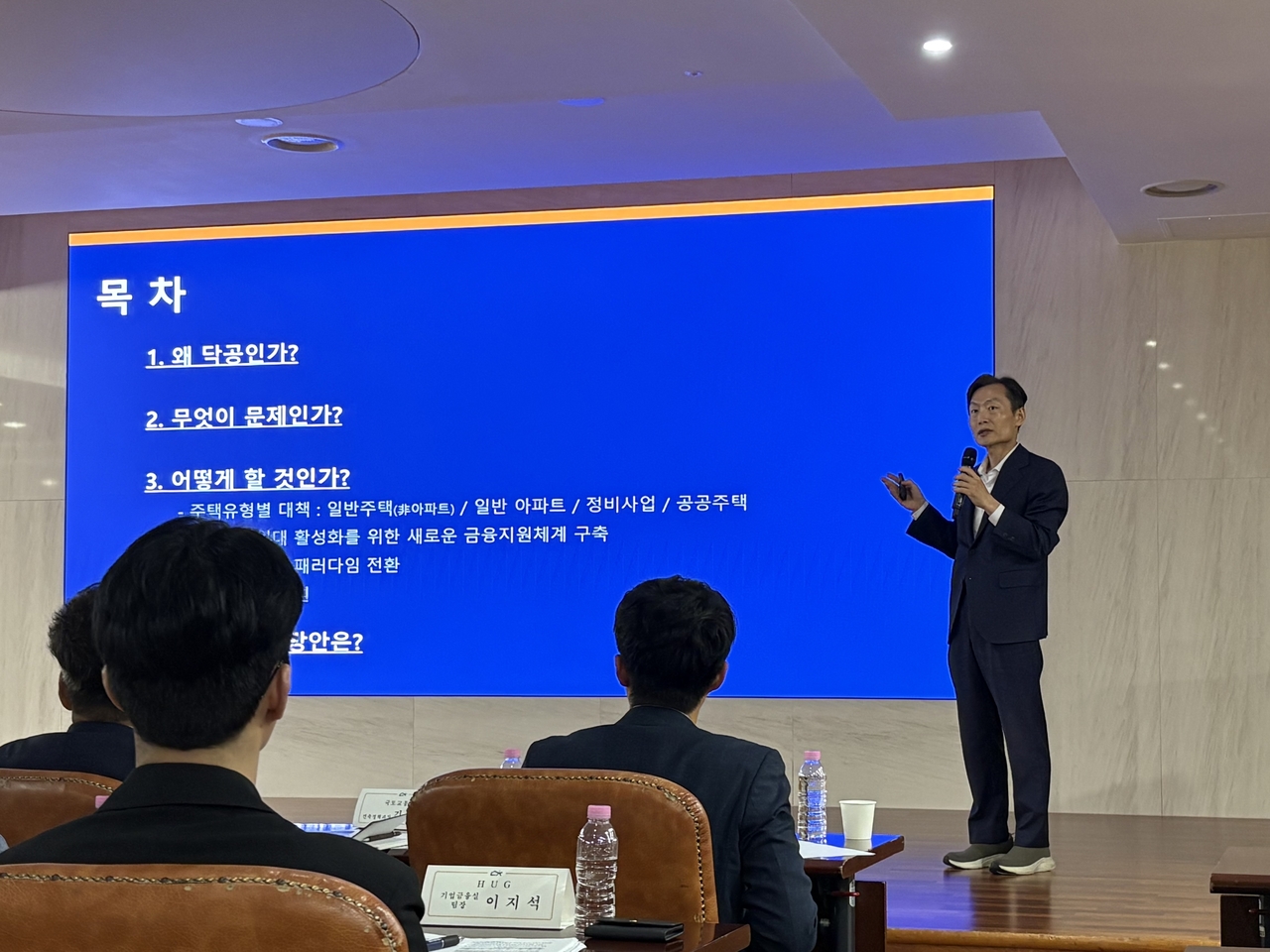
The housing industry called on the government Friday to expand support for Korea Land and Housing Corporation's new-build purchase agreement program, ease zoning conversion procedures, and relax project financing guarantee screening criteria — a set of practical measures aimed at accelerating housing ground-breakings.
The Ministry of Land, Infrastructure and Transport hosted the "Industry Briefing on Rapid Housing Supply Measures" Friday afternoon at the Construction Hall in Gangnam-gu, Seoul, where officials listened to industry proposals and concerns. Attendees included Jang Woo-cheol, the ministry's housing policy bureau chief, officials from the Korea Housing and Urban Guarantee Corporation (HUG) and Korea Land and Housing Corporation (LH), and representatives from three housing associations — the Korea Housing Association, the Korea Housing Builders Association and the Korea Developer Association — along with their member companies.
Jang opened the session by laying out his assessment of current market conditions and the intent behind the Aug. 13 housing supply package. "With jeonse and monthly rent prices rising alongside sale prices, we designed the Aug. 13 measures with a truly heavy and urgent sense of purpose," he said. "The goal of this package is not simply to increase the number of units supplied, but to strengthen the implementation of last year's Sept. 7 measures, dramatically shorten supply lead times, and restore the private housing supply ecosystem."
He added that the private supply ecosystem had effectively collapsed across both apartment and non-apartment segments. "Only when we restore that ecosystem and allow smooth chain-substitution effects across regions and housing types can we disperse the price-rise pressure concentrated in Seoul out to other regions," he said.
Jang also stressed the need to improve supply and the regulatory framework for non-apartment housing. According to ministry estimates, about 51 percent of Seoul residents currently live in non-apartment units such as officetels and multi-family homes. "Many residents live in general housing types temporarily, not necessarily for financial reasons but due to various circumstances," he said. "We also need to raise the quality of housing for non-apartment residents and put support systems in place for them."
Following the presentation, attendees put forward a series of requests. A private developer in the transit-oriented area near Geomam Station in Incheon called for a swift zoning conversion of urban support facility land — received as land compensation — into mixed-use residential land. The developer also said it was exploring officetel development on commercial lots within a public housing district but faced obstacles due to public housing officetel guidelines, and asked that regulations be eased where infrastructure and educational facilities are already in place.
Jang acknowledged the difficulty, saying zoning conversions raise land values and place a burden on frontline civil servants. "This round of regulatory reform includes provisions to support proactive action by civil servants, so we have set it up for joint review by the relevant municipal and county governments, the ministry, and civic committees," he said.
Participants also raised concerns about LH's new-build purchase agreement program. Under the program, LH introduced an additional 30 percent subsidy on land costs and progress-based construction payment. However, industry representatives noted that these benefits apply only to projects launched on or after Jan. 1, 2026, and are not retroactively applied to earlier cost-linked projects, resulting in low ground-breaking rates.
A representative from the Seoul chapter of the Korea Housing Builders Association said developers in the cost-linked program were taking out subordinated loans due to insufficient early-stage project funding, and that some had been unable to break ground at all. "To boost supply, early-stage funding support must be extended to cost-linked developers as well," the representative said. An LH official responded that the matter had not yet been reviewed, and urged developers to make use of the rapid ground-breaking improvements introduced under the May 22 package.
On project financing guarantee screening, participants called for a more realistic assessment of pre-sale prices at older urban development sites where comparable new apartment benchmarks are scarce.
A HUG official said the corporation was looking at using market prices from similar residential zones when no appropriate nearby comparables exist, and was also reviewing how to factor in the new-build premium over older units. "We are aiming to institutionalize improvements to the pre-sale price review process in the second half of this year," the official said.

shy@heraldcorp.com
hwshin@heraldcorp.com





