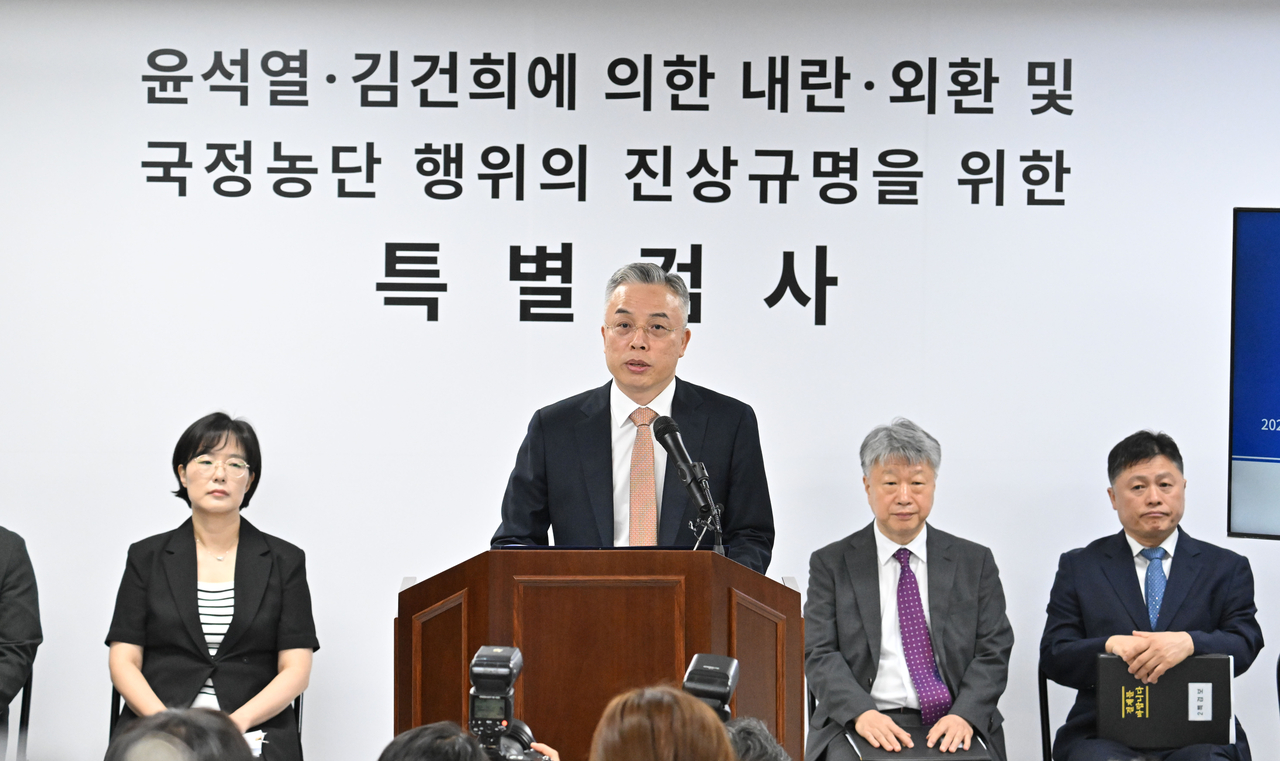
Special Prosecutor Kwon Chang-young, who led the second comprehensive special prosecutor team investigating allegations left unresolved after three earlier probes — covering insurrection, Kim Keon Hee, and the Marine Corps corporal case — said Monday that insurrection forces behind the Dec. 3, 2024, emergency martial law declaration still exist and that a long-term investigation is needed to uncover the full truth.
At a final briefing on the team's six-month investigation, Kwon said the team had received a total of 152 cases — 48 referrals, 71 cases the team itself initiated, and 33 complaints and accusations. It sent 60 cases to trial, with seven defendants held in detention and 51 released on their own recognizance, and transferred an additional 46 cases to the Korean National Police Agency's National Investigation Headquarters.
Kwon said the comprehensive special prosecutor investigation had fallen short of fully establishing the substance of the insurrection crimes. He described the crime of insurrection as a "constitutional offense" that destroys the constitutional order and is qualitatively different from ordinary crimes. "Those investigated so far represent only a fraction of the insurrection forces," he said. "We must not rest on our laurels just because we have won the first battle."
"In the war against the insurrection forces, the comprehensive special prosecutor is only the second piece," he said. "Further investigation is needed to reveal the full picture. The National Investigation Headquarters alone may have its limits. I believe it would be appropriate to establish a joint special investigation headquarters, composed of investigators from multiple agencies, to conduct a systematic and long-term probe."
He added that once the joint headquarters investigation had progressed sufficiently, establishing a fact-finding committee to secure testimony from those involved at the working level would allow investigators to fit together the final pieces of the puzzle and grasp the full scope of the abuse of state power. "That was the original vision I had when we launched this investigation," he said.
The earlier insurrection special prosecutor, led by Special Prosecutor Cho Eun-seok, had determined that the insurrection ended on Dec. 4, 2024, when martial law was lifted. Kwon said it should be considered to have ended on Dec. 14, 2024, when the impeachment motion against former President Yoon passed and he was suspended from his duties — and could even be extended to April 4 last year, when the Constitutional Court upheld the impeachment.
"If the facts differ, the legal principles applied must also differ," Kwon said. "Chun Doo-hwan's goal in the insurrection was to become president, but Yoon Suk Yeol's goal was to destroy the Constitution and render the National Assembly powerless. Chun's insurrection was an insurrection from below; this one is an insurrection from above — and the two are legally distinct in nature."
In keeping with its later determination of when the insurrection ended, the team indicted Lee Eun-woo, former head of the Korea Policy Broadcasting Service, without detention on charges of insurrection propaganda. It also detained and indicted Kim Tae-hyo, former first deputy director of the National Security Office, and other security office officials on charges of conveying messages to allied nations justifying the martial law declaration. The team also investigated a private gathering that took place immediately after the declaration, though that case was ultimately transferred to the National Investigation Headquarters.

Kwon said the case involving the so-called "No Sang-won notebook" — which relates to alleged preparations and conspiracy for insurrection-motivated killings — requires an extended additional investigation. The notebook, written in the hand of former Defense Intelligence Command chief No Sang-won and found at his mother's home, drew attention after it was reported to contain plans to kidnap, detain and kill politicians, as well as indications of plotting around the emergency martial law declaration.
The insurrection special prosecutor had previously investigated the notebook case before transferring it to a joint special investigation headquarters handling cases from the three earlier probes. The comprehensive special prosecutor team subsequently took over the case. The team said it had identified indications that killings using explosives and poisons had been considered, investigated Defense Intelligence Command officials, and examined specific locations named in the notebook — including Yeonpyeong Island and the Oeum-ri area — ultimately identifying three facilities suspected of having been intended as detention sites.
The team said key suspects had refused to cooperate and that a thorough, long-term investigation was needed given the gravity and complexity of the case. "The reason we went to the trouble of verifying this is that evidence disappears if it is not put on record," Kwon said. "When the results are made public, people will be enormously shocked — further extended investigation is necessary."
A case involving alleged presidential office interference in a Suwon District Prosecutors' Office investigation — which the team had labeled a suspected "mega-scale abuse of state power" — was closed without charges on grounds that prosecution was not possible. The team had received related materials from the Seoul High Prosecutors' Office and imposed travel bans on independent lawmaker Han Dong-hoon, a former minister of justice, and others as part of the investigation. The probe was halted after a court rejected a search and seizure warrant targeting the Suwon prosecutors' office on the grounds that it was not a valid subject of investigation.
"We confirmed indications that the presidential office interfered in the Suwon prosecutors' office case during former President Yoon's tenure," Kwon said. "We initiated the investigation on the basis that it fell within the scope of the special prosecutor act, but the court rejected the warrant." Deputy Special Prosecutor Kwon Young-bin, who had originally been assigned to the case but was removed after his prior defense work for former Gyeonggi Province Vice Governor for Peace Lee Hwa-young came to light, said he believed the decision to transfer the case was justified.
Regarding the alleged cover-up of the investigation into the Dior bag given to Kim Keon Hee, the team said it had confirmed indications that Kim had interfered in the prosecutors' investigation. However, face-to-face interviews with senior officials at the Seoul Central District Prosecutors' Office and other witnesses were needed to establish the charge of abuse of authority obstructing the exercise of rights. Citing the fact that some witnesses are currently studying abroad and that the investigation could not be completed within the allotted time, the team said it would transfer the case to the National Investigation Headquarters.
The team also indicted Hong Jang-won, former first deputy director of the National Intelligence Service and known as a whistleblower, on charges of performing an important role in the insurrection. "We booked 11 NIS officials, indicting four — including former Deputy Director Hong — finding one not guilty of any charges, and suspending indictment for six," a deputy special prosecutor said. "The six given suspended indictments mostly admitted to the criminal facts, but former Deputy Director Hong has never acknowledged his own conduct."
The team, which launched in February, had 130 personnel seconded from prosecutors, police, the Korea Coast Guard, the Ministry of National Defense, the NIS and the National Tax Service. Fifty-seven were appointed as special investigators, and 17 administrative support staff were also hired. Deputy special prosecutors included Kwon Young-bin, Kim Jeong-min, Kim Ji-mi, Jin Eul-jong and Kim Chi-heon. Having sent a total of 58 people to trial, the team now moves into the full-scale phase of maintaining its prosecutions.
bell@heraldcorp.com