South Korean markets are set to navigate a series of high-profile events this week, including Nvidia's earnings release, the Bank of Korea's Monetary Policy Board meeting and the Jackson Hole symposium. Investors are focused on whether two key headwinds — uncertainty over long-term government bond yields and growing skepticism about AI investment — will begin to ease.
The week kicks off with Nvidia's earnings release on Wednesday (local time), followed by the Bank of Korea's Monetary Policy Board meeting on Thursday and the Jackson Hole economic policy symposium on Friday and Saturday (local time).
The Jackson Hole symposium is drawing the most attention from global markets. Investors are treating the keynote address by Federal Reserve Chair Kevin Warsh, scheduled for Friday, as a potential turning point for the trajectory of long-term interest rates. The release of US personal consumption expenditures (PCE) price data on Wednesday (local time) will also be a key variable in gauging where long-term yields are headed.
Domestic markets bore the full brunt of a sharp global surge in long-term yields last week. Investor sentiment soured after the US 30-year Treasury yield climbed above 5.3 percent and Japan's 10-year government bond yield broke through 2.9 percent. Large-scale corporate bond issuances by major tech companies added further upward pressure on rates, heightening wariness about the scale of AI investment expansion.
"At Jackson Hole, we need to see how Chair Warsh interprets inflation and what his stance is on further rate hikes," said Ha Geon-hyeong, a researcher at Shinhan Investment. "If PCE data again confirms a slowdown in inflation and concerns about monetary policy also ease, there is a good chance that appetite for risk assets will strengthen again alongside stabilizing bond yields."
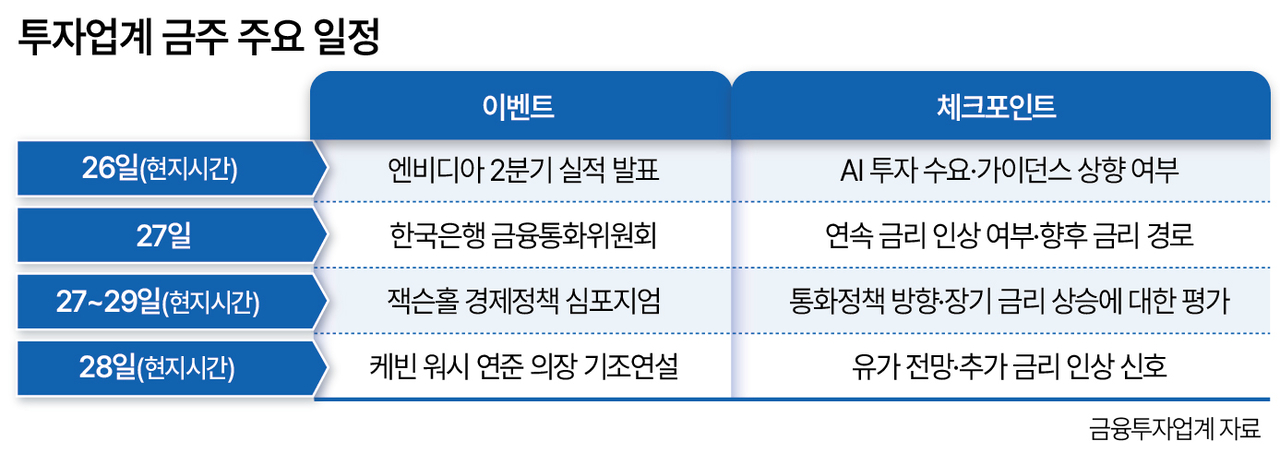
Nvidia's results are expected to shape investor sentiment across the broader market, including domestic semiconductor stocks. Key points to watch include whether the company beats consensus estimates, its forward earnings guidance and whether it can defend its gross margin.
Whether the earnings release resolves the so-called circular financing controversy will also be closely watched. On Aug. 10 (local time), Nvidia announced a plan to build a $500 billion AI financing platform with six global financial institutions. Concerns have been raised that the arrangement — in which funds Nvidia supplies to customers flow back into GPU purchases — may be inflating actual demand. Investors will be watching to see whether genuine underlying demand can be demonstrated to justify continued investment expansion.
"The second-quarter results, third-quarter guidance and whether high margins can be maintained all matter, but the core question is what answer Nvidia gives on the sustainability of AI investment and its financing structure — which is what the market is most worried about right now," said Kim Seok-hwan, a researcher at Mirae Asset Securities.
The Bank of Korea's Monetary Policy Board meeting on Thursday is another major variable for domestic markets. Securities firms broadly expect the central bank to raise its benchmark interest rate for a consecutive time. With upward pressure on prices persisting and export momentum strengthening — led by semiconductors — the policy burden is seen as limited.
"Considering remarks by the Bank of Korea's deputy governor on the need for rate hikes, the probability of another increase is indeed higher than before," said Kim Yu-mi, a researcher at Kiwoom Securities. "That said, given the recent rapid fall in the dollar-won exchange rate and the slowdown in July consumer price inflation, it is worth leaving open the possibility that the BOK holds in August and moves to raise rates again in October."
Securities firms broadly expect both Kospi and Kosdaq to remain volatile until uncertainty over interest rates is resolved.
"The direction of the market will depend on whether AI can keep growing despite rate concerns, or whether rate pressures weigh on growth expectations," said Hwang Su-uk, a researcher at Meritz Securities. "Both Kospi and Kosdaq — excluding Samsung Electronics and SK hynix — are at valuation levels sensitive to interest rates, so concentrating exposure in the top two semiconductor names is the appropriate short-term approach until rate stability is confirmed."
"The base scenario is one where Nvidia's earnings meet consensus, PCE comes in around expectations and Chair Warsh sticks to broadly principled remarks," said Lee Gyeong-min, a researcher at Daishin Securities. "In that case, the likelihood of Kospi consolidating above the 7,000 level and advancing toward the 8,000 range would increase."

moon@heraldcorp.com